CouponZania vs CashKaro: Why We Do It Differently
-
 Written by
Rajat Singh
Written by
Rajat Singh
- Published
- Updated
- Read time 15 min read
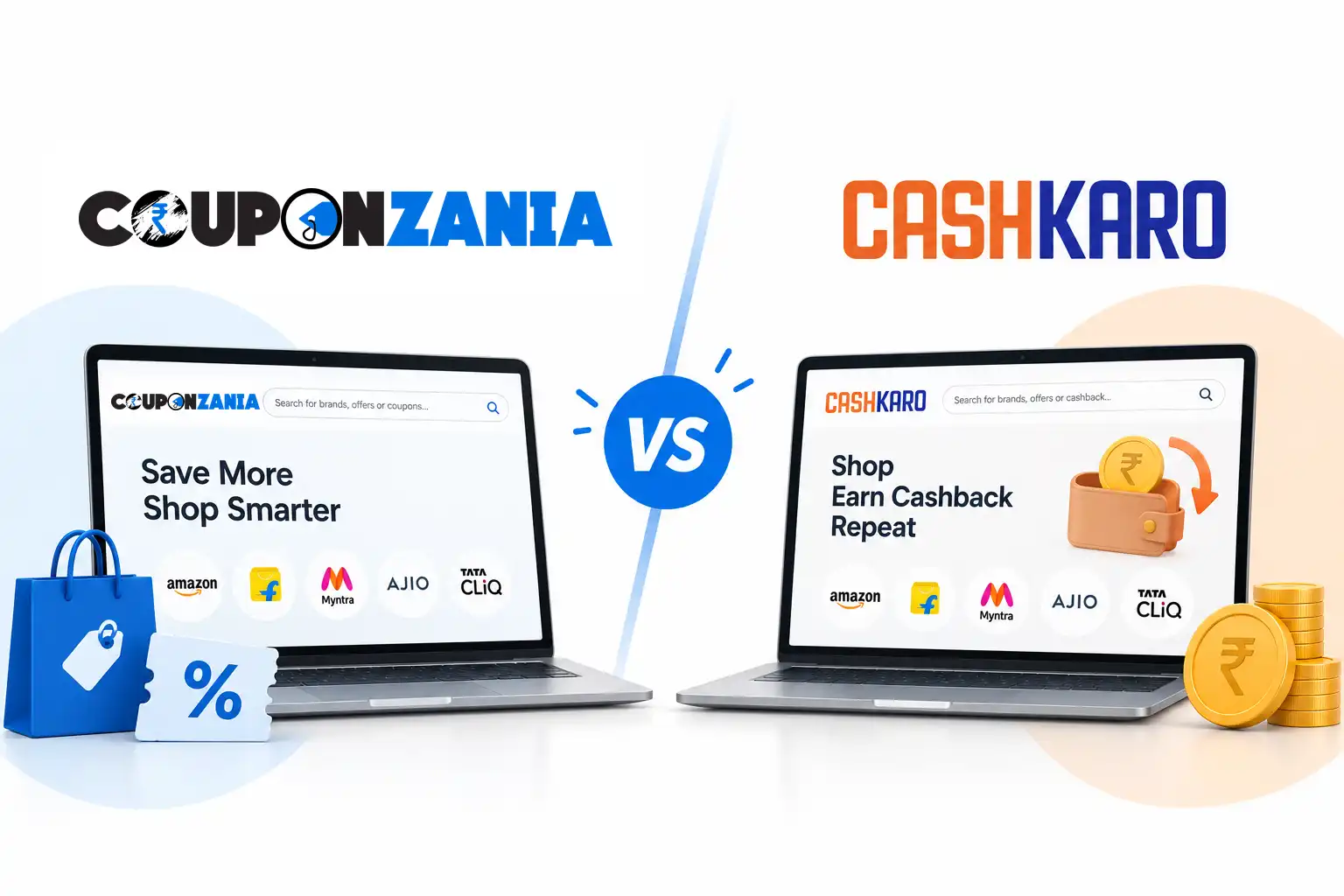
CouponZania runs on a single, simple idea: find a working discount code, apply it at checkout, pay less immediately. No signup, no cashback balance to track, no waiting period. That is a genuinely different mechanism from a cashback platform like CashKaro, which pays a percentage back after your order clears rather than lowering the price up front. This page covers what CouponZania actually is, how it actually works, and the real numbers behind it, verified directly from the site’s own database rather than a marketing estimate, since that distinction between a verified fact and an estimate matters more than most comparison pages bother to acknowledge.
On This Page 10 sections
- CouponZania tracks 2,537 stores and currently maintains roughly 10,000 active offers, with 9,801 of those carrying an actual coupon code rather than just a deal listing.
- Discounts apply directly at checkout on the retailer’s own site. There is no signup, no cashback balance, and no waiting period, since the mechanism is simply copying a code and pasting it.
- Offers are organized into 156 categories, 6 deal type collections spanning multiple stores at once, and 34 sale event collections, built to help you find a relevant discount fast rather than scrolling an undifferentiated list.
- CouponZania does not run a cashback program, unlike CashKaro. That is a deliberate scope choice, not a missing feature, and the two models solve the same underlying problem differently.
How CouponZania Actually Works
Every store on CouponZania has its own page listing currently active offers, coupon codes, and deals for that specific retailer. Finding a discount means going to that store’s page, copying a working code, and pasting it into the discount field at checkout on the retailer’s own website. The price drops immediately, in the same transaction, with nothing left pending afterward.
Each individual offer listing also carries information beyond just the code itself, an expiry date where one is known, the specific terms that apply, and a discount tag summarizing what the code actually does, whether that is a flat percentage, a fixed rupee amount, or a specific mechanic like a buy one get one structure. That detail exists so a shopper can judge whether a code is worth using before ever leaving the store’s offer page, rather than discovering the actual terms only after attempting to apply it at checkout.
There is no account creation required to use a code. There is no cashback balance accumulating in the background, no minimum payout threshold to hit before you can access your savings, and nothing that can be revoked later if a retailer cancels or modifies an order, since the discount already applied at the moment of purchase rather than being promised for later.
That structure also means the savings are visible before you commit. You see the discounted total at checkout, not an estimated cashback percentage that depends on a retailer confirming the order weeks later. What you see at the moment you pay is the actual, final number.
This also changes what happens if something goes wrong with the order afterward. A cancelled or returned order on a cashback platform typically means the promised cashback is revoked, since the retailer never actually confirms the sale. A coupon code applied at checkout already did its job the moment it was applied, since the discount was part of the original transaction rather than a separate reward tied to the order eventually being confirmed as final. If you cancel or return an item bought with a CouponZania code, the only thing that changes is the refund calculation on the discounted price you already actually paid, not a separate pending reward disappearing on you.
The mechanism works the same way regardless of how you pay. A code applied at checkout discounts the transaction whether you pay by card, UPI, a wallet, or cash on delivery where that is offered, since the discount is negotiated between the retailer and the code itself, not tied to a specific payment method the way some cashback or bank offers are, another real advantage of a discount that lives at the retailer’s own checkout rather than a separate tracking system layered on top of it.
The Real Scale of CouponZania, Verified From Its Own Database
Rather than a rounded marketing figure, here is what the site’s own live database actually shows as of this writing.
CouponZania figures pulled directly from the site’s own live database, checked August 2026.
Roughly 2,570 offers out of the 12,607 ever published are currently marked expired and removed from active listings, a real, visible maintenance category rather than dead codes simply being left live indefinitely for a visitor to stumble into and waste time on. Of the roughly 10,000 currently active offers, the large majority, 9,801, carry an actual coupon code to apply at checkout rather than being a deal listed without a code, which is the format most directly useful at the moment of purchase.
The remaining active offers, roughly 236, are deal listings without a specific code attached, typically an automatic discount, a storewide sale, or an offer that applies simply by shopping through a tracked link rather than entering a code manually. These are kept separate from coupon code listings specifically so a shopper scanning a store’s offer page can immediately tell which offers require an action, entering a code, and which apply automatically without any extra step at all.
How Coupon Validity Is Actually Maintained
A coupon site’s real, ongoing work is not publishing new codes, it is removing dead ones and confirming which ones still function, since a retailer discontinuing a code without notice is the norm rather than the exception. This is genuinely tedious, unglamorous maintenance work rather than a one time content creation task, and it is the actual determinant of whether a coupon site is useful on any given day rather than a list of codes that stopped working months ago.
CouponZania’s offer feedback system lets shoppers report directly whether a specific code worked or did not, feeding into which offers get flagged for review and eventually marked expired and removed. That feedback loop is imperfect, since it depends on shoppers actually reporting back, but it is a real, functioning mechanism, not a marketing claim, and the roughly 2,570 offers currently marked expired are the visible evidence of it actually operating rather than codes being left untouched forever.
The Editorial Standard Behind Every Listing
Every article and store page on CouponZania is written or reviewed by Rajat Singh before publishing, a deliberate editorial control point rather than an automated pipeline publishing content with no human check. That matters specifically for a coupon site, where the actual value delivered is accuracy about whether a code works, not volume of pages published as fast as possible.
A bootstrapped site with a single accountable editor has a different incentive structure than a large, investor funded platform optimizing for scale across thousands of merchant partnerships simultaneously. Fewer stores tracked with real, checked accuracy is the actual tradeoff being made here, not a limitation to apologize for. The 2,537 stores currently tracked reflect that deliberate choice rather than a ceiling the site is trying to raise as fast as possible regardless of listing quality.
There is no outside board setting a quarterly growth target, no pressure to launch a loyalty tier system or a cashback program simply because a funded competitor has one, and no investor return timeline forcing a pivot away from the site’s original, narrow purpose. Growth here happens on the actual pace that accurate, checked content can be produced at, which is slower by design than a venture funded platform hiring at scale to expand merchant coverage as fast as possible, but it is the tradeoff a bootstrapped, single editor operation makes deliberately rather than by necessity alone, and it is a tradeoff worth naming honestly rather than dressing up as an unqualified advantage.
How Offers Are Organized to Help You Find One Fast
Beyond individual store pages, CouponZania organizes offers into three additional real structures, each built for a different way of looking for a discount.
- 156 categories group stores by what they sell, electronics, fashion, food, travel, and more, so you can browse by product type rather than needing to already know which specific store you want.
- 6 deal type collections group offers by the mechanic itself, first order discounts, buy one get one, student discounts, across every participating store at once, useful when the type of deal matters more than any single brand.
- 34 sale event collections group offers by occasion, Black Friday, Diwali, and other recurring shopping moments, pulling together every relevant active offer across stores into one page rather than requiring a separate search per retailer.
CouponZania’s organizing structures, checked directly against the site’s own live database, August 2026.
These are not decorative navigation categories, they are functional collections built to solve the actual problem of finding a relevant discount without knowing exactly which store to check first. A shopper looking for any first order discount, regardless of brand, uses the deal type collection. A shopper planning ahead for a specific seasonal moment uses the matching sale event collection. Both routes exist alongside the standard per store page, not as a replacement for it.
The deal type collections specifically cover recurring offer mechanics that cut across brand loyalty entirely, first order discounts, buy one get one deals, and student discounts among them. A student comparing which stores currently offer a student discount does not need to check every retailer individually, since that single collection page already pulls together every participating store’s current offer in one place. The same logic applies to sale event collections during a specific shopping moment, where checking one page instead of a dozen separate store pages is the entire point.
The 156 categories run genuinely broad rather than covering only the obvious major shopping segments. Alongside the expected categories, electronics, beauty, and fashion, the list includes narrower ones like astrology, ayurveda, bus tickets, and art supplies, reflecting real, specific shopping needs rather than a generic template applied to every coupon site regardless of what shoppers actually search for. That breadth matters for a category that would otherwise have nowhere obvious to look, since a narrow category page is often the fastest, most direct route to a relevant code when the shopping need itself is genuinely narrow.
The Coupon Testing Pipeline
CouponZania’s coupon testing pipeline is the actual infrastructure behind the offer feedback loop described above, built specifically to catch and remove dead codes systematically rather than relying purely on a shopper happening to report one. That pipeline is part of what a single, focused site can invest in when the entire business exists to solve one problem well, rather than spreading engineering effort across cashback tracking, loyalty tiers, and a dozen other features a broader platform tries to maintain simultaneously.
The practical result shows up in the numbers already covered: roughly 2,570 offers currently marked expired out of 12,607 ever published is not a small number, and it reflects active, ongoing removal rather than a static archive nobody maintains. A coupon site’s real quality signal is not how large its total count grows, it is how quickly a code that stops working gets flagged and taken down before too many visitors waste a checkout attempt on it.
Share of all 12,607 offers ever published on CouponZania that remain active versus removed as expired, checked directly against the site’s own database, August 2026.
Building a Habit Around Checking Before You Buy
The shoppers who save the most consistently treat checking for a code as a fixed step before checkout, not an occasional afterthought. A few habits make that consistent rather than hit or miss.
- Check the store page before adding items to your cart, not after. Knowing which codes are active ahead of time avoids the frustrating moment of finding a working code only after already committing to a full cart.
- Read the code’s specific terms before applying it. Some codes apply only above a minimum cart value, only to new customers, or only to specific categories, so checking the listed conditions avoids a checkout surprise.
- Bookmark the relevant category or deal type page for stores you shop regularly. Checking one collection page covers several stores at once rather than visiting each store page individually.
- Report a dead code when you find one. This is a small action that directly improves the accuracy of what the next shopper sees, and it is the actual mechanism keeping the roughly 10,000 active offers genuinely current.
- Compare the coupon code discount against the store’s own listed sale price first. A retailer sometimes runs its own storewide sale deep enough that stacking a modest code on top adds little, while other times the code is the entire discount available. Checking both before assuming a code is worth applying avoids wasted effort on a marginal saving.
- Use the sale event collection during a major shopping occasion instead of guessing which stores are participating. Rather than manually checking a dozen stores during Diwali or Black Friday, the matching sale event page already surfaces every store with an active offer for that specific occasion.
- Treat a category page as your default starting point for a new, unfamiliar shopping need. When you do not already have a specific brand in mind, browsing the relevant category first surfaces options you might not have thought to search for individually, rather than starting from a single store you already know.
Who Actually Runs CouponZania
CouponZania was founded by Rajat Singh and remains bootstrapped, built and funded without outside venture capital. That is a real structural difference worth naming plainly next to a company like CashKaro, which has raised 32.5 million dollars across multiple funding rounds. A bootstrapped site has no investor growth targets to hit and no pressure to expand into a cashback model, a loyalty tier system, or any feature that does not directly serve the one thing the site actually does: track and verify coupon codes, checked and maintained by an actual person rather than left to run unattended.
How This Differs From a Cashback Platform Like CashKaro
CashKaro and similar platforms use a different mechanism entirely: cashback paid back after a retailer confirms your order, rather than a discount applied at the moment you pay. That model can add up to real savings over time when it works as intended, but it depends on tracking, a waiting period, and a retailer actually confirming the order, none of which a coupon code applied directly at checkout requires, since the entire transaction resolves in the same moment you complete it.
The two approaches are not mutually exclusive. Where a retailer allows it, applying a CouponZania code at checkout while still routing that same purchase through a cashback platform can capture both mechanisms on one order. But for savings that resolve the moment you pay, with nothing pending afterward, a coupon code is the more direct and predictable tool, and it remains the entire focus of what CouponZania builds and maintains rather than one feature among several competing priorities.
Frequently Asked Questions
Do I need to sign up to use a CouponZania code?
No. Codes are copied directly from a store’s offer page and applied at checkout on the retailer’s own site. No account, signup, or app install is required.
How many stores does CouponZania actually track?
2,537 stores, with roughly 10,000 currently active offers after removing expired ones, and 9,801 of those active offers carrying a real coupon code rather than a deal without a code. All figures are pulled directly from the site’s own database rather than a rounded marketing estimate.
Does CouponZania offer cashback?
No. CouponZania is a coupon code site, not a cashback platform like CashKaro. Discounts apply directly at checkout through a code, with no cashback balance, minimum payout threshold, or waiting period involved. That is a deliberate scope choice, not a missing feature.
What happens if a coupon code does not work?
Report it using the feedback option on that store’s offer page. Codes get discontinued by retailers without notice, and reporting a dead one is what actually keeps the listing accurate for the next shopper, feeding into which offers eventually get marked expired and removed.
Can I use a CouponZania code and a cashback platform on the same purchase?
Often, yes, when the specific retailer allows stacking. Applying a code at checkout while separately routing the purchase through a cashback platform can capture both savings mechanisms on one order, though this depends on the individual retailer’s own rules.
What are deal type and sale event collections?
Deal type collections group offers by mechanic, like first order discounts or buy one get one, across every participating store at once. Sale event collections group offers by occasion, like Black Friday or Diwali. Both let you browse by what you are actually looking for rather than checking each store individually.
Before You Go
Get a Discount You Do Not Have to Wait For
Browse real, currently active coupon codes across 2,537 stores, no signup or waiting period required.
Browse All Stores