Why Return Policies Frustrate Online Shoppers Everywhere
-
 Written by
Rajat Singh
Written by
Rajat Singh
- Published
- Updated
- Read time 15 min read
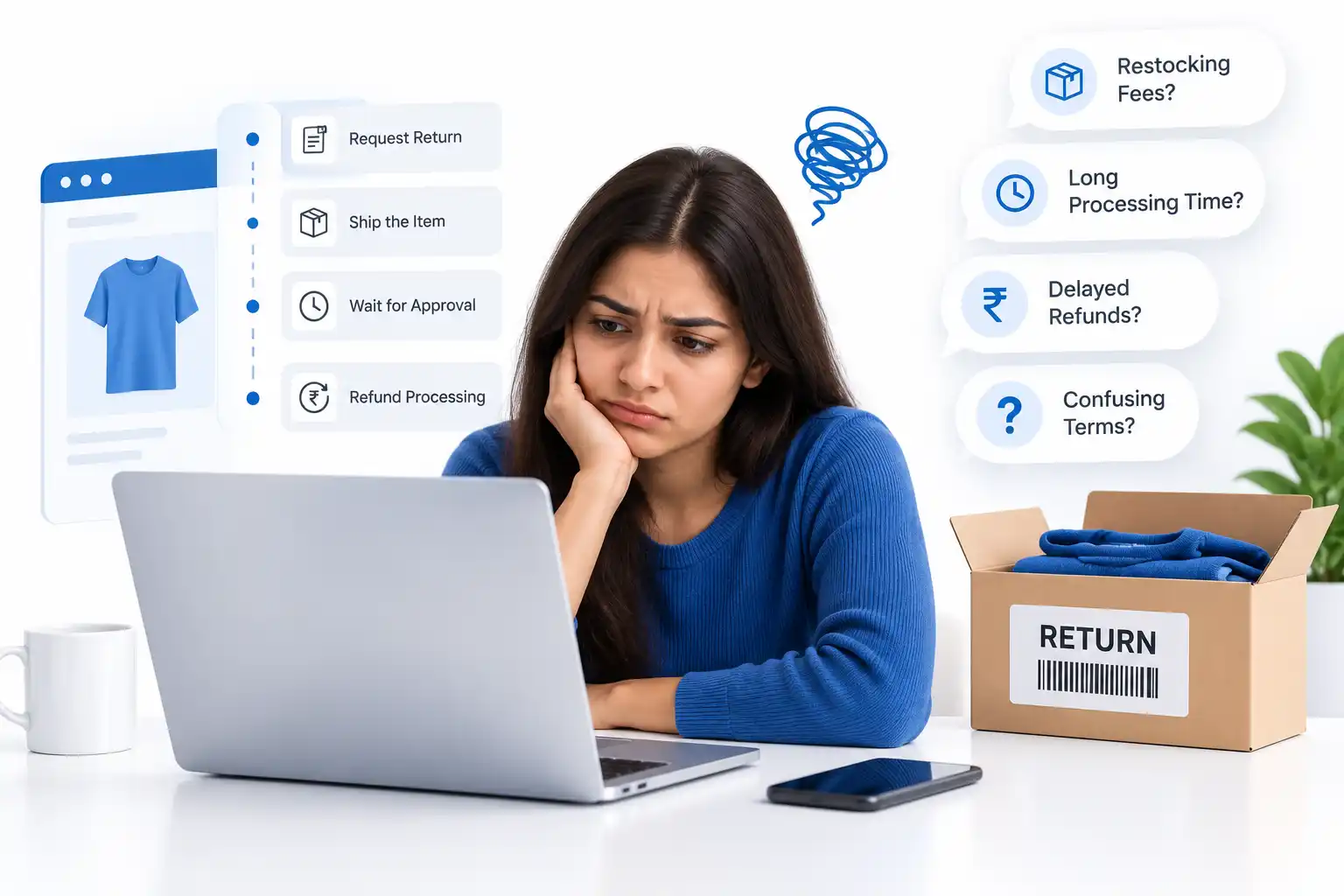
In 2025, US retailers took back $849.9 billion in returned merchandise, about $40 billion less than the year before, according to the National Retail Federation. Return volume is actually falling. Shopper complaints about the return experience are not.
On This Page 10 sections
That gap is the real story. Return windows have gotten longer on paper, refund processing has gotten faster in places, and yet a majority of shoppers across multiple regions now say return policies actively shape whether they buy at all. This piece looks at why, using current global data rather than any single country’s numbers.
- Global online return rates sit around 19 to 20% in 2026, but US retailers took back $40 billion less in 2025 than 2024, a real decline, not the “returns keep rising” story most coverage repeats.
- Average return windows have grown to roughly 39 to 41 days per Loop’s 2026 benchmark, though delivery delays and buried eligibility terms still eat into that window for many shoppers.
- Retailers including REI, Target, ASOS, and Boozt now actively restrict or fee frequent returners, with Boozt’s 2024 crackdown affecting about 60,000 customers.
- Return rights differ sharply by country: the EU and UK guarantee a 14 day change of mind window by law, while the US and Australia leave that decision entirely to the retailer.
- Refunds typically take 3 to 10 business days once approved, and 69% of shoppers now say a strict return policy actively discourages them from buying, up from 59% two years earlier.
How Big the Return Problem Actually Is
The scale is genuinely large. Online orders are returned at roughly two to three times the rate of in store purchases, and the category a shopper buys in matters more than almost anything else.
Apparel sits at the top of every benchmark, typically 20 to 40% depending on the retailer and season, driven by sizing uncertainty and the common habit of ordering multiple sizes to try at home. Electronics and beauty sit far lower, usually under 15%, because those purchases involve less physical guesswork.
Range midpoints compiled by Richpanel from NRF and Happy Returns’ 2025 Retail Returns Landscape and 2025 to 2026 industry benchmarks, except the 19.3% online overall figure, which NRF states directly. October 2025.
The bigger shift is in the total dollar figure, and it runs against the usual narrative. Retailers took back $890 billion in merchandise in 2024, a 16.9% return rate. That fell to $849.9 billion in 2025, a 15.8% return rate, according to the NRF’s October 2025 Retail Returns Landscape report.
Source: National Retail Federation and Happy Returns, 2025 Retail Returns Landscape, October 2025.
That’s a genuine decline, driven by retailers tightening policies and investing in better sizing tools, not a shopper base that suddenly stopped returning things. It matters because most coverage of this topic still assumes returns are an ever growing problem, when the total dollar figure just fell for the first time in years.
Return Windows Keep Shrinking Even As Delivery Gets Slower
Loop’s 2026 benchmark study found the average refund request window across retailers is now 39 days, with the average exchange window slightly longer at 41 days. On paper, that looks generous compared to the 14 to 30 day windows common a few years ago.
In practice, the window that matters is the usable one, not the stated one. Fast fashion and grocery adjacent categories still commonly set narrower limits of 14 to 30 days, and delivery delays during peak shopping periods eat directly into whatever window a shopper actually gets to use.
NRF’s own 2025 data shows 17% of holiday season purchases are expected to be returned, and holiday orders are exactly when carriers are most likely to run behind schedule. A 39 day average window shrinks fast when the package itself takes a week longer than usual to arrive.
Why So Many Return Policies Are Confusing By Design
Return eligibility is rarely one simple rule. It’s usually a stack of category exclusions, seller specific terms, and location dependent conditions buried inside a general terms and conditions page that almost nobody reads before checkout.
Common exclusions repeat across nearly every major marketplace: opened electronics, worn or altered apparel, intimates and swimwear, personalized or made to order items, and anything marked final sale. The problem isn’t that these exclusions exist. It’s that they’re frequently disclosed only after a purchase is already complete, on a packing slip or a returns portal rather than the product page itself.
Seasonal sales make this worse. Gartner survey data shows 60% of shoppers now want holiday return windows longer than the typical 30 to 60 days retailers offer, precisely because gift purchases often aren’t opened, tried, or evaluated until well after a standard window would have already closed. A policy written for an everyday purchase doesn’t automatically fit a gift bought weeks in advance.
The Rise of Return Abuse Detection and Serial Returner Bans
Return fraud is real and expensive enough that retailers are now willing to publicly ban customers over it, something that was rare even three years ago. The NRF’s 2025 Retail Returns Landscape survey puts fraudulent or abusive returns at 9% of the total, worth roughly $76 billion in 2025 alone.
That 9% figure comes from NRF’s own retailer survey. A separate analysis by Appriss Retail and Deloitte, using different methodology, put 2024’s figure higher, at 15.14% of returns and about $103 billion. Both are legitimate, named estimates. They simply measure abuse differently, which is itself a useful reminder that “return fraud rate” isn’t one settled number industry wide.
Source: National Retail Federation, 2025 Retail Returns Landscape, October 2025.
Target updated its policy language in September 2024 to say it can deny returns for fraud, suspected fraud, or abuse. ASOS began charging some UK customers a £3.95 fee for frequent returns the same month. H&M, Zara, American Eagle, and TJ Maxx have all introduced return fees in some markets over the same period.
Two specific behaviors drive most of what gets flagged. Bracketing is ordering multiple sizes or colors of the same item with the intent to return whatever doesn’t fit, common enough in apparel that many retailers now treat it as normal rather than abusive. Wardrobing is different and closer to what triggers a ban: wearing or using an item, then returning it as if new.
How a Refund Actually Moves Through the System
Once a return is approved, the refund itself passes through three separate systems before it shows up on a statement, and each one adds its own delay.
The merchant confirms the return
The store inspects the returned item at its warehouse and approves the refund, typically within 1 to 3 business days of the item arriving.
The card network transmits the credit
Visa, Mastercard, or another network passes the refund from the merchant’s bank to the shopper’s card issuer, usually within about 1 business day.
The card issuer posts it to the account
This stage varies the most by bank. Visa’s published guidance sets a 5 business day floor, Mastercard often clears in 2 to 3 days, and American Express tends to land in 3 to 7.
Altogether, that puts a typical card refund at 3 to 10 business days once a return is approved, before counting the shipping time and inspection window that come before approval. Digital wallets and other non card refund methods often move faster, since they skip the card network stage entirely.
What a Single Return Actually Costs a Retailer
The fees, bans, and shrinking windows covered above aren’t arbitrary. A return isn’t just a refund, it’s an entire reverse trip through the supply chain, and that trip has a real, well documented cost.
Industry cost studies put the fully loaded cost of handling one return at roughly $20 to $30 on average, made up of return shipping, inspection labor, restocking, and customer service time. The total can run much higher for bulky categories, with furniture and large items commonly costing $55 to $90 or more per return to process, according to Eightx’s 2026 vertical breakdown.
Share of average per-return cost, compiled from Claimlane and WarehousingCosts.com reverse logistics breakdowns, 2026.
Return shipping alone eats the largest share, which is exactly why the retailers introducing return fees have targeted shipping first rather than refusing returns outright. A $5 fee doesn’t cover the full cost of a return, but it changes a shopper’s behavior enough to reduce how often a marginal return happens at all.
This is also the real economic backdrop to the serial returner crackdowns above. When a small group of customers returns 79% of what they buy, as REI found among the members it eventually restricted, the reverse logistics cost of serving that group can outweigh the profit from their purchases entirely.
What Return Rights Actually Exist, Region By Region
This is where a lot of shopper frustration actually starts. People assume return rights work the same everywhere, and they don’t. Some regions grant a legal right to change your mind. Others leave the entire decision to the retailer.
| Region | Change of mind right? | Standard window | Enforcement |
|---|---|---|---|
| European Union | ✓ Yes, by law | 14 days from delivery | National consumer authorities per member state |
| United Kingdom | ✓ Yes, by law | 14 days to cancel, 14 more to return | CMA and Trading Standards |
| United States | ✗ No federal right | Set entirely by the retailer | FTC (deceptive claims only), state attorneys general |
| Australia | ✗ Faulty goods only | N/A for change of mind | ACCC |
| India | Seller must disclose terms | Typically 7 to 10 days, seller set | Central Consumer Protection Authority |
Compiled from the EU Consumer Rights Directive 2011/83/EU, UK Consumer Contracts Regulations 2013, US FTC guidance, Australia’s Consumer Law, and India’s Consumer Protection (Ecommerce) Rules, 2020.
The EU and UK both guarantee a 14 day cooling off period under distance selling law, and a retailer that fails to disclose that right upfront can see the withdrawal window extended by up to 12 months. Since June 19, 2026, EU Directive 2023/2673 has required online retailers to offer a dedicated withdrawal button, making it just as easy for a shopper to cancel a contract as it was to enter one in the first place.
That withdrawal button requirement doesn’t create a new right. It targets a specific complaint regulators kept hearing: that plenty of EU retailers technically honored the 14 day window but buried the cancellation process behind enough friction that shoppers gave up before finishing it.
The United States has no equivalent federal law at all. The FTC doesn’t require a store to accept a return for a non defective item, it only requires that whatever return policy a retailer does publish is truthful and not misleading. A handful of states, including California, New York, and Massachusetts, require the policy to at least be posted somewhere conspicuous.
Australia’s Consumer Law works differently again. It guarantees strong remedies, repair, replacement, or refund, when a product is faulty, unsafe, or not as described, and a retailer cannot use its own return policy to override that guarantee. But it grants no right at all to a change of mind return, which is entirely a courtesy some retailers choose to offer.
India sits closer to a disclosure model. The Consumer Protection (Ecommerce) Rules, 2020 require sellers to clearly state their return and refund terms and give platforms compliance oversight responsibility, but the specific window is seller set rather than fixed by law, commonly 7 to 10 days.
Why Return Policy Quality Drives Loyalty and Revenue
Return policy isn’t a back office detail shoppers ignore until something goes wrong. It’s something most people actively check before they ever add an item to a cart.
Sources: Route consumer survey via CX Dive, 2026, and NRF and Appriss Retail data via eMarketer, December 2024.
The share who say a strict policy discourages them from buying jumped from 59% in 2023 to 69% today, a fast move for consumer sentiment on any single factor. Gen Z shoppers made an average of 7.7 returns in the past year, more than any other generation, which means the group retailers most want to win over is also the group most sensitive to return friction.
Timing compounds the effect. 46% of shoppers say they make more returns during the holiday season than the rest of the year combined, which is also when carriers run slowest and return windows get stretched thinnest. The season retailers most want a smooth experience for is the same season the entire system is least equipped to handle.
What Shoppers Can Actually Do About It
None of this is within an individual shopper’s control to fix, but a few habits meaningfully reduce the odds of a bad return experience.
- Check the actual window before buying, not after. A product page’s stated window can differ from a store’s general policy, especially for sale items or specific categories.
- Keep original packaging until the return window closes. Most rejected returns cite packaging or condition issues, and keeping the box costs nothing.
- Use traceable return shipping and keep the tracking number until the refund actually posts, not just until the item is dropped off.
- Know your region’s baseline legal right separately from the retailer’s own stated policy. A store’s policy can offer more than the law requires, but it cannot legally offer less where a statutory right exists.
- Expect the slowest stage to be your bank, not the store. If a merchant confirms a refund quickly but it hasn’t posted after a week, the delay is most likely sitting with the card issuer, not the retailer.
FAQ
What is a normal return window for online purchases?
Most online retailers now offer somewhere between 14 and 41 days, depending on the study and category. Loop’s 2026 benchmark puts the average refund request window at 39 days and the average exchange window at 41 days, though fast fashion and grocery adjacent categories often set narrower limits of 14 to 30 days. Always check the specific window on the product page or order confirmation rather than assuming a store wide default.
Do online stores have to accept returns just because you changed your mind?
It depends entirely on where you’re shopping. Shoppers in the European Union and United Kingdom have a legal right to a 14 day cooling off period for a change of mind purchase, but the United States has no federal law requiring this at all, and Australia’s Consumer Law only guarantees remedies for faulty or misdescribed goods, not a change of mind.
How long does a refund actually take after a return is approved?
Card refunds typically take 3 to 10 business days to fully post once approved, moving through three stages: the merchant confirming the return (1 to 3 days), the card network transmitting it (about 1 day), and the card issuer posting it to the statement, which varies most by bank. Visa sets a 5 business day floor for that final stage, Mastercard often clears in 2 to 3 days, and American Express tends to take 3 to 7.
Can a retailer ban a customer for returning too many items?
Yes, and several major retailers now do exactly that. REI stopped processing returns from a small group of members averaging 79% of purchases returned, Boozt banned about 60,000 customers responsible for roughly 20% of its returns, and Target and ASOS have both introduced policy language or fees targeting frequent returners. These actions typically affect well under 1% of total customers.
Are online return policies the same in every country?
No, they vary significantly by region. The EU and UK guarantee a 14 day change of mind right by law, the US and Australia leave change of mind returns entirely up to the individual retailer, and countries like India require sellers to disclose their return terms clearly under dedicated ecommerce consumer protection rules. A policy that feels standard in one country can be unusually generous or unusually restrictive in another.
Why do so many shoppers find return policies frustrating?
Frustration usually comes from a mix of narrow return windows relative to shipping delays, eligibility terms buried in fine print, inconsistent enforcement at the inspection stage, and refunds that take days longer than the original purchase took to process. About 69% of shoppers now say a strict return policy actively discourages them from buying, up from 59% just two years earlier.
Return policy is no longer a quiet back office detail. It’s a visible, comparison shopped feature that shoppers factor into a purchase before they ever click buy, and the retailers treating it that way are the ones pulling ahead on repeat business.