Coupon Myths, Checked Against Real Sources Instead of Assumed
-
 Written by
Rajat Singh
Written by
Rajat Singh
- Published
- Updated
- Read time 15 min read
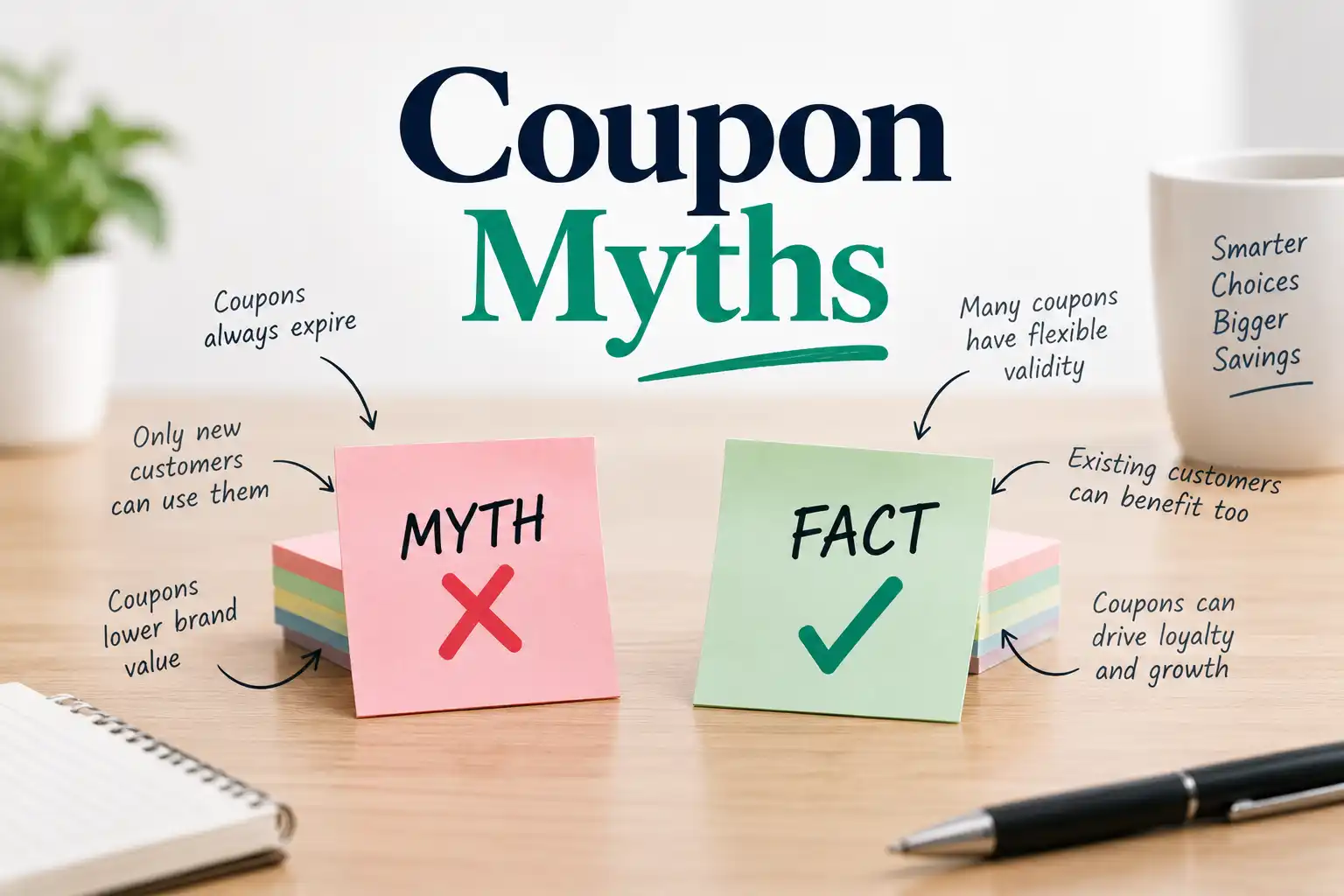
Most coupon myth articles have a predictable pattern: every myth gets debunked as completely false, every concern gets waved away, and couponing comes out looking flawless. That’s not honest, and it’s not actually useful. Some of these claims are genuinely false, some are true with real caveats, and at least one turns out to be roughly accurate once you check the real numbers, which is exactly the kind of nuance a genre built entirely around reassurance tends to skip.
On This Page 14 sections
This guide checks each myth against verifiable sources instead of assuming the answer that makes couponing look best, correcting a few overconfident claims along the way that turned out not to hold up under a closer look.
Key facts:
- Loyalty cards genuinely do track your purchases and drive targeted offers based on buying history, a real and well documented retail practice, not a myth.
- People who use coupons regularly save an average of $1,465 a year according to 2026 industry research, close to the “over $1,000” figure often repeated, though the mechanism behind it is more specific than a flat percentage.
- Whether a store actually loses money on a coupon depends on who issued it. Manufacturer coupons get reimbursed to the store, while store issued coupons are an absorbed marketing cost with no reimbursement from anyone.
- The claim that several states legally require coupons to stay valid for at least a year is false. That rule applies to gift certificates under the federal CARD Act, a different legal category entirely.
- Digital coupons now account for 53.4% of all US coupon redemptions, which has made the old “carrying coupons is cumbersome” concern largely outdated rather than solved by a bigger binder.
Every Myth Checked Against a Real Source
| Claim | Verdict | What’s actually true |
|---|---|---|
| Coupons must stay valid at least a year in some states | False | That rule is for gift certificates under federal law, not coupons |
| Loyalty cards track your purchases | True | Real, documented retail practice used to send targeted offers |
| Stores lose money on every coupon | Partly true | Manufacturer coupons are reimbursed, store coupons are not |
| Regular coupon users save over $1,000 a year | Roughly true | 2026 research puts the real average at $1,465 a year |
| Carrying coupons is a hassle | Increasingly outdated | 53.4% of US redemptions are now digital, not physical |
Each claim checked against a verifiable source, current as of 2026.
Myth: Loyalty Cards Don’t Actually Track What You Buy
Verdict: false, they genuinely do. Loyalty card programs are built specifically to analyze purchase history and send targeted offers based on what you actually buy, a well documented and standard retail practice, not a conspiracy theory.
Buy pet food for one brand regularly, and you may start seeing offers for that brand and its direct competitors, since retailers and manufacturers both have a real incentive to either reward your loyalty or win you away from it. This isn’t inherently a bad thing for you as a shopper, since it means the offers you receive are at least somewhat tailored rather than completely random, but it’s worth knowing your purchase history is the actual input driving them.
This is also why two shoppers at the exact same store can see completely different digital coupons in their own accounts. The offers aren’t random or unfair, they’re built from each person’s own purchase history, which means comparing coupon offers with a friend and finding them different isn’t a sign either of you is being shortchanged by the store.
Myth: Stores Lose Money Every Time You Use a Coupon
Verdict: partly true, it depends on who issued the coupon. A manufacturer coupon gets reimbursed to the store by the manufacturer, including a small handling fee, so the store genuinely doesn’t lose money redeeming one correctly. A store issued coupon is different: nobody reimburses the store for that discount, since it’s the store’s own marketing cost, absorbed directly against that sale’s margin.
This distinction matters more than most myth debunking articles acknowledge. It’s also why a store’s own coupon policy, including limits and stacking rules, reflects a real business decision about how much of that cost it’s willing to absorb, not an arbitrary inconvenience aimed at shoppers.
Coupon doubling, where a store voluntarily doubles the value of a small manufacturer coupon, is a good example of this tradeoff in practice. The manufacturer only reimburses the original face value, so the doubled portion comes entirely out of the store’s own margin, which is exactly why doubling programs have become far less common than they were a decade ago, especially outside a handful of regional chains that still run them.
Myth: Couponing Saves Barely Anything for the Time It Takes
Verdict: roughly the opposite is true. People who use coupons regularly save an average of $1,465 a year according to 2026 industry research, and 72% of digital coupon users save at least $10 a month.
2026 industry research on coupon usage and savings.
That last figure is worth sitting with, since coupon users spend 24% more per order on average, not less. That’s not a contradiction, it reflects that a coupon often unlocks a bigger basket rather than simply shrinking a fixed one, which is a genuinely different mechanism than the “you’ll barely notice the savings” framing implies.
Breaking the average annual savings down by category shows where most of it actually comes from, which is useful context for deciding where to focus your own coupon effort first.
2026 category level breakdown of average annual coupon savings.
Time investment does drop with practice, and most of that time now goes toward clipping digital offers to a loyalty account rather than physically cutting and organizing paper. Our full guide to how to start couponing covers a realistic first month timeline rather than an idealized one.
None of this means couponing is genuinely effortless. It means the time and savings tradeoff is more favorable than the myth suggests once you’re past the initial learning curve, which is a different, more honest claim than pretending there’s no learning curve at all.
Myth: Coupons Only Exist for Junk Food
Verdict: false, but the correction needs real examples, not an anecdote. Major protein brands, produce, and household essentials all regularly carry manufacturer coupons alongside the snack and cereal aisle offers that dominate the genre’s reputation.
Fresh meat and produce specifically are less common for traditional paper coupons, since they’re harder to standardize by SKU, but cashback and rebate apps fill that gap by offering rebates on fresh items after purchase rather than a code applied at checkout. Frozen produce, flash frozen close to peak ripeness, carries manufacturer coupons regularly and is a genuinely reasonable nutritional substitute worth considering rather than a lesser option.
Coupons also extend well beyond food entirely, covering household goods, pet supplies, and pharmacy items. Treating the category as junk food specific undersells how broad manufacturer coupon programs actually are.
The junk food perception likely persists because snack and cereal brands run higher volume, more frequent coupon campaigns than a protein or produce brand typically does, which makes them more visible in any given week’s inserts or app. Frequency of promotion isn’t the same thing as exclusivity, even though it can feel that way when scanning through available offers on a typical grocery trip.
Myth: Several States Legally Require Coupons to Stay Valid a Full Year
Verdict: false, and this specific claim circulates constantly. That minimum validity rule is real, but it applies to gift certificates under the federal CARD Act, a legally distinct instrument from a standard percentage off coupon. A coupon has no comparable federally mandated minimum lifespan.
Coupons genuinely do vary quite a bit in how long they last, and many extend a couple of months or more past when you clip them, but that’s set by the issuer’s own terms, not a legal floor. Our full breakdown of coupon compliance and the real legal rules covers this distinction and several other widely repeated myths about coupon law specifically.
A related version of this same myth claims the European Union mandates a minimum coupon validity period of several months. That’s also false. There’s no EU wide rule at all, and individual member states set their own voucher rules that apply to prepaid instruments, not ordinary discount codes, another distinction that gets flattened in most casual retellings.
Myth: Carrying Coupons Around Is Too Much Hassle
Verdict: increasingly outdated, not really solved by a bigger binder. The old advice here was always some version of get organized, use a binder, but that misses how much the whole format has shifted. Digital coupons now account for 53.4% of all US coupon redemptions versus 40.8% for paper.
SmartSource, the largest Sunday newspaper insert publisher, printed its final issue in March 2025, which means the paper heavy version of this myth is genuinely fading rather than just being managed with better organization. A phone with clipped offers already attached to a loyalty account solves the physical hassle problem more completely than any binder system ever did.
Myth: A Manufacturer Coupon Only Works at One Specific Store
Verdict: false, but with real conditions attached. A genuine manufacturer coupon works at any store that both sells the specific product and accepts manufacturer coupons generally, not just one designated retailer. That’s a meaningfully broader reach than a store issued coupon, which really is locked to that one retailer and won’t work anywhere else.
The confusion usually comes from confusing the two coupon types, exactly the same root cause behind the stacking and expiration myths covered elsewhere in this guide. Checking whether a coupon says manufacturer or store on it, rather than assuming based on where you found it, settles the question directly and takes less time than a debate at the register would.
Myth: Using an Expired Coupon Is Harmless if the Cashier Accepts It
Verdict: false, and this one has real financial consequences. A store that accidentally accepts an expired coupon still submits it to the manufacturer for reimbursement, and manufacturers routinely reject expired submissions during their own audit process. The store, not you, absorbs that loss after the fact, which is exactly why a cashier catching an expired date isn’t being overly strict for no reason.
The honest version of this myth is closer to “an expired coupon getting scanned doesn’t retroactively make it valid,” a distinction worth understanding even though it rarely comes up in casual couponing. For most shoppers, the practical takeaway is simple: purge expired coupons from your collection regularly rather than assuming a cashier’s acceptance settles the question.
Myth: You Can Stack Coupons the Same Way at Every Store
Verdict: false, and this is a common source of real checkout confusion. Combining a manufacturer coupon with a store coupon is legal and common, but the actual depth allowed varies significantly by retailer. Advice that worked at one chain doesn’t automatically transfer to another.
CVS permits some of the deepest legitimate stacks among major US retailers, while Walmart doesn’t issue its own store coupons at all, meaning any advice about stacking store and manufacturer coupons there is likely describing a different retailer’s policy. Our detailed breakdown of how coupon stacking actually works covers the real store by store differences.
Myth: A Promo Code You Find Online Will Always Work
Verdict: false, and this is one of the most common frustrations shoppers actually report. Promo codes expire, get restricted to specific regions, or get capped at a single use per account, none of which is visible just from seeing the code listed on a coupon site or forum. A code that worked perfectly for someone else last week can already be dead by the time you try it.
A browser extension that automatically tests multiple codes at checkout, like Capital One Shopping or Rakuten, handles this failure rate better than manually copying a single code from a search result, since it tries several in sequence rather than betting everything on one that might already be dead. Even then, no extension guarantees a working code exists for every purchase, and that’s a realistic expectation to have going in rather than a flaw in the tool.
The more useful mental model is treating any listed code as a possibility worth trying, not a guarantee, and having a backup plan, checking the store’s own current promotions directly, for when it doesn’t pan out.
Quick Answers to the Remaining Common Concerns
Overbuying unnecessary items. This is a real risk, not a myth to dismiss. A discount on something you wouldn’t otherwise buy is still spending, not saving, and it’s the single most common way couponing ends up costing money rather than earning it, regardless of how favorable the underlying discount percentage looks.
Stockpiling. Building a modest stockpile of non perishables at their lowest price is genuinely reasonable, but the same behavior taken too far leads to real, documented shelf clearing incidents that get store policies tightened for everyone afterward, not just the shopper involved. The line between smart stockpiling and a problem worth avoiding usually comes down to whether you’ll realistically use everything before it expires or spoils.
Social stigma. This is subjective rather than factually checkable, and couponing has become mainstream enough that most cashiers and fellow shoppers barely notice a reasonable, organized coupon user anymore.
Our full guide to coupon etiquette for shoppers covers the checkout and shelf clearing concerns in more depth, backed by real, documented incidents rather than general advice. Both of those genuinely matter more to how your coupon habits affect other people than any of the myths debunked earlier in this guide.
The Honest Overall Verdict
Most of the negative myths about couponing turn out to be false or badly outdated, and the real savings data actually understates how much a disciplined coupon user can save, since it doesn’t fully capture the bigger basket effect covered above. But a couple of the “concerns” people wave away, overbuying and shelf clearing specifically, are genuinely real risks worth taking seriously rather than dismissing outright.
The pattern across almost every myth here traces back to the same two root causes: confusing coupons with a legally distinct instrument like gift certificates, and assuming one retailer’s specific policy applies universally when it doesn’t. Once you know to check for those two errors specifically, most other couponing claims become much easier to evaluate on your own, without needing to look each one up individually.
Fraud concerns deserve the same honest treatment as everything else here. Legitimate couponing carries essentially no fraud risk for the shopper, but counterfeit codes and manipulated coupons are a real, documented problem worth understanding rather than dismissing as paranoia. Our guide to preventing coupon fraud and abuse covers the actual patterns retailers watch for, and why those patterns exist in the first place.
For a fuller, more balanced look at the real tradeoffs, not just a myth versus fact framing, our guide to the real pros and cons of coupons covers when the math genuinely works in your favor and when it doesn’t. And if you’re still getting the basics straight, what coupons actually are is the right place to start before any of these myths matter much at all.
Frequently Asked Questions
Do loyalty cards really track what you buy?
Yes, this is a real, standard retail practice, not a myth. Loyalty programs analyze your purchase history to send targeted offers, and switching to a competitor’s product can trigger a competing offer from the brand you left, since both sides have a real incentive to respond to your buying pattern.
Do stores actually lose money when you use a coupon?
It depends on who issued it. A manufacturer coupon is reimbursed to the store including a small handling fee, so the store doesn’t lose money, while a store issued coupon is an absorbed marketing cost with no reimbursement from anyone.
Is it true that coupons must stay valid for at least a year in some states?
No, that claim is false and confuses coupons with gift certificates, which do have a federally mandated minimum validity period under the CARD Act. A standard discount coupon has no comparable federal minimum lifespan.
How much can you actually save by using coupons regularly?
People who use coupons regularly save an average of $1,465 a year according to 2026 industry research, and 72% of digital coupon users save at least $10 a month. Coupon users also spend 24% more per order on average, since a coupon often unlocks a bigger basket rather than simply shrinking a fixed one.
Are coupons only available for junk food?
No, manufacturer coupons regularly cover fresh and frozen protein, household goods, pet supplies, and pharmacy items alongside snack and cereal offers. Fresh produce is less common for traditional coupons but is well covered by rebate apps that pay back after purchase instead.
Can I use the same coupon stacking rules at every store?
No, stacking depth varies significantly by retailer, and advice from one chain often doesn’t apply at another. CVS allows some of the deepest legitimate stacks among major retailers, while Walmart doesn’t issue its own store coupons at all.