Coupon Stacking: How It Actually Works in 2026
-
 Written by
Rajat Singh
Written by
Rajat Singh
- Published
- Updated
- Read time 15 min read
CVS has a real, genuinely underused loophole most shoppers never use on purpose. When an item goes fully free under a buy one get one promotion, CVS still lets you apply 2 separate manufacturer coupons, 1 per unit, even though the second unit is already priced at exactly $0. That single rule is a genuinely good example of what coupon stacking actually is: not a trick at all, just knowing a store’s own policy well enough to use it completely and fully.
On This Page 10 sections
This guide covers how stacking actually works, the verified 2026 policies at the retailers that allow it most, and 1 widely repeated claim about Walmart that turns out to be false. Every figure here is sourced, not copied from another coupon site’s unverified roundup.
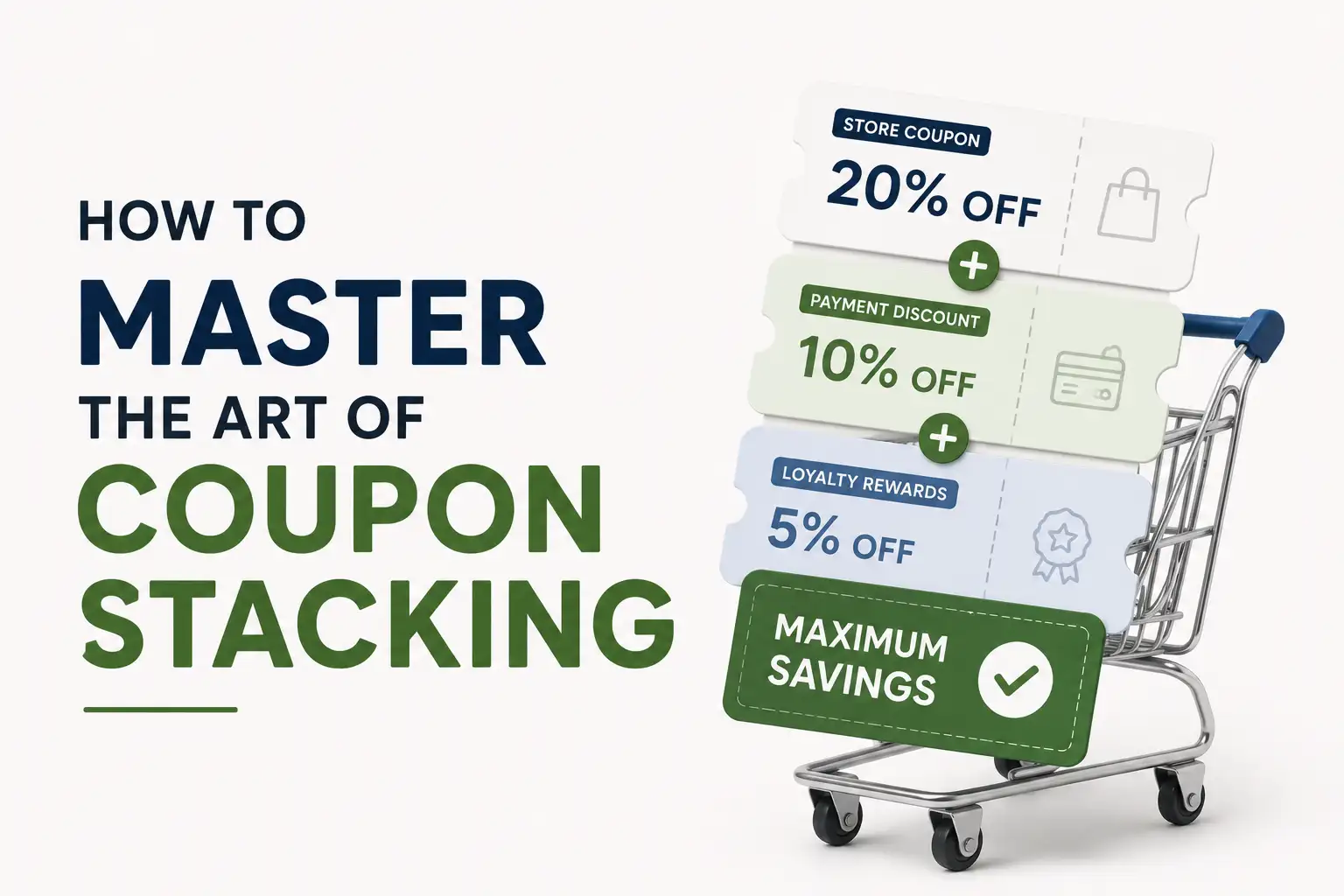
- Coupon stacking means layering 2 or more discounts on the same purchase, a manufacturer coupon, a store coupon, a loyalty offer, and cashback, where the store’s policy allows it.
- CVS allows the deepest legitimate stack, a manufacturer coupon, a store coupon, and ExtraBucks Rewards together, up to 1 manufacturer coupon per item.
- Target permits 3 layers per item, 1 manufacturer coupon, 1 Target store coupon, and 1 Circle offer, and Circle offers now stack with price matched items as of January 2026.
- Walmart does not actually have its own store coupons at all, a claim repeated across many coupon sites. Real stacking there means a manufacturer coupon plus a Rollback or clearance price, nothing more.
- Grocery chains have gotten stricter about stacking through 2025 and 2026 specifically to protect margins, a real reversal from the looser policies of a few years ago.
How to Actually Stack Coupons
- Check the store’s own coupon policy page before assembling anything, the exact number of layers allowed genuinely varies by retailer and changes over time.
- Apply the manufacturer coupon first, then the store coupon, then any loyalty or rewards offer last, this order matches how most point of sale systems actually calculate a stacked discount.
- Confirm 1 manufacturer coupon is being used per item, not per order, nearly every major retailer that allows manufacturer coupons caps them at 1 per qualifying item.
- Watch for a household or daily limit on identical coupons, 4 identical coupons per household per day is the standard cap at both CVS and Target.
- Wait for an item to go on sale or Rollback before applying a coupon, stacking a coupon onto an already discounted price is where the real savings compound.
- Never assume a coupon usable on mobile at 1 store works the same way at another, Walmart specifically requires a printed paper coupon at checkout, with digital coupons only accepted through its own app.
- Price compare before checkout even with a stack ready to apply, a coupon does not guarantee the lowest total price against a competing retailer.
What Coupon Stacking Actually Means
Coupon stacking is genuinely layering more than 1 discount onto the same single purchase, a manufacturer coupon plus a store coupon plus a loyalty reward, wherever the retailer’s own policy actually allows it. It is completely, unambiguously legal. Retailers set their own rules for how many layers they permit, and manufacturer coupons combined with store coupons is a pattern most retailers fully anticipate rather than try to block.
The math is straightforward once you see it laid out. A $10 product with a $1 manufacturer coupon, a 20% store coupon applied after that, and 10% cashback on the remaining total, stacks to real, compounding savings rather than a single flat discount.
| Step | Calculation | Running Price |
|---|---|---|
| Start | Original price | $10.00 |
| Manufacturer coupon | -$1 flat | $9.00 |
| Store coupon | 20% off $9 | $7.20 |
| Cashback | 10% of $7.20 back | $6.48 effective |
Illustrative example showing how discounts compound when applied in order, not a specific store’s actual offer.
The types of coupons involved matter as much as the order they are applied in. A manufacturer coupon comes directly from the product maker and is honored anywhere the item is sold, while a store coupon only works at the specific retailer that issued it. Digital codes and rebate apps add a separate layer entirely, applied after checkout rather than at the register.
Why Retailers Actually Accept Manufacturer Coupons
A manufacturer coupon is not a cost the retailer simply absorbs. A 3 party system handles it: the manufacturer issues the coupon, the retailer accepts it at checkout, and a third party clearinghouse, Inmar being 1 of the largest, processes and reimburses the retailer on the manufacturer’s behalf.
The retailer genuinely gets back the full face value of the coupon plus a real handling fee, historically around $0.08 to $0.10 per coupon, meant genuinely to cover the real cost of accepting, sorting, and actually submitting it. That reimbursement cycle typically takes 4 to 6 weeks from the moment a shopper actually uses the coupon to when the retailer finally gets paid back in full.
Understanding that mechanism explains why a retailer readily accepts a manufacturer coupon on top of its own store coupon: the manufacturer coupon costs the store nothing directly, and the small handling fee means accepting it is mildly profitable for the retailer rather than a pure loss.
What happens when a coupon’s value is larger than the item’s own price also matters to understand upfront. Nearly every major retailer caps the coupon’s own applied value at the item’s already reduced price and does not issue cash back for the leftover difference, so a $5 coupon on a $3 item genuinely only ever saves $3, never the full $5.
Verified 2026 Stacking Policies at Major Retailers
Policies genuinely differ enough between retailers that assuming 1 store’s rules apply everywhere is the single most common way a coupon stack gets rejected at checkout.
| Retailer | What Stacks | Per Item Limit |
|---|---|---|
| CVS | Manufacturer coupon, store coupon, ExtraBucks Rewards | 1 manufacturer coupon |
| Target | Manufacturer coupon, Target store coupon, Circle offer | 1 of each type |
| Walmart | Manufacturer coupon plus Rollback or clearance price only | 1 manufacturer coupon, no store coupons exist |
| Amazon | Subscribe and Save discount layered with Prime member pricing | Varies by product and promotion |
Compiled from each retailer’s own published coupon policy, checked August 2026.
CVS runs the deepest legitimate stack of the group. A manufacturer coupon, a CVS store coupon from the app or an ExtraCare kiosk, and ExtraBucks Rewards can all apply to the same transaction, capped at 1 manufacturer coupon per qualifying item and generally 4 identical coupons per transaction.
Target’s policy genuinely allows 3 real, distinct layers on a single item: 1 manufacturer coupon, 1 Target branded store coupon, and 1 separate Circle member offer. As of January 2026, Target Circle offers also stack with a price matched item, meaning a shopper can match a competitor’s lower price through Target and still apply a Circle offer on top of that matched price.
Walmart also stopped accepting manufacturer coupons displayed on a phone screen. A coupon has to be printed on paper and scan properly at checkout, with the sole exception being a digital coupon loaded directly through Walmart’s own app rather than a third party coupon site.
Maximum coupon layers permitted per single item, compiled from each retailer’s own published policy, checked August 2026.
Why Grocery Chains Have Gotten Stricter
Grocery retailers specifically have genuinely tightened coupon stacking rules through 2025 and well into 2026, a real, measurable reversal from the noticeably looser stacking culture of just a few years earlier. Thin grocery margins mean a chain that once allowed generous stacking absorbs a real cost every time a heavily discounted transaction goes through, and rising input costs have made that math harder to justify at scale.
That tightening shows up as lower per household coupon limits, fewer items eligible for both a manufacturer and a store coupon simultaneously, and more coupons explicitly excluding already clearanced items. Checking a specific grocery chain’s current policy before planning a large stacked purchase matters more now than it did even 2 years ago.
Kroger runs a genuinely different model worth understanding on its own terms entirely. It is a digital first coupon chain, meaning a coupon has to be clipped inside the app or website to a loyalty account before checkout even starts, not just presented directly at the register the way a printed coupon works elsewhere.
Kroger’s own policy explicitly and clearly blocks combining a digital coupon with a paper coupon on the exact same item, since both genuinely count as manufacturer coupons internally within its system. A less obvious exception genuinely exists though: Kroger’s own “5x digital coupon” promotions are coded internally as store coupons rather than manufacturer coupons, which means a regular digital manufacturer coupon can legitimately stack with a 5x digital coupon on the exact same item, even though 2 ordinary digital coupons could never combine that same way.
Stacking Online: Codes, Cashback, and Browser Tools
Online stacking genuinely works differently than in store stacking, since a checkout page either accepts 1 promo code field or several, and many retailers explicitly block combining 2 separate percentage off codes even when a cashback portal is layered on top.
A browser extension that automatically tests available codes removes most of the manual trial and error from online stacking, applying the strongest working code automatically rather than testing each one by hand. Layering a cashback portal click before entering any code, rather than after, also matters since some cashback portals stop tracking a purchase once a separate coupon site has already been visited in the same session.
Amazon stacks in a genuinely specific order rather than a free for all. Clipping a product specific coupon first, then enrolling that same item in Subscribe and Save for an automatic 5% to 15% discount, and finally paying with a rewards credit card that returns another percentage back, is the sequence that actually compounds.
A $22 item can realistically drop to around $14 once a clipped 20% coupon, a 15% Subscribe and Save discount, and a 5% card reward all apply together in that exact order. Amazon does not publish sitewide promo codes the way some retailers do, so “Clip Coupon” buttons on individual product pages and card specific point promotions are the actual mechanism, not a code typed into a discount field. Any site claiming to offer a universal Amazon discount code is not describing how the platform genuinely works.
Rebate Apps and the Double Dipping Trick
Ibotta genuinely stacks on top of a store’s own sale price, a manufacturer coupon, and a store loyalty card all at once, adding a real fourth layer that pays back after the purchase entirely rather than discounting it directly at checkout. Buying a sale priced item, applying a manufacturer coupon, and still earning Ibotta cash back on the same receipt is a stack most shoppers never realize is possible.
A less obvious trick works across multiple rebate apps at once. The same receipt can legitimately be scanned into Ibotta, Fetch Rewards, and Checkout 51 separately, and if a specific brand happens to be running an offer on more than 1 of those platforms at the same time, each app pays out independently for the identical purchase without conflicting with the others.
None of these rebate apps require an exclusive relationship either, so running the same receipt through all 3 costs nothing beyond a few extra minutes of scanning after checkout is already finished. The only real downside is the manual effort involved, which is exactly why linking a loyalty card directly, rather than scanning paper receipts by hand every single trip, is worth setting up once and forgetting about.
| Layer | Example Discount |
|---|---|
| Store sale price | Item marked down from shelf price |
| Store loyalty coupon | Digital coupon clipped to loyalty account |
| Manufacturer coupon | Separate discount from the product maker |
| Rebate app cash back | Paid out after the receipt is scanned or linked |
| Credit card rewards | Cash back or points from the payment method itself |
A theoretical 5 layer stack on a single grocery item, illustrative rather than guaranteed on any specific product.
Ibotta and Fetch both integrate directly with major online grocery platforms too, letting a shopper link a loyalty card or email address once rather than manually scanning a paper receipt after every trip. Not every Ibotta offer combines with a coupon though, so checking the specific offer’s own terms before assuming every layer applies avoids a rebate quietly falling through at the last step.
Where Legitimate Stacking Ends and Fraud Begins
Every single tactic covered in this guide works entirely within a retailer’s own published policy, which is exactly what genuinely separates real stacking from actual coupon fraud. A photocopied or digitally altered coupon, a counterfeit barcode, or a coupon used well past its printed expiration date is genuinely fraud regardless of exactly how the discount gets applied at checkout.
Manufacturers and clearinghouses actively track redemption patterns specifically to catch this kind of abuse, and a retailer that accepts an invalid coupon simply does not get reimbursed for it, which is exactly why store policies exist and get enforced strictly at the register in the first place. Reading how coupon fraud actually gets caught makes the real difference between clever, entirely legal stacking and something that can get a shopper’s own account flagged genuinely clear.
Mistakes That Break a Stack at Checkout
Skipping the fine print entirely is genuinely the single most common failure of all. Eligible items, real expiration dates, and any minimum spend requirements all sit directly in the coupon’s own terms, and missing even 1 single detail is exactly what causes a register to reject an otherwise valid stack.
Trusting an unverified coupon code from an unfamiliar site is a separate, real risk worth naming directly. Knowing how to identify a fake coupon site before entering payment information matters more than any single stacking tactic covered above, since a scam site does not care whether the discount actually works.
Assuming 2 full manufacturer coupons can genuinely apply to a single item is another frequent mistake, since nearly every major retailer caps manufacturer coupons at 1 per item regardless of how many total coupons the shopper is holding. Buying something purely because a coupon happens to exist for it, rather than because it was genuinely already needed, is a more subtle version of that same overspending trap.
Cashier and fellow shopper etiquette matters more once a stack gets large. Reading through basic coupon etiquette before attempting a heavily stacked, genuinely multi item transaction avoids holding up a checkout line unnecessarily, and a cashier who genuinely understands the store’s own policy is generally far more willing to help a shopper who is visibly organized rather than fumbling through a large stack of loose printouts.
Anyone genuinely wanting to push stacking further, buying in the real volume that actual extreme couponing genuinely requires, needs a real system for tracking coupon expiration dates across dozens of active offers at once, not just the tactics covered here in this guide alone.
Frequently Asked Questions
What is coupon stacking?
Coupon stacking is applying 2 or more discounts, typically a manufacturer coupon, a store coupon, and a loyalty or cashback offer, to the same purchase. It only works where the retailer’s own policy explicitly allows combining those discount types.
Is coupon stacking legal?
Yes, entirely. Retailers set their own individual rules for how many coupons can be applied per item or per transaction, and combining a manufacturer coupon with a store coupon is a practice most retailers fully anticipate and deliberately design their point of sale systems to genuinely allow.
Which store allows the most coupon stacking?
CVS currently allows the deepest legitimate stack among major US retailers, combining a manufacturer coupon, a CVS store coupon, and ExtraBucks Rewards on the same purchase. Target follows closely with 3 layers per item: a manufacturer coupon, a store coupon, and a Circle offer.
Does Walmart allow coupon stacking?
Only partially, and Walmart does not issue its own store coupons at all, despite that claim being repeated on several coupon sites. Real stacking at Walmart means combining a manufacturer coupon with an already discounted Rollback or clearance price, nothing more.
Can you use 2 manufacturer coupons on the same item?
Generally no, almost every major retailer caps manufacturer coupons at 1 per qualifying item. CVS carries a genuine exception during buy one get one free promotions, where a separate manufacturer coupon can apply to each unit individually, including the free one.
Why have grocery stores gotten stricter about coupon stacking?
Thin margins and rising costs made generous stacking harder for grocery chains to absorb at scale through 2025 and into 2026. That shows up as lower per household coupon limits, fewer items eligible for both a manufacturer and store coupon together, and more exclusions on already clearanced items.