Digital Coupons: What Changed and What the Honey Collapse Means
-
 Written by
Rajat Singh
Written by
Rajat Singh
- Published
- Updated
- Read time 15 min read
More than half of all US coupon redemptions are now digital, and the gap over paper keeps widening every year. Digital coupons first overtook physical ones back in 2020, and by the most recent available data, they account for 53.4% of redemptions against 40.8% for paper.
On This Page 14 sections
That shift changed more than just where a coupon lives. It changed who profits from finding one for you, how retailers track what you actually buy, and what happens when an entire distribution channel collapses almost overnight, which is exactly what happened to the biggest browser extension in this space earlier in 2026.
This guide covers what digital coupons actually are, the real numbers behind the major players, and what’s changed since printable coupons stopped being the default.
Key facts:
- Digital coupons make up 53.4% of US coupon redemptions versus 40.8% for paper, based on the most recent available data. Digital first took the lead in 2020.
- The global digital coupon market is projected to reach $12.55 billion in 2026.
- Honey, once the largest coupon browser extension, lost roughly 8 million Chrome users amid more than 20 class action lawsuits, and Rakuten Advertising removed it from its own affiliate network entirely on January 12, 2026.
- Rakuten, a competing cashback platform, has paid out more than $2 billion in cashback to members since launch, with the average member earning over $120 total.
- Two companies, NCH Marketing Services and Inmar Intelligence, process an estimated 85% of all manufacturer coupons redeemed in North America, digital included.
What Digital Coupons Actually Are
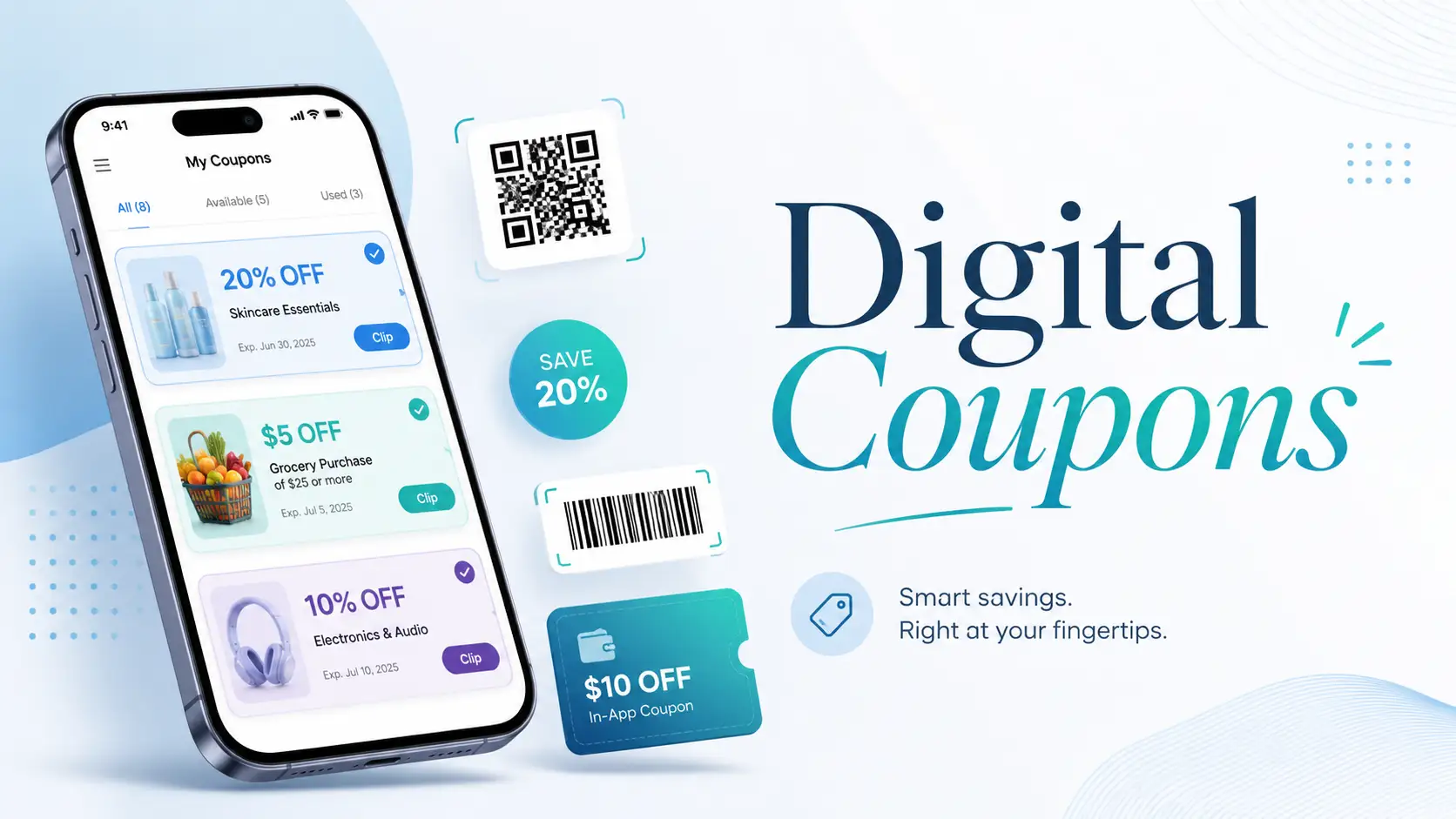
A digital coupon is a discount stored and redeemed entirely electronically, no printing or clipping required. It shows up as a promo code entered at online checkout, a QR or barcode scanned at a register, or a discount already loaded onto a loyalty account that applies itself automatically.
That last format, sometimes called a clipped coupon, is where retailers have pushed hardest. A shopper taps a coupon inside an app once, and it applies at checkout without a code, a scan, or anything to remember at the register.
The common thread across every digital format is that a business somewhere is tracking redemption in real time. A paper coupon’s true redemption count wasn’t known until a slow, manual clearinghouse process finished weeks later, while a digital coupon’s performance is visible to the issuing business almost instantly.
How Digital Coupons Actually Work
Find a real, current coupon
A retailer app, a coupon aggregator, or an email newsletter, checked for a live expiration date before relying on it.
Save, clip, or copy it
A loyalty app coupon needs a single tap to save, while a promo code just needs copying before checkout.
Apply it at checkout
Enter the code online, or scan a barcode or QR code in store, though a clipped loyalty coupon applies on its own.
Confirm the discount landed
Check the total or receipt before completing the purchase, since a code that failed silently is easy to miss until it’s too late to fix.
The Real Scale of the Shift
Digital passed paper coupon redemption for the first time in 2020, and it hasn’t looked back since. As of the most recent available data, 53.4% of US coupon redemptions are digital against 40.8% for paper, with the remainder split across other formats.
Source: Inmar Intelligence coupon redemption reporting, most recent available data (2024).
The global digital coupon market itself is projected to reach $12.55 billion in 2026. Behind that number sits a real, specific infrastructure most shoppers never think about: NCH Marketing Services and Inmar Intelligence together process an estimated 85% of manufacturer coupons redeemed across North America, digital and paper alike, auditing and settling payments between retailers and the brands that issue each coupon.
Skip the Extensions
Verified Deals, No Browser Add On Required
Browse current digital coupons directly on CouponZania instead of relying on an extension that could shut down or get flagged tomorrow.
The Four Real Types
| Type | How it applies | Best for |
|---|---|---|
| Promo code | Typed into a checkout field manually | Online only purchases |
| QR or barcode | Scanned by a cashier or self checkout kiosk | In store redemption without a code to remember |
| Loaded loyalty coupon | Applies automatically once clipped inside an app | Repeat shoppers at grocery and pharmacy chains |
| Cashback | Refunded after purchase, not applied at checkout | Stacking on top of an already discounted price |
The loyalty clipped coupon deserves the most attention here, since it’s genuinely different from the other three. Once a shopper links a loyalty card or phone number to their account, discounts apply without a code or scan at all, and that link is also what lets a retailer build a detailed purchase history behind the scenes.
What separates these four formats in practice is who controls the moment a discount actually gets applied, the shopper typing a code, a cashier scanning a phone, or software running quietly in the background the whole time. That distinction matters more for trust and transparency than it does for convenience alone, a point the rest of this article covers in more depth.
QR Codes Went From Niche to Standard Fast
Mobile QR code coupon redemptions in the US reached an estimated 5.3 billion in 2025, up from just 1.3 billion in 2017. That’s a fourfold increase in less than a decade, and QR driven redemption now exceeds traditional paper coupon volume outright.
The habit behind that growth is broad, not niche. 72% of consumers report scanning a QR code within the past month, and roughly 102.6 million US smartphone users are projected to scan one specifically in 2026. Within retail specifically, 41% of all QR scans happen while a shopper is physically standing inside a store.
What changed wasn’t the technology itself, QR codes have existed since the 1990s, it was contactless payment habits from 2020 onward making a quick phone scan feel normal rather than novel. A format that once needed explanation now needs none, and a retailer skipping QR support in 2026 is skipping a genuinely mainstream habit, not a fringe one.
What Actually Happened to Honey
For years, Honey was the default recommendation in almost every “best coupon tools” article, a browser extension owned by PayPal that automatically tested codes at checkout. That reputation started collapsing on December 21, 2024, when YouTuber MegaLag published an investigation alleging Honey was quietly rerouting affiliate commissions away from the creators who’d actually referred the sale.
The mechanism worked through what’s called last click attribution, the industry standard where a sale’s commission goes to whoever generated the final click before checkout. The investigation alleged that when a shopper clicked “apply discounts” inside Honey, the extension quietly opened a hidden tab simulating its own affiliate click, overwriting the original creator’s tracking cookie before closing itself.
More than 20 class action lawsuits followed through 2025. Then, on December 22, 2025, almost exactly a year after the first video, MegaLag released a second, deeper investigation revealing a hidden system inside Honey’s own code called Selective StandDown, built specifically to detect compliance testers and behave differently for them than for ordinary users.
The practical lesson isn’t to avoid every coupon extension. It’s to understand that an extension automatically testing codes at checkout is also a business with its own revenue model, one that isn’t always transparent about how it actually makes money from a purchase a shopper thinks they’re making independently, a distinction that took over a year of independent investigation to fully surface in Honey’s case.
Cashback, With the Real Numbers Behind It
Cashback isn’t technically a coupon, since the discount arrives after purchase rather than at checkout, but it functions the same way in practice. Rakuten, one of the largest cashback platforms, has paid out more than $2 billion to members since launch, with the average member earning over $120 total.
Rakuten covers more than 3,500 partner stores, with cashback rates typically running 1% to 15% and occasionally spiking as high as 40% during specific promotional windows. The mechanism is straightforward, Rakuten earns a referral commission from the retailer for sending the sale, then shares a portion of that commission back with the shopper, functioning as a legitimate, transparent version of the same underlying model Honey’s hidden mechanism corrupted.
That same referral commission mechanism is exactly what the Honey allegations centered on, whether the extension was crediting itself for sales a different, unrelated referral source actually generated. Understanding how the commission flows helps explain why this specific complaint mattered enough to trigger over 20 lawsuits rather than reading as a minor technical dispute most shoppers would never notice or care about.
Digital Coupon Fraud Looks Different From Paper
A printed coupon gets counterfeited through image editing and reposting. A digital promo code faces a different threat entirely, automated software that rapidly tests thousands of character combinations against a checkout field until one happens to work.
This is exactly why code randomization matters so much for any business issuing digital coupons. Our detailed breakdown of preventing coupon fraud covers the real math behind why an 8 character randomized code, drawn from a large enough character set, makes this kind of brute force attempt computationally pointless.
Account level abuse is the other major digital specific risk. Creating multiple accounts with slightly altered email addresses specifically to reclaim a one time welcome discount is far easier with a digital signup form than it ever was with a physical coupon tied to nothing but a piece of paper.
Most of that abuse still comes from ordinary repeat customers exploiting the same loophole, not organized fraud rings. Only roughly 5% to 10% of promotion abuse attempts involve someone actively disguising themselves as a different, legitimate customer, a pattern that holds for digital coupons as much as any other promotional format.
Why Your Coupons Look Different From a Friend’s
A printed coupon in a newspaper looked identical for every reader. A digital coupon inside a retailer app increasingly doesn’t, since personalization now shapes which offers a specific shopper actually sees.
McKinsey research puts the realistic revenue lift from effective ecommerce personalization at 10% to 15% for most retailers, with top performers reaching around 25%. Loyalty linked digital coupons are one of the clearest ways that shows up in practice, a shopper who regularly buys a specific category sees more offers in that category, not a generic storewide code.
Who’s Actually Driving the Digital Shift
Coupon usage overall skews older, but the format someone reaches for splits sharply by age. Shoppers aged 18 to 34 use coupons about as often as older age groups, but they overwhelmingly favor digital formats, while shoppers 55 and older remain the group most likely to still use paper and printable coupons specifically.
Digital coupon usage isn’t concentrated among lower income shoppers either, a common assumption that doesn’t hold up under real data. Affluent shoppers earning $200,000 or more annually use coupons at rates statistically close to shoppers earning $20,000 to $39,000, meaning the digital shift is happening across income brackets, not just among budget conscious households.
Globally, the pattern holds beyond the US. In the UK, digital coupons are about 77% more likely to actually get redeemed than a printed equivalent, and more than 66% of European consumers overall now use digital coupons regularly, with the UK, France, and Germany leading adoption.
The Real Limitations
Digital coupons trade one set of inconveniences for a different set, not a frictionless upgrade over paper in every respect.
Account creation is a real barrier for some shoppers. A coupon that requires downloading an app or creating an account adds a step that a printed coupon never demanded, and that step is exactly the exchange for the personalization discussed above.
Store specific restrictions are common and easy to miss. A promo code tied to one retailer’s checkout system simply won’t work anywhere else, a limitation less obvious than it sounds when a shopper is juggling codes from several different sources at once.
Technical failures happen without a paper trail. A code that silently fails to apply at checkout leaves no physical evidence the way a rejected paper coupon at least gives a cashier something to look at and troubleshoot.
Privacy tradeoffs are real, even when a shopper never reads the terms. Linking a loyalty account or installing a retailer app hands over a level of purchase history detail that a printed coupon clipped from a newspaper never generated, a genuine exchange rather than a purely one sided convenience upgrade.
Getting the Most Out of Digital Coupons
Stack a digital coupon with an active sale, not a full price item. Combining a promo code with an already discounted item, where the retailer allows it, produces meaningfully larger savings than either discount used alone. Our detailed guide to coupon stacking covers exactly which combinations typically work.
Prefer a retailer’s own app or site over a third party extension when possible. Given what happened with Honey, a coupon sourced directly from the business you’re buying from carries less risk than one routed through an intermediary with its own separate revenue incentive.
Don’t assume every extension shares Honey’s specific problem. The issue wasn’t that Honey automated code testing, it was the undisclosed commission redirection layered on top. A tool that’s transparent about how it earns money doesn’t carry the same risk.
Before You Go
Find Digital Coupons Without the Extension
Check current store deals on CouponZania before your next purchase, verified directly, no third party extension in between.
Browse Store DealsA Coupon Site and a Coupon Extension Aren’t the Same Trust Model
The Honey story is a useful lens for a broader question worth asking about any digital coupon source, not just browser extensions specifically. What does this specific tool or site actually do with the moment right before checkout, and who benefits from that action?
A coupon site a shopper visits deliberately, reads, and copies a code from operates on a fundamentally different trust model than an extension quietly running in the background at every single checkout across every site a shopper visits. The extension has far more access and far less visibility into what it’s actually doing at any given moment.
That distinction doesn’t make every extension untrustworthy, and it doesn’t make every coupon site automatically safe either. It does mean the amount of unsupervised access a tool has at checkout is a real, relevant question, not a technical detail only developers should care about, especially given how long Honey’s specific mechanism went undetected before an independent investigator found it.
Frequently Asked Questions
What percentage of coupons are digital now?
Digital coupons account for 53.4% of US coupon redemptions versus 40.8% for paper, based on the most recent available data. Digital first overtook paper redemption back in 2020, and the gap has widened since.
Is the Honey browser extension still safe to use?
Honey faces more than 20 class action lawsuits after a 2024 and 2025 investigation by YouTuber MegaLag alleged it rerouted affiliate commissions and ran a hidden system called Selective StandDown to evade compliance testers. PayPal acknowledged and disabled that mechanism on January 12, 2026, the same day Rakuten Advertising removed Honey from its own affiliate network, a real signal worth weighing before relying on it.
How does Rakuten cashback actually work?
Rakuten earns a referral commission from a retailer when it sends a sale, then shares a portion of that commission back to the shopper as cashback. Rates typically run 1% to 15% and can spike as high as 40% during specific promotional windows, with the platform having paid out more than $2 billion to members total.
How is digital coupon fraud different from paper coupon fraud?
Digital coupons face automated code testing, software that rapidly tries thousands of character combinations against a checkout field until one works, rather than image editing and reposting. This is why randomized codes drawn from a large character set matter so much for any business issuing digital promo codes.
Why do I see different coupons than someone else at the same store?
Loyalty linked digital coupons are increasingly personalized based on your actual purchase history, not identical for every shopper the way a printed newspaper coupon was. McKinsey research shows this kind of personalization can lift ecommerce revenue by 10% to 15% for most retailers, which is exactly why stores have invested in it.
Do I need to create an account to use digital coupons?
Some do, particularly loyalty linked coupons that apply automatically at checkout, while promo codes and QR codes generally don’t require an account at all. Creating an account is the tradeoff for the personalized offers loyalty programs provide, not a requirement across every digital coupon format.