Printable Coupons: What Actually Still Works in 2026
-
 Written by
Rajat Singh
Written by
Rajat Singh
- Published
- Updated
- Read time 15 min read
For decades, “check SmartSource” was close to universal advice for finding a printable coupon. That advice stopped being accurate in 2025, when Neptune Retail Solutions confirmed it had discontinued the SmartSource newspaper insert business entirely, ending a nearly four decade run in Sunday papers.
On This Page 14 sections
A lot of printable coupon advice online still hasn’t caught up to that shift. This guide covers what printable coupons actually are, where they genuinely come from today, and what’s changed in how stores handle them, including a couple of things that quietly became rarer than most guides admit.
Key facts:
- SmartSource, once the largest source of printable and clippable coupons in the US, formally discontinued its newspaper insert business in 2025 as its parent company shifted toward digital incentives.
- Coupons.com’s parent company, Quotient Technology, was acquired by SmartSource’s own parent company, Neptune Retail Solutions, in 2023, putting two once separate coupon giants under the same roof.
- Digital coupons made up 53.4% of all US coupon redemptions as of the most recent available data (2024), ahead of paper coupons at 40.8%. Digital first overtook paper back in 2020, and the gap has widened since.
- Double couponing has quietly disappeared from most national grocery chains over the past decade. It still exists at select regional grocers, and even those have gotten stricter about stacking rules through 2025 and 2026 to protect margins.
- Coupon Information Corporation guidance applies directly to printable coupons specifically, since a printed image is exactly the format counterfeiters find easiest to alter or duplicate.
What Printable Coupons Actually Are
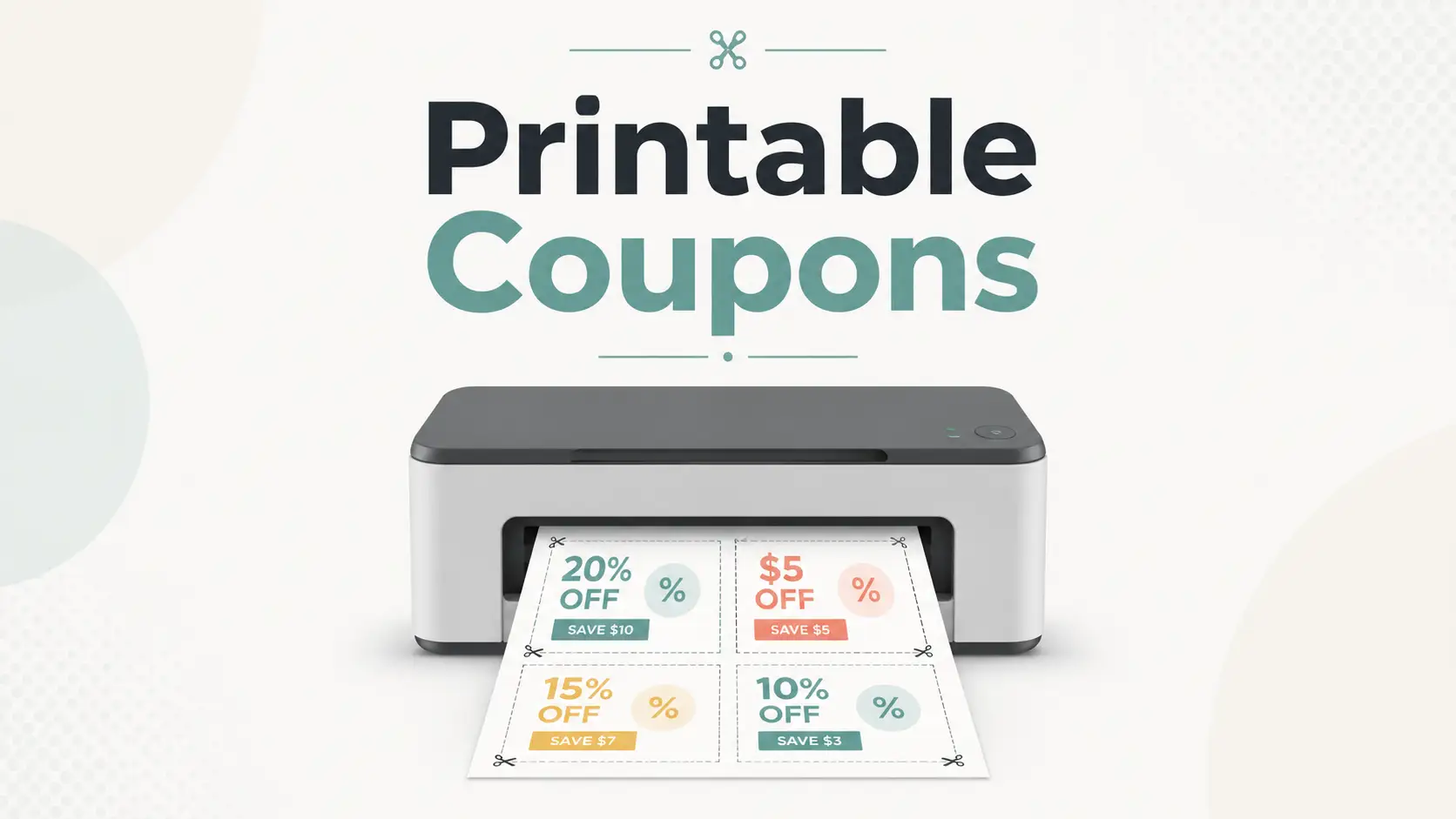
A printable coupon is a digital file, almost always a PDF, that a shopper downloads and prints at home rather than clipping from a physical newspaper insert. Once printed, it functions exactly like a traditional paper coupon, presented at checkout and scanned or manually entered by a cashier.
That’s the key distinction from a purely digital coupon, which lives entirely on a phone or loyalty account and never needs paper at all. Printable coupons sit in an odd middle position, distributed digitally but redeemed the old fashioned way.
Manufacturers, retailers, and independent coupon sites, including dedicated coupon aggregators, all still offer them. What’s changed is which of those sources are actually reliable in 2026 versus which ones are running on reputation from a decade ago.
How Printable Coupons Actually Work
Find a real, current coupon
A manufacturer site, a retailer’s own coupon page, or an active coupon aggregator, checked for a live expiration date.
Print it at full quality
A faded or low resolution barcode is the single most common reason a printable coupon gets rejected at checkout.
Cut it out cleanly
Keep the barcode and expiration date fully intact, both are required for the cashier to redeem it.
Present it at checkout
Hand it over before or during scanning, since some store systems apply coupon discounts in a specific order.
Confirm the discount applied
Check the receipt before leaving, since a manually entered code is more prone to human error than a scanned one.
Where to Actually Find Them Now
The source landscape looks meaningfully different than it did even three years ago. Two of the industry’s biggest historical names, SmartSource and Coupons.com, are now owned by the same parent company, Neptune Retail Solutions, following its 2023 acquisition of Quotient Technology.
| Source type | Current reliability | What to expect |
|---|---|---|
| Manufacturer websites | Reliable | Brands like Procter and Gamble and Unilever still run their own printable coupon pages directly |
| Retailer websites and apps | Reliable, increasingly app based | Grocery chains like Kroger now push most coupons through their app rather than a printable PDF |
| Independent coupon aggregators | Mixed | Quality varies significantly, check for an active expiration date before printing anything |
| SmartSource specifically | Discontinued as a newspaper insert | The print business that made the name well known no longer exists as of 2025 |
Source: Neptune Retail Solutions company statements, 2025; Quotient Technology acquisition reporting, 2023.
Skip the Guesswork
Find Verified Deals Instead
Browse current store offers on CouponZania instead of hunting through aggregator sites of varying reliability.
Grocery loyalty programs remain a genuinely strong source, worth calling out separately. Chains like Kroger increasingly let a shopper “clip” a coupon digitally to their loyalty account rather than printing anything, which functions almost identically at checkout but skips the paper entirely.
Digital Passed Paper Years Ago, and the Gap Keeps Widening
Digital coupon redemption first overtook physical coupon redemption back in 2020, according to Inmar Intelligence reporting. As of the most recent available data, digital coupons account for 53.4% of all US redemptions against 40.8% for paper, with the remainder split across other formats.
Source: Inmar Intelligence coupon redemption reporting, most recent available data (2024).
Email remains a real, preferred channel within that digital shift, not just an afterthought. About 45% of American shoppers say they prefer receiving grocery coupons through email specifically, the single most popular delivery method among digital options. Our guide to how email coupons actually perform covers that channel’s real numbers in more depth.
What Actually Happens After a Coupon Gets Scanned
A shopper handing over a printable coupon rarely thinks about what happens next, but the process behind it explains a lot about why stores enforce coupon rules as strictly as they do. Once a store accepts a manufacturer coupon, it needs to recover that discount from the manufacturer who issued it.
That recovery runs through specialized clearinghouse companies. NCH Marketing Services and Inmar Intelligence together process an estimated 85% of all manufacturer coupons handled in North America, auditing, settling, and reconciling redemption payments between retailers and the brands that issued each coupon.
A coupon that fails an audit at this stage, a duplicate, an altered barcode, one redeemed past its expiration, doesn’t just get rejected quietly. The store that accepted it can end up eating the cost itself rather than recovering it from the manufacturer, which is the real financial reason behind seemingly strict store level coupon policies.
That also explains why manufacturers keep issuing coupons at all rather than simply lowering the shelf price. A coupon lets a brand offer a discount specifically to price sensitive shoppers willing to seek one out, while a shopper who’d pay full price anyway usually doesn’t bother finding and printing one.
Trial incentive works the same way. A new product coupon exists specifically to get a first purchase from someone who wouldn’t otherwise try an unfamiliar brand at full price, a cost manufacturers treat as marketing spend rather than a straightforward price cut.
Who Actually Still Prints Coupons
Coupon usage overall skews older as a habit, but the pattern by format is sharper than the overall number suggests. 87% of shoppers aged 18 to 34 use coupons, rising to 91% for ages 35 to 54, and 96% for shoppers 55 and older.
What differs by age isn’t whether someone uses a coupon, it’s which format they reach for. Shoppers over 55 remain the group most likely to use paper and printable coupons specifically, while shoppers 18 to 34 overwhelmingly favor digital formats even when they coupon just as often.
Overall paper coupon usage is declining at roughly 22% a year, a steep enough trend that it explains the shift in where manufacturers and retailers are investing their coupon budgets. Printable coupons specifically sit in between the two trends, still paper at the point of redemption, but distributed exclusively through digital channels now.
The Real Advantages
Printable coupons still offer real, specific benefits over both a Sunday insert that no longer exists and a purely app based digital coupon.
No geographic restriction. A shopper in a region that never received a particular newspaper insert can still access the same manufacturer coupon online, something the old print distribution model never allowed. Regional newspaper insert allocation used to genuinely determine who got access to which coupons, a limitation that simply doesn’t apply once distribution moves entirely online.
Genuine stacking potential. A printable manufacturer coupon can often combine with a store’s own digital coupon or loyalty discount, a real stacking opportunity our detailed guide to coupon stacking covers in more depth. This works because a manufacturer coupon and a store coupon are legally and financially distinct, funded by two different parties rather than competing against the same discount budget.
Works without a smartphone or app. This matters more than it might seem. A shopper without a smartphone, or one who simply prefers not to install another retailer app, still has a real path to the same discount, without creating an account or handing over an email address just to access a single one time offer.
The Real Limitations, Including Fraud Risk
Printable coupons carry limitations that a purely digital or app based coupon doesn’t share, and one of them is genuinely a security concern rather than just an inconvenience.
Printable coupons are the format counterfeiters target most. A printed image is comparatively easy to alter, duplicate, or share far beyond its intended audience, which is exactly why the Coupon Information Corporation’s fraud guidance applies to this format specifically. Our full breakdown of preventing coupon fraud covers the warning signs worth knowing before printing a coupon from an unfamiliar site.
The specific counterfeit pattern to watch for with printable coupons is an image edited to show an unrealistic discount, a free product, or a value far above what any real manufacturer coupon typically offers. These images circulate widely on social media precisely because a printed image is easy to screenshot and reshare far beyond its original, legitimate audience.
Print limits are real and enforced. Most sources cap a coupon at two prints per device, tracked through browser cookies or account history, not an honor system a shopper can simply ignore. Clearing cookies or switching browsers specifically to bypass that limit typically violates the coupon’s stated terms, even if the technical trick itself works.
Retailer acceptance varies by store, not just by chain. An individual store location can set stricter coupon rules than its own chain’s general policy, which is why checking a specific store’s posted coupon policy matters more than trusting a brand’s general reputation. A franchise location in particular can set its own coupon acceptance rules independent of corporate policy, even under the same brand name.
Double Couponing: Rarer Than Most Guides Admit
Double couponing, where a store matches a manufacturer coupon’s value with an equal store discount, used to be common across national grocery chains. Most large chains quietly dropped the practice over the past decade as margins tightened.
It hasn’t disappeared entirely. A handful of regional grocers, Harris Teeter, ShopRite, and Stop and Shop among them, still offer everyday doubling in at least some of their markets.
The practical takeaway is to treat double couponing as a real but increasingly location specific perk, not a standard feature of printable coupons broadly. Calling ahead or checking a store’s current posted policy beats assuming based on what used to be common, especially for a shopper who moved to a new area or hasn’t shopped at a particular chain recently.
The Shift Away From Print Isn’t Just a US Pattern
The move away from print is a global trend, not something unique to the US market. In the UK, 81% of consumers use coupons or vouchers, heavily channeled through loyalty programs like Tesco Clubcard and Nectar rather than a printed insert.
Digital coupons are about 77% more likely to actually get redeemed than a printed equivalent in the UK market specifically, a real gap that mirrors what’s happening in the US. More than 66% of European consumers overall now use digital coupons regularly, with France, Germany, and the UK leading adoption.
The global digital coupon market is projected to reach $12.55 billion in 2026. Our separate look at how coupon culture differs across countries covers these regional patterns in more depth than fits in a printable coupon specific guide.
Why Printable Coupons Have Such Short Windows
A claim that circulates widely holds that coupons must legally stay valid for a certain minimum period, similar to a gift card. That’s genuinely false, and worth correcting directly since it affects how a shopper plans around a printable coupon’s expiration date.
The US federal CARD Act does require gift certificates to remain valid for at least 5 years, and some states extend that further. That protection is legally specific to stored value gift cards and certificates, not to ordinary discount coupons, which have no federally mandated minimum validity period at all.
A manufacturer or retailer can set a printable coupon’s expiration at two weeks, ten days, or any window it chooses, entirely within the law. The short windows common on printable coupons specifically aren’t an accident or a workaround, they’re a deliberate, legal choice to control redemption timing and campaign budget.
Getting the Most Out of Printable Coupons
A few habits separate shoppers who consistently save from those who print coupons that end up unused or rejected.
Check the expiration date before printing, not after. A coupon printed the week it expires is far more likely to go unused than one with real time remaining, since it removes the flexibility to plan a shopping trip around it.
Sort by store, not just by category. Organizing printed coupons around the specific stores a shopper actually visits, rather than a general household category, saves time at checkout when it matters most.
Prioritize manufacturer and retailer sources over unfamiliar aggregators. Given how much the source landscape has shifted since 2025, a coupon straight from a brand’s own site carries far less risk than one from a site with no clear ownership or track record.
Print only what you’ll realistically use before it expires. A stack of printed coupons for products a household doesn’t actually buy isn’t savings, it’s clutter that never converts into an actual discount, and it wastes the limited print count most sources enforce per coupon.
Before You Go
Skip the Printer Next Time
Check current store deals on CouponZania before your next shopping trip, no printing required.
Browse Store DealsAre Printable Coupons Still Worth the Effort
Given how far digital has pulled ahead, printing a coupon at all can feel like an outdated habit. For most shoppers most of the time, a retailer app or digital wallet coupon genuinely is faster and skips the risk of a scanning error entirely.
The format still earns its place in specific situations. A high value manufacturer coupon that only exists as a printable PDF, a shopper without a smartphone, or a store that hasn’t fully adopted digital coupon scanning yet are all real, current reasons printable coupons haven’t disappeared alongside the SmartSource insert.
The honest answer is that printable coupons are a shrinking but not obsolete part of how people actually save money, worth knowing how to use well rather than either ignoring entirely or treating as the default the way older advice still does. Knowing which sources are still current, and which ones are running on a reputation that no longer matches reality, is the actual skill worth having here.
Frequently Asked Questions
Is SmartSource still a good source for printable coupons?
No, not in the way it used to be. Neptune Retail Solutions confirmed in 2025 that it discontinued the SmartSource newspaper insert business entirely, ending nearly four decades of Sunday paper coupon inserts as the company shifted toward digital incentives.
What’s the difference between a printable coupon and a digital coupon?
A printable coupon is downloaded and printed at home, then physically presented at checkout like a traditional paper coupon. A purely digital coupon lives entirely on a phone or loyalty account and never requires paper at all, and digital coupons made up 53.4% of US redemptions versus 40.8% for paper as of the most recent available data (2024).
Do stores still offer double couponing?
Most national grocery chains dropped the practice over the past decade, but a handful of regional grocers, including Harris Teeter, ShopRite, and Stop and Shop, still offer everyday doubling in some markets. Even those stores have tightened their stacking rules through 2025 and 2026, so it’s worth confirming a specific store’s current policy rather than assuming.
How can I tell if a printable coupon is fake?
A legitimate printable coupon is always free, so one sold on a secondhand marketplace is an immediate red flag. Also check that the discount matches what the brand actually advertises elsewhere, and be cautious of coupons from unfamiliar sites with no clear ownership.
Why did my printable coupon get rejected at checkout?
The most common reason is a faded or low quality barcode that the scanner can’t read correctly, which usually requires a cashier to manually enter the code instead. Expired coupons and store specific acceptance policies are the next most common causes of rejection.
How many times can I print the same coupon?
Most sources limit a coupon to two prints per device, tracked through browser cookies or account history rather than an honor system. Trying to bypass this limit by clearing cookies or using a different browser typically violates the coupon’s actual terms.