Manufacturer Coupons: What Actually Still Works
-
 Written by
Rajat Singh
Written by
Rajat Singh
- Published
- Updated
- Read time 15 min read
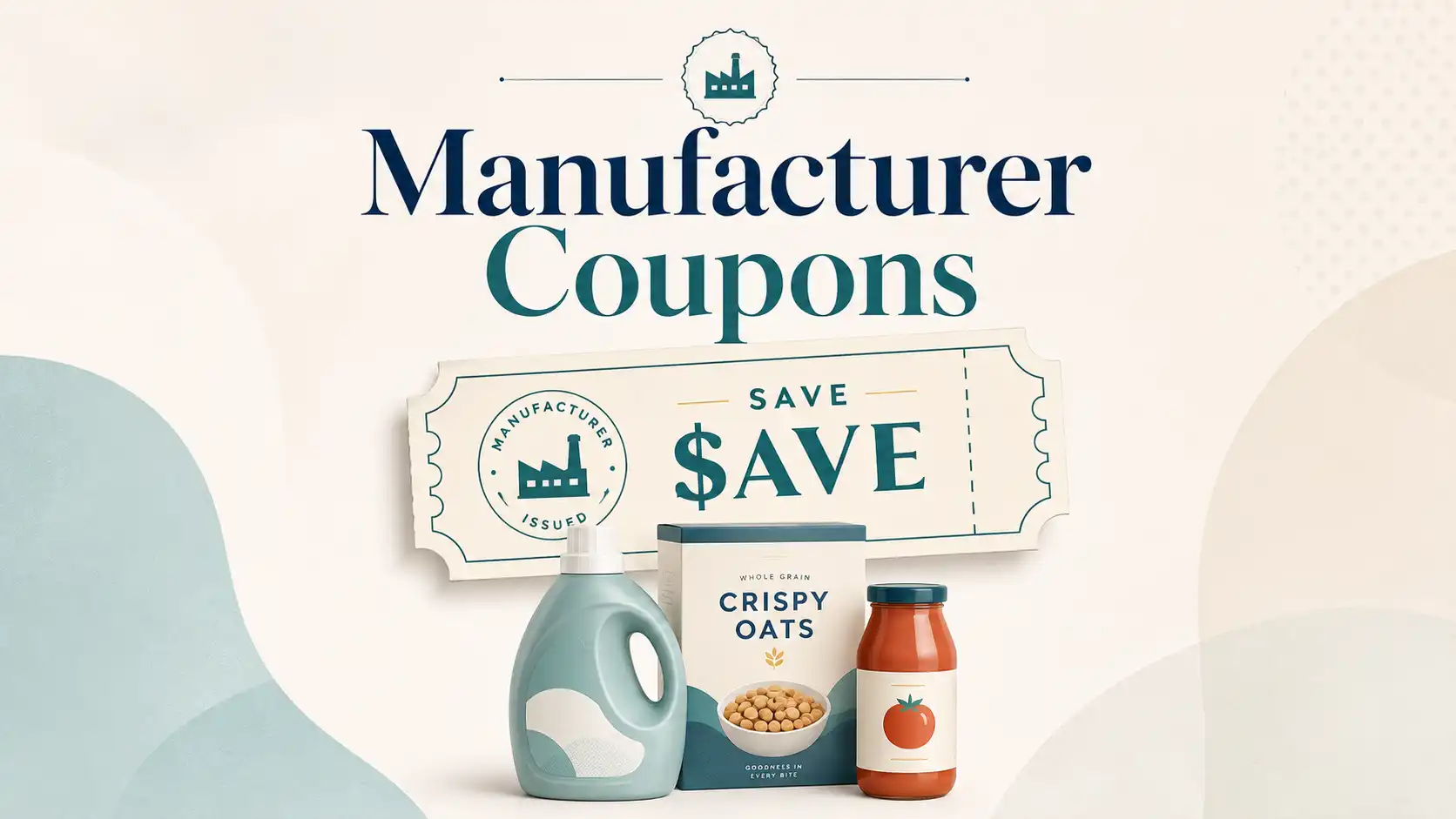
A manufacturer coupon comes from the company that makes the product, not the store selling it, which is exactly why the same coupon works at Walmart, Target, or a local grocery store rather than being locked to one retailer. That single distinction is the whole reason stacking a manufacturer coupon with a store coupon is even possible.
On This Page 15 sections
This guide covers what manufacturer coupons actually are, where to find real, current ones today, and how stacking genuinely works, including a couple of sources that used to be reliable recommendations and no longer are.
Key facts:
- A manufacturer coupon is issued by the brand that makes the product and works at any participating retailer, unlike a store coupon that only works at one specific retailer.
- SmartSource, long recommended as a manufacturer coupon source, discontinued its newspaper insert business entirely in 2025. Coupons.com, another major source, has been owned by the same parent company as SmartSource, Neptune Retail Solutions, since 2023.
- NCH Marketing Services and Inmar Intelligence together process an estimated 85% of manufacturer coupons redeemed across North America, auditing and settling payments between retailers and the brands that issue each coupon.
- A manufacturer coupon and a store coupon are legally and financially distinct, funded by two different parties, which is what actually makes stacking them possible rather than a store simply being generous.
- Digital coupons now account for 53.4% of all US coupon redemptions versus 40.8% for paper, based on the most recent available data.
What Manufacturer Coupons Actually Are
A manufacturer coupon is a discount funded and issued by the company that makes a product, designed to get a specific item into a shopper’s cart regardless of which store they buy it from. If Procter and Gamble issues a coupon for Tide laundry detergent, that coupon works at Walmart, Target, or a local grocery store, since it’s the brand paying for the discount, not any one retailer.
A store coupon works the opposite way. It’s funded by one specific retailer and only redeemable there, which is the entire reason the two can typically be combined together on the same item without either party paying for the other’s discount.
Where to Actually Find Manufacturer Coupons Now
The source landscape has changed enough since the usual advice was written that a couple of long standing recommendations need a real update rather than repeating them unchanged.
| Source | Current status | What to expect |
|---|---|---|
| Brand websites | Reliable | Procter and Gamble, Unilever, and Colgate all still run direct coupon pages for their own product lines |
| Retailer apps | Reliable, increasingly the default | Kroger, Safeway, and similar chains let you clip manufacturer coupons digitally, applied automatically at checkout |
| Coupons.com | Still active, now under different ownership | Acquired by Neptune Retail Solutions in 2023, the same parent company as SmartSource |
| SmartSource newspaper inserts | Discontinued | Neptune Retail Solutions confirmed it ended the newspaper insert business entirely in 2025 |
| Independent coupon aggregators | Mixed | Quality varies significantly, check for a live expiration date before relying on any listing |
Source: Neptune Retail Solutions company statements, 2025; Quotient Technology acquisition reporting, 2023.
Skip the Outdated Lists
Find Current Manufacturer Deals Instead
Browse current store offers on CouponZania rather than checking a source that quietly stopped updating.
Worth correcting directly: RetailMeNot has never actually been a newspaper insert source, despite that pairing showing up in a lot of older coupon guides. RetailMeNot has always operated as an online promo code aggregator, a genuinely different distribution model from a printed Sunday insert, and one that never carried manufacturer coupons in the physical clip and redeem sense at all.
Grocery store loyalty programs deserve a mention on their own, separate from the table above. Chains like Kroger and Safeway increasingly push manufacturer coupons through the loyalty app directly rather than a separate printable page, meaning the coupon clips to an account automatically instead of needing a code entered or a barcode scanned.
Manufacturer Versus Store Coupons: The Real Difference
The distinction is legal and financial, not just descriptive. A manufacturer coupon is a contract between the brand and the shopper, while a store coupon is a contract between the retailer and the shopper, and neither party is obligated to honor the other’s promise.
| Attribute | Manufacturer coupon | Store coupon |
|---|---|---|
| Issued by | The brand that makes the product | The specific retailer |
| Where it works | Any participating retailer | Only the issuing store |
| Who pays for the discount | The manufacturer | The retailer |
| Redemption processing | Cleared through NCH or Inmar | Handled internally by the retailer |
That last row explains why manufacturer coupons carry stricter fraud controls than store coupons often do. NCH Marketing Services and Inmar Intelligence together process an estimated 85% of manufacturer coupons redeemed across North America, auditing every claim before the retailer actually recovers the discount cost from the brand.
A store coupon skips that external audit step entirely, since the retailer is both issuing and honoring its own discount with no separate party to reimburse. That structural difference is part of why manufacturer coupon fraud gets tracked and reported so much more formally than store coupon misuse typically does, with an actual industry body watching for it.
A coupon that fails that audit, expired, duplicated, or altered, doesn’t get quietly waved through. The store that accepted it can end up covering the cost itself, which is the real financial reason store coupon policies exist and get enforced as strictly as they do.
How Stacking Actually Works
Because a manufacturer coupon and a store coupon come from two entirely different parties, a retailer can allow both on a single item without either party covering the other’s discount. Target and Walgreens are both commonly cited as allowing this combination, though a store’s specific policy can change, so it’s worth confirming current terms rather than assuming based on reputation alone.
Here’s the math, illustrated with round numbers rather than a specific claimed real world case. A $6 bottle of shampoo, a $2 manufacturer coupon, and a $1 store coupon combine to bring the price down to $3, cutting the cost in half without either coupon issuer paying a cent toward the other’s discount.

Our full breakdown of how coupon stacking actually works covers the broader mechanics, including combinations beyond just manufacturer plus store coupons, like stacking a coupon with an active store sale.
Manufacturer Coupons Have Gone Mostly Digital Too
The same shift covered in our guides to printable coupons and digital coupons applies directly to manufacturer coupons specifically. Digital redemption overtook paper back in 2020, and as of the most recent available data, digital coupons account for 53.4% of all US redemptions against 40.8% for paper.
Most Manufacturer Coupons Never Actually Get Used
A statistic that surprises a lot of shoppers, most manufacturer coupons issued are never redeemed at all. Paper coupons historically redeem at around 1%, meaning 99 out of every 100 printed or clipped coupons expire unused.
Digital coupons perform meaningfully better, with a typical redemption rate around 7%, still a small fraction of what gets issued but a sizable improvement over paper. That gap is a real part of why brands have shifted so much of their coupon budget toward digital formats, since a sevenfold redemption improvement changes the actual return on a given campaign budget substantially.
Source: aggregated coupon redemption industry benchmarks, most recent available data.
This is also why a retailer earns a small handling fee for every manufacturer coupon it accepts and processes, typically 8 to 10 cents per coupon, compensating the store for the real operational cost of sorting, bundling, and submitting coupons for reimbursement. It’s a small amount per coupon, but it adds up across the volume a large grocery chain processes.
That handling fee is also why some smaller, independent retailers are more hesitant about manufacturer coupons than large chains are. The clearinghouse relationship, audit process, and reimbursement timeline all favor a business with the volume and infrastructure to make the fee genuinely worth the administrative overhead involved.
Face values vary meaningfully by category too. Baby products carry some of the highest average manufacturer coupon face values, around $3.50, reflecting both higher price points in that category and the value of winning a new parent’s brand loyalty early, a household that will keep buying the same category of product for years.
Why Manufacturers Issue Coupons Instead of Just Lowering the Price
A permanent price cut affects every buyer, including the shopper who’d have paid full price anyway. A coupon lets a manufacturer offer a discount specifically to price sensitive shoppers willing to seek one out, while treating the cost as marketing spend rather than a straightforward margin cut, and reversing it is far easier than walking back a permanent shelf price once customers expect it.
Trial incentive works the same way, aimed at getting a first purchase from someone who wouldn’t otherwise try an unfamiliar brand at full price. That’s also why manufacturer coupons on new product launches tend to carry higher face values than coupons on established, already popular items, since a launch has the most ground to make up before earning repeat purchases on its own merits.
The Named Programs Worth Knowing
A handful of major consumer goods companies run their own dedicated coupon hubs rather than relying only on third party distribution, worth knowing by name since they’re a genuinely reliable, direct source.
Procter and Gamble runs P&G Good Everyday, a single hub covering coupons across its full portfolio, Tide, Pampers, Gillette, Olay, and more, rather than making a shopper hunt separately per brand. General Mills runs a comparable program called Tablespoon, covering its own food brand lineup the same way.
These portfolio wide hubs exist because a single company owning dozens of brands has more to gain from one unified coupon destination than from scattering separate coupon pages across each individual brand’s own website. A shopper loyal to one P&G brand is a plausible customer for several others in the same portfolio.
Signing up for a rewards account on one of these hubs also tends to unlock offers a shopper wouldn’t find by simply browsing a single brand’s coupon page, since the hub can personalize suggestions across the full portfolio rather than treating each brand as an isolated silo, matching offers to categories a household actually buys regularly.
The Legal Rules That Actually Apply
A claim that circulates widely holds that coupons must legally stay valid for some minimum period, similar to a gift card. That’s false for manufacturer coupons specifically, and worth correcting directly.
The federal CARD Act requires gift certificates to remain valid at least 5 years, a protection that’s legally specific to stored value gift cards, not ordinary discount coupons. A manufacturer can set a coupon’s expiration at two weeks or any window it chooses, entirely within the law.
On the enforcement side, the FTC’s Section 5 authority over deceptive practices carries real teeth for coupon fraud specifically, up to $53,088 per violation as of 2026, adjusted for inflation. Our detailed guide to coupon compliance and the real legal rules covers this alongside several other legal claims about coupons that circulate without a real source behind them.
Using a Manufacturer Coupon Step by Step
Find a real, current coupon
A brand’s own site, a portfolio hub like P&G Good Everyday, or a coupon aggregator, checked for a live expiration date.
Read the fine print before shopping
Minimum purchase requirements and per transaction limits are common enough on manufacturer coupons to plan around in advance.
Check the store’s stacking policy
Confirm the retailer actually allows combining a manufacturer coupon with a store coupon before counting on the combined discount.
Present or apply it at checkout
Hand over a paper coupon before scanning begins, or confirm a digital one is clipped to your account ahead of time.
Confirm the discount landed
Check the receipt or total before leaving, since a coupon that failed silently is easier to catch immediately than after the fact.
Mistakes That Actually Cost Real Savings
Not reading the fine print. A minimum purchase requirement or a per transaction limit is common on manufacturer coupons specifically, and missing it is the single most common reason a coupon gets rejected at checkout.
Letting coupons expire before shopping. Manufacturer coupons typically carry shorter windows than store coupons, so planning a shopping trip around an expiration date matters more here than with most other coupon types.
Assuming a store’s stacking policy instead of checking it. Not every retailer allows a manufacturer and store coupon on the same item, and a policy that applied last year at a specific store isn’t guaranteed to still apply unchanged, particularly as stores have tightened stacking rules in general to protect margins.
Manufacturer coupons specifically attract a particular counterfeit pattern, images edited to show an inflated face value far above what the brand actually offers. A $1 off coupon reposted as $10 off circulates precisely because it’s easy to screenshot and reshare well beyond the audience the manufacturer actually intended.
Our full guide to preventing coupon fraud covers this pattern in more depth, along with the real math behind why randomized digital codes make brute force guessing computationally pointless for the manufacturers issuing them.
Before You Go
Find Verified Deals, Not Outdated Advice
Check current store deals on CouponZania before your next shopping trip, verified and updated, not left running on autopilot.
Browse Store DealsThis Isn’t Just a US Distribution Model
Brand funded coupons operate as a distinct category from store discounts in most major markets, not something unique to how US retail happens to be structured. In the UK, 81% of consumers use coupons or vouchers, heavily channeled through loyalty programs like Tesco Clubcard and Nectar rather than a manufacturer specific insert.
More than 66% of European consumers overall now use digital coupons regularly, with the UK, France, and Germany leading adoption. The underlying legal distinction between a brand funded discount and a retailer funded one holds across these markets, even where the specific distribution channels look meaningfully different from what’s common in the US.
Who Actually Uses Manufacturer Coupons
Coupon usage isn’t concentrated among lower income shoppers, a common assumption that doesn’t hold up under real data. Shoppers earning $200,000 or more annually use coupons at rates statistically close to shoppers earning $20,000 to $39,000, meaning manufacturer coupon usage spans income brackets rather than being a purely budget driven behavior.
Age matters more for format than for whether someone coupons at all. Shoppers 55 and older remain the group most likely to still use paper manufacturer coupons specifically, while younger shoppers coupon just as often but overwhelmingly favor digital formats instead, a real generational split worth keeping in mind.
What This Actually Adds Up To
The core mechanic behind manufacturer coupons hasn’t changed, a brand funds a discount to win a specific purchase, redeemable anywhere that accepts it. What’s genuinely changed is the source landscape underneath that mechanic, several long trusted names have consolidated, gone digital only, or discontinued entirely.
Checking whether a source is actually current, rather than repeating a recommendation from a decade of accumulated advice, is now a genuinely useful skill on its own. The redemption rate data above explains why that vigilance pays off, most issued coupons never get used, so the ones a shopper actually finds and applies are disproportionately valuable relative to how many exist.
That gap between what’s issued and what’s actually redeemed is also the clearest reason manufacturer coupons remain worth the small effort of hunting one down, rather than treating the discount as too marginal to bother with, particularly on categories a household already buys regularly.
Frequently Asked Questions
What’s the difference between a manufacturer coupon and a store coupon?
A manufacturer coupon is issued and funded by the brand that makes the product, so it works at any participating retailer. A store coupon is funded by one specific retailer and only works there, which is exactly why the two can usually be combined on the same item without either party paying for the other’s discount.
Is SmartSource still a good source for manufacturer coupons?
No, not for newspaper inserts specifically. Neptune Retail Solutions confirmed in 2025 that it discontinued the SmartSource newspaper insert business entirely, shifting toward digital incentives instead.
Can you stack a manufacturer coupon and a store coupon?
Yes, at retailers that allow it, since the two coupons are funded by different parties and don’t compete against the same discount budget. Target and Walgreens are commonly cited as allowing this combination, though it’s worth confirming a specific store’s current policy rather than assuming.
Who actually processes manufacturer coupon redemptions?
NCH Marketing Services and Inmar Intelligence together process an estimated 85% of all manufacturer coupons redeemed across North America. They audit each claim and settle payment between the retailer that accepted the coupon and the brand that issued it.
Why do manufacturers offer coupons instead of just lowering prices?
A coupon lets a brand discount specifically for price sensitive shoppers willing to seek one out, while a permanent price cut benefits every buyer including those who’d have paid full price anyway. Manufacturers treat coupon costs as marketing spend, particularly for driving trial of a new product.
How can I tell if a manufacturer coupon is fake?
A legitimate manufacturer coupon is always free, so one sold on a secondhand marketplace is an immediate red flag. Also verify the discount matches what the brand actually advertises elsewhere, and be cautious of coupons circulated through unfamiliar sites with no clear ownership.