Ethnic Wear Statistics: Market Intelligence, Consumer Analytics & Category Insights
-
 Written by
Rajat Singh
Written by
Rajat Singh
- Published
- Updated
- Read time 15 min read
Manyavar’s parent company posted a full year profit of ₹375.54 crore for FY26, and its quarterly revenue has now fallen for three straight quarters. That combination, a genuinely healthy company navigating a real slowdown, says more about where India’s ethnic wear money is actually moving than any single market size figure could.
On This Page 15 sections
This article covers what’s actually verifiable about India’s ethnic wear market: real brand financials, real festive spending data, the government programs actually funding this industry, and where credible research firms genuinely disagree on market size, rather than a single confident number with no source behind it.
Every figure below is sourced and checked as of August 2026.
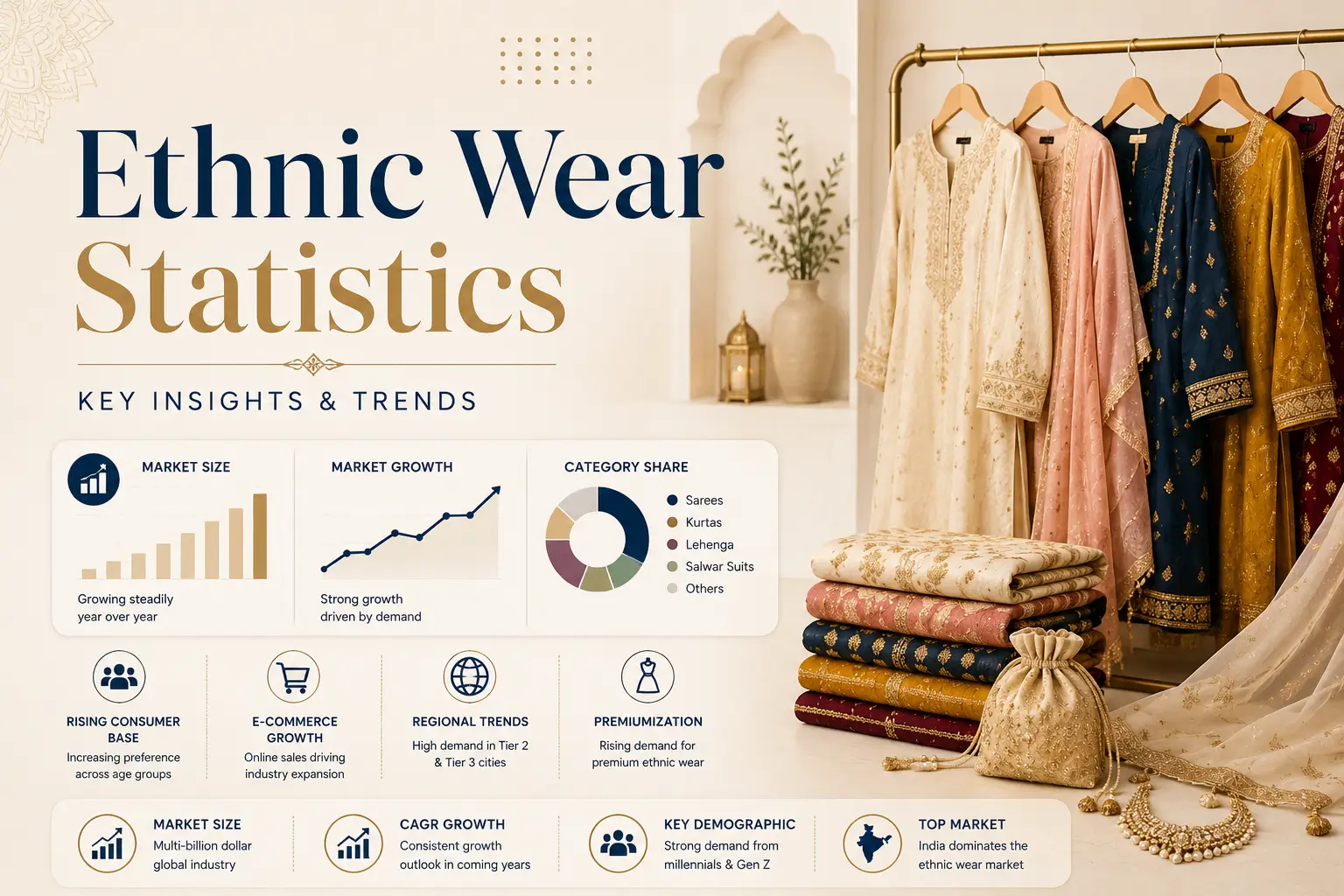
- Market size is genuinely disputed: Grand View Research values India’s ethnic wear market at $19.09 billion (2023), while Apparel Resources cites $22 billion for FY24, growing toward $26.9 billion by FY26, different firms, different scope.
- Sarees have their own dedicated market: IMARC Group values it at $6.15 billion for 2025, projected to reach $10.77 billion by 2034.
- Ethnic wear is menswear’s fastest growing segment, at 14.0% annually, inside a broader Indian menswear market IMARC values at $21.91 billion for 2025.
- Manyavar’s parent, Vedant Fashions, posted ₹1,435.48 crore in FY26 revenue and ₹375.54 crore net profit, even as quarterly revenue fell three quarters running, from ₹492 crore to ₹301 crore.
- Diwali 2025 trade hit a record ₹6.05 lakh crore, up 25% year over year, per CAIT, though apparel isn’t broken out as its own category in that data.
- India’s most recognizable sarees carry real GI tag registrations, Banarasi since 2009, Kanjeevaram since 2005 to 2006, each a legally protected geographic indication, not just a marketing term.
- Government backed textile investment is real and dated, PM MITRA has drawn ₹63,177 crore in investment interest across its 7 finalized park sites, and the PLI scheme for textiles has approved 170 companies nationally.
Apparel Resources, IMARC Group, Vedant Fashions, CAIT. Checked August 2026.
How Big Is India’s Ethnic Wear Market, Actually
Ask different research firms and you’ll get different answers, because they scope the category differently. Some count only women’s ethnic wear, others include menswear, kidswear, and accessories.
| Source | Valuation | Forecast |
|---|---|---|
| Grand View Research | $19.09B (2023) | $30.45B by 2030, 6.9% CAGR |
| Apparel Resources | $22B (FY24) | $26.9B by FY26, ~10.6% CAGR |
Each source’s own currently published figure, checked August 2026. Apparel Resources places ethnic wear as the largest single segment of India’s broader $102 billion garment industry.
Neither figure is wrong, they’re measuring slightly different things. What both agree on is direction: ethnic wear is growing faster than India’s overall apparel market, and it remains the largest single segment within it.
A separate, aggregator sourced estimate puts the organized ethnic wear segment specifically, branded stores and recognized D2C players rather than unbranded local tailoring, at only 15 to 20% of the overall market, roughly ₹28,000 to 37,000 crore, growing about 20% a year. That’s a real structural detail worth knowing, most of the category’s total value still sits outside any brand covered in this article.
Sarees Are the One Category With Real Dedicated Data
Most ethnic wear sub categories, lehengas, kurtas, don’t have a standalone market size report from a named research firm. Sarees are the exception. IMARC Group publishes a dedicated India saree market report, valuing it at $6.15 billion for 2025, projected to reach $10.77 billion by 2034 at a 6.43% compound annual growth rate.
IMARC ties that growth to rising female labor force participation, up to 41.7% in FY24 per government data cited in the report, alongside government backed GI tag and Handloom Mark initiatives and growing online commerce penetration for a category that traditionally relied on in person buying.
Menswear’s Fastest Growing Piece Is Ethnic Wear
India’s menswear market overall is valued at $21.91 billion for 2025 by IMARC Group, rising to $23.50 billion in 2026 and projected to reach $42.44 billion by 2034, a 7.24% compound annual growth rate. Inside that broader menswear figure, one segment is growing far faster than the category average.
IMARC identifies ethnic wear specifically, branded kurtas, sherwanis, and festive occasion wear, as menswear’s fastest growing segment at 14.0% annually, roughly double the overall menswear growth rate. That’s real, direct confirmation that men’s festive and traditional clothing is outpacing everyday menswear in India, not just anecdotal brand growth.
That growth shows up directly in brand strategy. Manyavar built its entire retail footprint around exactly this category, sherwanis and kurtas for weddings and festivals, and its parent company’s scale, 600 plus stores across the Manyavar and Mohey brands, only makes sense against a segment growing at 14% a year rather than the menswear market’s overall 7.24%.
What the Brands Themselves Actually Disclose
Real financial figures beat market estimates for understanding how individual brands are actually performing. Here’s what’s genuinely disclosed, not projected.
| Brand | Latest Disclosed Revenue | Funding or Ownership |
|---|---|---|
| Manyavar | ₹1,435.48 crore, FY26 | Publicly listed, Vedant Fashions Ltd |
| Biba | ₹798 crore, FY25, +4% | Warburg Pincus and Faering Capital backed since 2013 |
| FabIndia | ₹1,310 crore, FY25 | IPO filed, ₹500 crore fresh issue |
| Libas | ₹500 crore, FY24 | ₹150 crore raised from ICICI Venture, May 2024 |
| Koskii | ₹150 crore, FY25 | $7.44 million raised, including Baring Private Equity |
| Rangriti | Not separately disclosed | Unfunded, operates under the Biba group |
Each company’s own recent disclosures or credible financial press coverage, checked August 2026. FabIndia and Biba figures come via aggregator sources rather than a primary filing, treat as moderate confidence.
Koskii is guiding toward ₹200 to 240 crore for FY26, a 33 to 60% jump from FY25, alongside real store expansion, its 25th store opened in Kochi in January 2025 and its 29th in Gurgaon by December 2025. Libas is targeting 200 to 250 stores over 2.5 years, up from just 18 exclusive brand outlets at the time of its funding round. Manyavar’s parent now runs over 600 stores nationally across its menswear Manyavar brand and womenswear Mohey brand combined, by far the largest physical footprint of any company in this table.
FabIndia’s filing carries a detail most IPOs don’t: alongside its ₹500 crore fresh issue and an offer for sale of over 2.5 crore shares, promoters are gifting more than 7 lakh shares directly to artisans and farmers in its supply chain, a structure the company has positioned as India’s first ESG focused IPO. No listing date or price band had been announced as of this check.
Manyavar’s Parent Is Profitable and Slowing Down at the Same Time
Vedant Fashions closed FY26 with ₹1,435.48 crore in revenue, up from ₹1,386.48 crore the year before, and ₹375.54 crore in net profit, slightly down from ₹388.47 crore in FY25. The board recommended a final dividend of ₹7.75 per share. That’s a company that’s still solidly profitable, not one in trouble.
What’s genuinely notable is the quarterly trend underneath that annual number. Standalone quarterly revenue has fallen for three consecutive quarters through mid 2026.
Vedant Fashions standalone sales, via screener.in and company filings. Checked August 2026.
The Wedding Market Number Depends Entirely on What You Count
Weddings drive a large share of India’s ethnic wear demand, particularly for lehengas and sherwanis, but the actual dollar figure for “the Indian wedding market” varies wildly by source, and not by a small margin.
Grand View Research values India’s wedding services market at $103.93 billion for 2024, projected to reach $228.69 billion by 2030. IMARC Group, covering what sounds like the same category, values it at just $32.98 billion for 2025, roughly a third of GVR’s figure. That’s not a typo on either side, it reflects genuinely different scope definitions of what counts as a wedding service.
Diwali 2025 Set a Real Spending Record
The Confederation of All India Traders reported total Diwali 2025 trade at ₹6.05 lakh crore, up 25% from 2024’s ₹4.25 lakh crore, the highest festive trade figure CAIT has recorded. 87% of surveyed consumers said they chose Indian made products over imported goods.
Apparel isn’t broken out as its own line in CAIT’s public data. Garments and gifts are reported together as a combined 7% of total trade, so there’s no clean, isolated figure for ethnic wear specifically within that record breaking Diwali number, and we’re not going to invent one just because it would be a tidier statistic.
Readers checking Diwali deals or Raksha Bandhan offers on CouponZania will find festive pricing tracked live rather than projected from last year’s pattern, alongside the full ethnic wear category for year round browsing.
The Sarees With Legal Protection, Not Just a Regional Name
Several of India’s best known sarees aren’t just regionally associated names, they carry an actual Geographical Indication registration, a legal status that restricts who can legitimately use the name commercially, similar in principle to Champagne or Darjeeling tea.
| Saree | Region | GI Registered |
|---|---|---|
| Banarasi Brocade and Sarees | Varanasi, Uttar Pradesh | 2009 |
| Kanjeevaram Silk | Kanchipuram, Tamil Nadu | 2005 to 06 |
| Mysore Silk | Mysuru, Karnataka | 2005 |
| Chanderi Saree | Chanderi, Madhya Pradesh | 2005 |
| Pochampally Ikat | Pochampally, Telangana | 2005 |
India’s GI Registry, via district government records and legal trade publications. Checked August 2026. Chanderi’s 2005 registration made it India’s 4th GI tagged product overall, across any category.
Other regionally significant weaves carry real GI registrations too, Paithani in Maharashtra, Gadwal and Uppada Jamdani in Andhra Pradesh and Telangana, Sambalpuri Ikat and Bomkai in Odisha, Ilkal and Molakalmuru in Karnataka, Baluchari and Santipore in West Bengal, Patola in Gujarat, and Balaramapuram in Kerala among them, though we couldn’t pin down each exact registration date in this check.
Varanasi’s own weaving economy is genuinely large, though the exact headcount is where sources disagree badly enough that we’re leaving it out. One figure puts local weavers at roughly 1,24,832, another claims close to 30 lakh, a number that would be mathematically impossible given the national handloom census total below. What multiple sources do roughly agree on: the Banarasi sari trade is valued at ₹5,000 to 6,000 crore annually and supports over 5 lakh livelihoods in and around the city.
Who Actually Weaves This: The Handloom Workforce
Behind the brand names is a real, government counted workforce. India’s 4th All India Handloom Census, published in 2019, counted 26,73,891 handloom weavers plus 8,48,621 allied workers, roughly 35.22 lakh people total, 72.29% of them women.
That census is now over six years old, and no newer one has been published as of this check, so treat it as the most recent available figure rather than a current headcount. Handloom specific exports totaled roughly ₹1,359 crore, about $142.23 million, between April 2025 and February 2026, a small 0.42% slice of India’s total textile and apparel export earnings. The Textiles Ministry has stated a target of $10 billion in handloom exports by 2031.
Surat: The Hub Behind the Brand Names
Most ethnic wear sold under a recognizable brand name passes through manufacturing hubs most shoppers never think about. Surat is the largest of these for sarees specifically. Its saree industry alone employs an estimated 500,000 people directly and indirectly, with an annual turnover above ₹50,000 crore.
Surat’s broader textile economy employs roughly 1.5 million people directly and another 1 million indirectly, weaving an estimated 30 million meters of fabric a day. The city processes around 75% of India’s polyester yarn and supplies close to 90% of the country’s synthetic cloth, with over 60,000 textile units concentrated in its Udhna, Pandesara, and Sachin industrial corridors.
The Government Programs Actually Funding This Industry
Two real, currently active government schemes are shaping India’s textile and ethnic wear manufacturing base. PM MITRA has finalized 7 mega textile park sites, Virudhunagar, Warangal, Navsari, Kalaburagi, Dhar, Lucknow, and Amravati, with a ₹4,445 crore outlay planned through 2027 to 2028, targeting ₹70,000 crore in eventual investment and close to 20 lakh direct and indirect jobs. Total investment interest across the parks has reached ₹63,177 crore as of this check.
Separately, the Production Linked Incentive scheme for textiles has approved 170 companies nationally across 225 notified products, mostly man made fiber apparel, fabrics, and technical textiles. The scheme was reopened in October 2025 with lowered eligibility thresholds, a 50% cut to the minimum investment requirement, and the application window extended to March 31, 2026.
How Ethnic Wear Actually Performs Online
Myntra‘s premium ethnic wear vertical, Runway Icons, has grown over 100% year over year, onboarding more than 50 brands into the segment, with 60% of premium ethnic wear sales coming from metro and Tier 1 cities specifically, per the company’s own reporting.
AJIO doesn’t disclose GMV or revenue at all, Reliance doesn’t break it out in financial reporting. What AJIO has stated directly is a 35% year over year expansion of its product catalog to 2.7 million options.
The broader festive online commerce picture was strong across categories, not just fashion. Redseer projected festive season online commerce GMV crossing ₹1,15,000 crore, roughly $13.1 billion, in 2025, growth of 20 to 25%, the best festive period for Indian online commerce in five years.
Meesho, a major value fashion platform though not one CouponZania currently carries, filed an updated IPO prospectus with SEBI for a fresh issue of up to ₹4,250 crore, targeting a total raise of $700 to 800 million at an estimated $5.5 to 6.5 billion valuation. Its Q1 FY26 order volume grew 50% year over year to 562 million orders, a real signal of how large the value end of Indian fashion online commerce has become, even without an ethnic wear specific breakout.
The Bigger Textile Industry Behind the Category
Ethnic wear sits inside a much larger Indian textile and apparel industry. The India Brand Equity Foundation puts India’s domestic textile and apparel market at $225 billion for 2025, growing 10 to 12% annually, with a projected path to $350 billion by 2030.
The industry contributes roughly 2% of India’s GDP and 11% of manufacturing gross value added, employing more than 45 million people. Ready made garments alone accounted for $15.77 billion in exports for FY26, 44% of India’s total textile and apparel exports, the single largest export category within the sector. No official trade category isolates ethnic wear exports specifically from that broader ready made garment figure.
Recent Funding in the Space
Beyond the brands already covered, several other ethnic wear and occasion wear companies raised real, dated funding rounds in the past year.
- Kalki Fashion, a bridal and occasion wear D2C brand, raised ₹225 crore from Lighthouse Funds in August 2025 for Indian and global retail expansion
- Kisah Apparels raised ₹13 crore in a round ahead of its Series A in June 2025, led by Wow! Momo founder Sagar Daryani alongside Inflection Point Ventures, on the back of revenue growing from ₹23 crore to roughly ₹50 crore year over year
- Alaya By Stage3, a modern Indian wear brand, raised a funding round targeting ₹50 crore in annual recurring revenue
Frequently Asked Questions
How big is India’s ethnic wear market?
Estimates genuinely differ by source. Grand View Research values it at $19.09 billion for 2023, while Apparel Resources cites $22 billion for FY24 growing to $26.9 billion by FY26. Both agree ethnic wear is the largest single segment of India’s broader garment industry.
How big is the saree market specifically?
IMARC Group values India’s saree market at $6.15 billion for 2025, projected to reach $10.77 billion by 2034. It’s one of the only ethnic wear sub categories with a dedicated, named market research report.
Is men’s ethnic wear growing faster than menswear overall?
Yes. IMARC Group identifies ethnic wear, including branded kurtas, sherwanis, and festive occasion wear, as the fastest growing segment within India’s $21.91 billion menswear market, expanding at 14.0% annually, roughly double the overall menswear growth rate.
Is Manyavar’s parent company doing well financially?
Yes overall, FY26 revenue reached ₹1,435.48 crore with ₹375.54 crore net profit. But quarterly revenue has fallen for three straight quarters through mid 2026, which the company attributes to fewer December and January wedding dates and softer middle class spending.
How much was spent during Diwali 2025 in India?
CAIT reported total Diwali 2025 trade at ₹6.05 lakh crore, up 25% year over year and a record high. Clothing isn’t broken out as a separate category in that data, it’s combined with gifts under a single 7% share.
How big is the Indian wedding market?
It depends heavily on scope. Grand View Research values India’s wedding services market at $103.93 billion for 2024, while IMARC Group values essentially the same category at $32.98 billion for 2025, roughly a third of that figure, reflecting different definitions of what counts as a wedding service.
Which sarees have official GI tag protection?
Banarasi brocade and sarees have carried GI registration since 2009, and Kanjeevaram silk since 2005 to 2006. Mysore silk, Chanderi, and Pochampally Ikat have all held GI status since 2005, a legal protection on the name, not just a regional association.
How many people work in India’s handloom sector?
India’s 4th All India Handloom Census, published in 2019, counted roughly 35.22 lakh people, 26,73,891 weavers plus 8,48,621 allied workers, 72.29% of them women. No newer census has been published as of this check.
Which ethnic wear brands have raised outside funding recently?
Libas raised ₹150 crore from ICICI Venture in May 2024, Koskii has raised $7.44 million across rounds including from Baring Private Equity, and Kalki Fashion raised ₹225 crore from Lighthouse Funds in August 2025. Rangriti, by contrast, remains unfunded and operates under the Biba group.
Is the Indian government funding textile and ethnic wear manufacturing?
Yes, through two active schemes. PM MITRA has finalized 7 mega textile park sites and drawn ₹63,177 crore in investment interest so far, while the Production Linked Incentive scheme for textiles has approved 170 companies across 225 products and was reopened in October 2025 with lower eligibility thresholds.
Where does most of India’s saree manufacturing actually happen?
Surat, Gujarat is India’s largest saree manufacturing hub, employing an estimated 500,000 people in that industry alone, with an annual turnover above ₹50,000 crore. The city’s broader textile economy processes about 75% of India’s polyester yarn and supplies close to 90% of its synthetic cloth.