mCaffeine Sales: The Real Pattern, Not a Fake Calendar
-
 Written by
Rajat Singh
Written by
Rajat Singh
- Published
- Updated
- Read time 16 min read
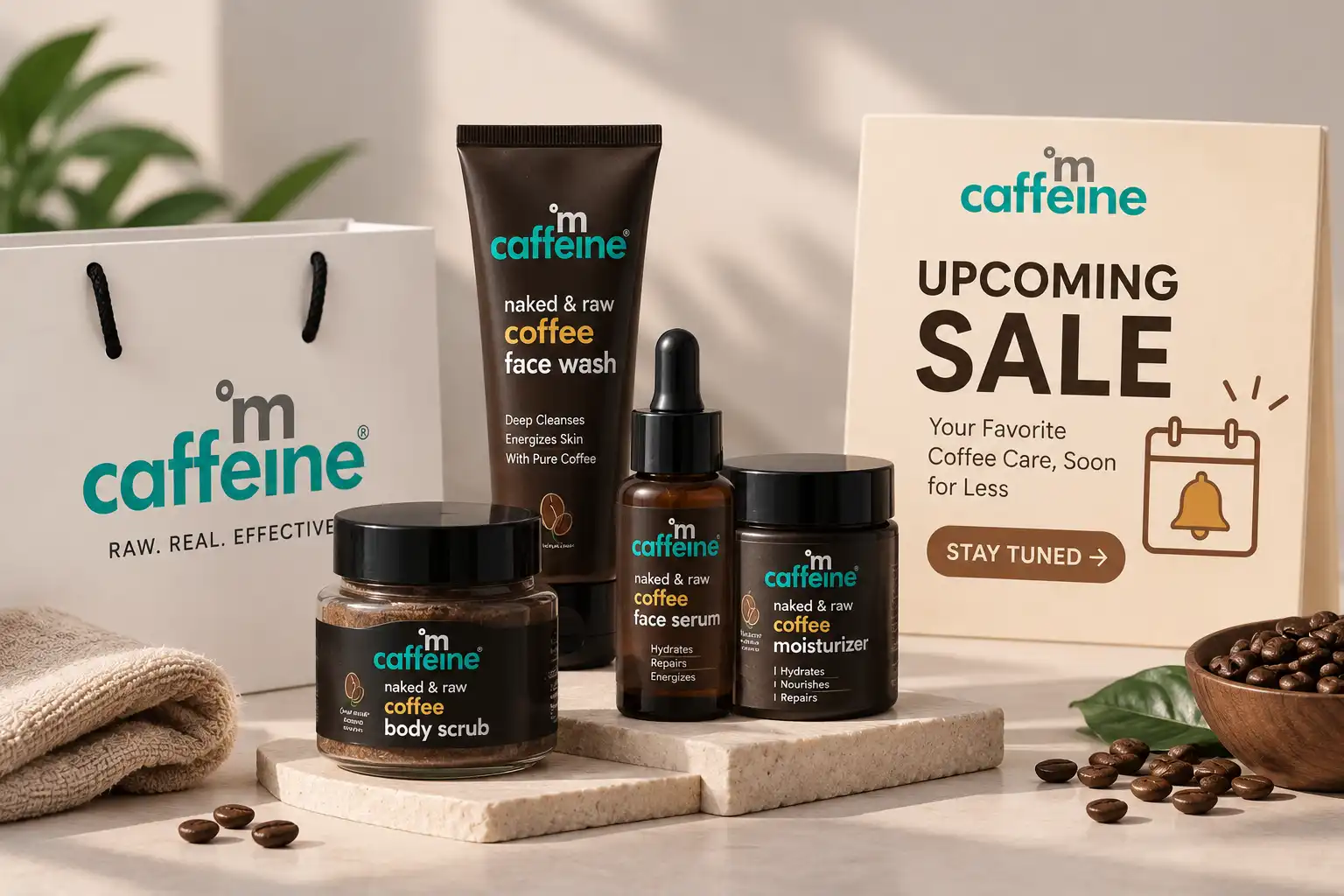
mCaffeine built its entire identity around one ingredient, caffeine, across skincare, hair care, and body care. That focus, combined with genuinely frequent sale activity, makes it one of the more consistently discounted D2C beauty brands in India.
On This Page 9 sections
This guide covers what’s actually real about the brand, when its sales genuinely tend to cluster around the year, and where to check for currently live offers rather than a fixed calendar that goes stale the moment it’s published.
- mCaffeine was founded in 2016 by a team of five founders under Pep Technologies, and has grown into a genuinely large caffeine focused personal care catalog of 95+ products.
- The brand raised roughly $31.5 million in a Series C round at a valuation near ₹1,000 crore, and FY23 revenue reached ₹210.1 crore, up 51.8% year over year.
- Sale activity clusters predictably around real Indian retail calendar events: Republic Day, Holi, Independence Day, the festive season around Diwali, and Black Friday, in that same rough order across a typical year.
- A fixed day by day sale calendar with specific codes goes stale within weeks. The live mCaffeine store page reflects what’s actually running right now.
- Buy 2 Get 3 and BOGO style structures are mCaffeine’s most consistently repeated promotional format, more common than flat percentage discounts.
The Real Company Behind the Brand
mCaffeine was founded in 2016 by Tarun Sharma, Vikas Lachhwani, Vaishali Gupta, Mohit Jain, and Saurabh Singhal, operating under the parent company Pep Technologies. It markets itself as India’s first caffeine focused personal care brand, and the product range genuinely reflects that positioning throughout.
The brand has already expanded into Nepal and the Maldives, with plans for roughly 20 additional country launches including the Gulf market. That growth trajectory matters for shoppers mainly as context, a brand actively expanding tends to run more frequent promotional activity to build volume in new and existing markets alike, not less.
The FY23 revenue jump of 51.8% is a genuinely strong growth rate for a personal care D2C brand at that particular stage of its life, and it lines up well with the broader funding history described above. Raising a Series C round specifically, rather than staying on earlier seed or Series A funding, signals investors were confident enough in the unit economics to back a larger, later stage bet, not just early stage potential.
Certifications matter for a brand built this heavily around ingredient claims, and mCaffeine states its products are formulated without SLS or parabens, are Made Safe certified, PETA certified as cruelty free, and produced with a stated zero plastic footprint commitment. Made Safe certification specifically requires third party review against a banned ingredient list, which is a meaningfully higher bar than a brand simply stating “clean” or “natural” on its own packaging without any external verification behind the claim.
These specific certifications are worth checking independently rather than taking a brand’s own summary of them at face value, a habit worth applying to any personal care purchase, not just this one. A quick search of the certifying body’s own registry confirms whether a specific product line genuinely holds the certification being claimed, and takes less time than reading a single product review.
Does the Caffeine Actually Do Anything?
Since the entire brand is built around one active ingredient, it’s worth asking whether the science actually backs it up, separate from the marketing.
Topically applied caffeine is a phosphodiesterase inhibitor, which raises cyclic AMP levels and constricts superficial blood vessels. That mechanism genuinely reduces the redness and bluish tint behind vascular dark circles, and a 2005 study by Hexsel and colleagues confirmed that caffeine at 3 to 5% concentration measurably reduces under eye puffiness. A separate 2015 trial using caffeine pads showed visible improvement in both puffiness and dark circles after four weeks of use.
The honest caveat: dark circles have several distinct underlying causes, and caffeine specifically addresses the vascular, bluish purple type. It does comparatively little for dark circles caused by pigmentation, hollowness, or bone structure and shadowing, categories caffeine was never going to fix regardless of concentration. The strongest, most reproducible clinical evidence for topical caffeine actually sits outside skincare entirely, in cellulite reduction and reduced hair shedding, both shown in randomized trials with objective measurement over 8 to 24 weeks of consistent use.
None of this makes caffeine a weaker ingredient choice than the marketing suggests, it simply means the marketing tends to blur together several distinct, separately studied benefits into one blanket claim. A shopper who understands which specific benefit applies to their actual concern, puffiness versus pigmentation versus hair thinning, is in a genuinely better position to judge whether a specific mCaffeine product is likely to work for them than one relying on the word “caffeine” alone as a signal of effectiveness.
The timeline for actually seeing results also varies a lot by what you’re using it for, and setting the right expectation upfront avoids the common trap of giving up on a product after a week because a slower acting benefit hasn’t shown up yet.
Puffiness reduction is the fastest visible benefit, showing up within weeks in clinical trials, which is likely why it’s the most heavily marketed claim across the eye care category generally. Hair shedding and cellulite reduction both require months of consistent use before the studied results actually appear, closer to a genuine treatment routine than a quick fix.
That gap in timeline is worth keeping in mind specifically when a sale creates pressure to buy a larger bundle than usual. A three month supply of a hair or body product aimed at a slow, cumulative benefit is a genuinely reasonable purchase timed around a sale. The same logic doesn’t automatically apply to a fast acting eye product, where a single unit used consistently already delivers most of the studied benefit, and a bulk purchase mostly just ties up money in product that will sit unused.
The Market mCaffeine Is Competing In
India’s beauty and personal care market is large and growing quickly, which is the real backdrop behind how aggressively D2C brands like mCaffeine compete on promotions to acquire and retain customers.
Market size estimates for 2025 and 2026 range from roughly $26 billion to $34 billion depending on the research firm and exact category definitions used, with most projections agreeing on a compound annual growth rate somewhere between 5% and 11% through the early 2030s. That growth is being driven by rising disposable income, deeper ecommerce penetration outside major metro areas, and a real shift in how younger Indian consumers discover and research products through social media before buying.
A crowded, fast growing category like this one is exactly the environment where frequent promotional activity becomes a competitive necessity rather than an occasional event, which is part of why mCaffeine’s sale cadence stays consistently active rather than clustering around just one or two annual moments.
mCaffeine competes directly against a cluster of other well funded Indian D2C personal care brands built around a single distinctive ingredient or positioning, the same playbook applied to different actives. That competitive density is exactly why promotional cadence across the category as a whole has stayed high rather than settling down as brands mature.
This matters practically for timing a purchase. When several well capitalized competitors are all fighting for the same customer’s attention in the same category, the natural result is more frequent promotional activity industry wide, not less, since no single brand can afford to let a competitor’s sale window pass unanswered without losing share in the moment. A shopper genuinely benefits from that competitive pressure, even if it makes predicting an exact sale date harder than it would be in a less contested category.
When mCaffeine Sales Actually Happen
Rather than publish a specific day by day calendar with exact codes, which is guaranteed to be wrong within a few weeks of publishing, here’s the honest pattern: mCaffeine’s promotional activity clusters around the same real retail calendar events every Indian D2C brand leans into.
- Republic Day (late January): New year momentum plus a genuine national sale moment across Indian ecommerce.
- Holi (March): A natural tie in for a brand built around bright, playful packaging and gifting.
- Summer (April to June): Sunscreen, body wash, and cooling product categories see the heaviest promotional push.
- Independence Day (mid August): A second major national sale moment across Indian retail broadly.
- Festive season (September through Diwali): The single heaviest promotional period of the year for nearly every Indian D2C brand, mCaffeine included.
- Black Friday and year end (late November through December): Clearance style activity ahead of the calendar year closing out.
None of these windows are unique to mCaffeine specifically, they’re the same real calendar every major Indian ecommerce and D2C brand builds its promotional strategy around, because they align with genuine shifts in consumer spending intent, not arbitrary marketing invention. A gifting occasion like Diwali or Holi creates real demand for bundled, gift ready products specifically, which is exactly the format mCaffeine leans into hardest during those windows.
The festive season deserves particular emphasis. Industry wide ecommerce data consistently shows the September through November window accounting for a disproportionate share of annual D2C revenue across nearly every consumer category in India, beauty and personal care included, which is precisely why the deepest and most frequent promotional activity concentrates there rather than spreading evenly across the calendar year.
What Actually Goes On Sale Most Often
Across mCaffeine’s catalog, a handful of categories show up in promotional activity more consistently than others, based on the brand’s own bestseller positioning and repeat promotional structure.
- Body care and scrubs. The coffee body scrub and body wash lines are consistently featured in bundle and BOGO style offers, and are typically the brand’s highest volume category by unit sales.
- Face care. Face masks and serums, particularly the green tea and coffee lines, appear frequently in multi buy structures, especially around the festive season when gifting demand peaks.
- Lip care. Lip balms are a common low price entry point into combo and gift set offers, often used as an add on item to push a cart above a free shipping or bundle discount threshold.
- Hair care. The coffee infused shampoo and conditioner range has expanded steadily and shows up in newer bundle promotions, reflecting the brand’s broader push beyond its original body and face care roots.
Eye care products, built specifically around the caffeine backed puffiness benefit covered above, occupy a smaller but genuinely differentiated niche in the catalog. These tend to be priced at a premium relative to body care items and are less frequently discounted as deeply, since the category faces less direct price competition than a body scrub or body wash does.
Sunscreen deserves a specific mention too, since it sits at the intersection of two of the strongest promotional windows on the calendar above. Summer heat drives genuine seasonal demand, and India’s beauty market broadly has seen rising sunscreen adoption over the past several years as awareness of daily SPF use has spread beyond a small dedicated skincare audience. A brand actively competing for share of that growing category has real reason to discount aggressively during the exact months demand is naturally highest.
How to Actually Shop an mCaffeine Sale
- Check the live mCaffeine store page for currently active offers rather than relying on a fixed calendar.
- Compare a Buy 2 Get 3 or BOGO structure’s real per unit price against a flat percentage discount elsewhere. The multi buy format isn’t automatically better, it depends on whether you’d genuinely use three of the item.
- Combo and gift sets tend to offer better real per product value than buying the same items individually, since they’re priced as a bundle from the start.
- Watch for bank card offers stacked on top of the brand’s own promotion during major sale windows, these are typically separate and can combine.
Do the actual per unit math yourself before assuming a multi buy structure is automatically the better deal. A Buy 2 Get 3 offer sounds generous, but if the standalone price of a single item is already inflated to make the bundle math work, the real discount can end up smaller than a straightforward 30% off promotion elsewhere. This is a general pattern across BOGO heavy categories, not something specific to mCaffeine, and it’s worth checking regardless of which brand is running the offer.
Shipping thresholds are worth planning around too. Many D2C brands, mCaffeine included, set a minimum order value for free shipping that sits just above their typical single item price, which nudges a cart toward adding a second or third product specifically to clear that threshold. That’s not inherently a bad outcome if you were going to buy those items anyway, but it’s worth noticing when a “free shipping” nudge is actually driving the purchase decision rather than genuine need.
Timing a purchase around the festive season specifically tends to produce the deepest real combined value, since brand level discounts, bank card offers, and gift set bundling all tend to stack in the same window rather than appearing separately across the year. A patient shopper willing to wait for that overlap generally does better than one buying at full price during a quieter month purely out of impatience, and the wait itself typically runs no more than a few weeks given how often the festive window recurs on the calendar.
Why This Guide Doesn’t List Exact Dates and Codes
For the actual current offer, the live store page updates as real promotions go active and expire, which a static article embedded in search results simply cannot do.
How to Tell a Real mCaffeine Offer From a Fake One
The same caution that applies to any popular brand online applies here. A coupon code circulating on an unfamiliar site, especially one promising a discount far steeper than anything the brand’s own official channels are offering, is a real, common pattern behind fake coupon sites rather than a genuine leak of an unpublished deal.
- Apply a code directly on mCaffeine’s own website or app checkout, and treat any code that requires visiting a third party site first with real suspicion, since that’s a common misdirection tactic used by fake coupon sites specifically to harvest traffic or personal data.
- A legitimate discount code should never require entering payment details or personal information anywhere other than the brand’s own official checkout page, no exceptions.
- If a deal seems significantly better than what’s showing on the brand’s own official social media or website, verify it there first before assuming an unfamiliar third party source is telling the truth.
Frequently Asked Questions
Is mCaffeine a real, established brand?
Yes. Founded in 2016 under Pep Technologies, mCaffeine has raised roughly $31.5 million in a Series C round at a valuation near ₹1,000 crore, and reported FY23 revenue of ₹210.1 crore, up 51.8% year over year. It has also expanded into Nepal and the Maldives.
When does mCaffeine usually run its biggest sales?
The festive season around Diwali, typically September through November, is the heaviest promotional period. Republic Day in late January, Holi in March, and Independence Day in mid August are the other reliable windows, consistent with the broader Indian ecommerce sale calendar.
What kind of discounts does mCaffeine typically offer?
Buy 2 Get 3 and BOGO style multi buy structures show up more consistently than flat percentage discounts, particularly on body care and face care bestsellers. Combo and gift sets also tend to offer better real per product value than buying items separately.
Where can I find mCaffeine’s currently active offers?
The live mCaffeine store page reflects what’s actually running right now. A fixed calendar with specific dates and codes published once cannot stay accurate as promotions rotate.
What categories does mCaffeine sell?
The catalog spans body care, face care, hair care, and lip care, all built around caffeine as the core active ingredient, alongside eye care products. The brand has more than 95 products across these categories.
Is mCaffeine cruelty free?
Yes. The brand states its products are SLS and paraben free, Made Safe certified, PETA certified, and 100% vegan and cruelty free, with a stated zero plastic footprint commitment.
mCaffeine’s growth and expansion are real, and so is its consistent promotional activity around the same seasonal windows every other major Indian D2C brand leans into. The most useful thing this guide can offer isn’t a calendar that expires, it’s knowing when to check back.
The underlying ingredient science holds up reasonably well too, within its actual limits. Caffeine genuinely helps with puffiness and vascular dark circles specifically, genuinely takes months to show its strongest documented effects on hair shedding and cellulite, and genuinely doesn’t fix every cause of dark circles regardless of concentration or price point. Buying with that real picture in mind, rather than the more sweeping version of the claim a product label sometimes implies, is the actual difference between a purchase that delivers what you expected and one that leaves you disappointed months later.
Before You Go
See mCaffeine’s Live Offers
Skip the guesswork and check what’s actually active right now.
View mCaffeine Deals