The Affiliate Industry’s Open Secret: Bidding on Brands You Don’t Own
-
 Written by
Rajat Singh
Written by
Rajat Singh
- Published
- Read time 19 min read
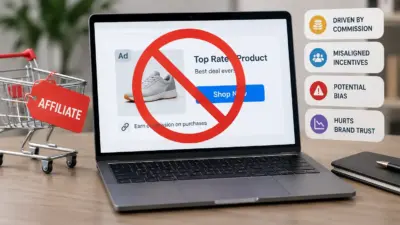
Someone searches a brand’s name directly. They already know what they want to buy. An ad appears above the brand’s own listing, they click it, and they buy exactly what they were already going to buy.
On This Page 13 sections
Somewhere, an affiliate dashboard just logged a conversion. Commission gets paid to whoever bought that ad, not to whoever actually influenced the purchase. The brand pays twice: once for the ad, once for the commission, for a sale it already had.
This is brand bidding. It’s not a rare exploit or a clever hack, it’s an ordinary, everyday tactic in how affiliate traffic gets bought in India today. The reason it keeps happening is duller and more damning than any single scandal: nobody with the power to stop it at the source has actually built a system that does.
- Brand bidding means an affiliate buys search ads on a company’s own trademarked name, then claims commission for a sale the affiliate didn’t actually cause, thanks to last click attribution.
- Amazon and Flipkart both had to write explicit contract clauses banning it, with zero commission and account termination as the penalty, proof the industry couldn’t rely on norms alone.
- No affiliate network runs a blanket ban. Rakuten, CJ, and Impact all run opt in permission systems instead, meaning brand bidding is allowed by design wherever a merchant doesn’t actively switch it off.
- Indian courts contradicted themselves twice in 2023 alone on whether bidding on someone else’s trademark as a keyword is even illegal. There is still no settled national answer, and the US, EU, and UK have all landed on roughly the same “not automatically infringing” position India can’t seem to hold onto consistently.
- Google’s own ad policy allows bidding on any trademark as a keyword worldwide, including India. The auction itself has no built in guardrail, even though Google removed 503.1 million ads for trademark violations in 2024 alone, all of it enforcement against visible ad text, none of it against the keyword auction.
- Nobody publishes real numbers on how common this is, and that silence is not an accident. It’s the direct result of a practice everyone polices with a contract clause but nobody wants to measure out loud.
- India’s affiliate industry is worth $331 million as of 2023, projected past $420 million by 2025, and Indian regulators have started fining companies roughly ₹20 lakh combined under a dark patterns framework that could eventually reach brand bidding directly.
What Brand Bidding Actually Is
Brand bidding is an affiliate buying paid search ads on a merchant’s own brand name, often including common misspellings, and brand name plus “coupon” or “promo code” style long tail terms. The click routes through the affiliate’s tracking link instead of straight to the merchant.
The mechanism that makes this profitable is last click attribution. Under standard affiliate tracking, whoever’s link the customer clicked immediately before checkout gets credited with the sale, regardless of what actually convinced that customer to buy. A shopper who found the brand through a podcast mention, a friend’s recommendation, or the brand’s own SEO work still gets counted as the affiliate’s conversion if the affiliate’s ad was the last click.
Industry veteran Matt McWilliams, who writes one of affiliate marketing’s most read program management blogs, puts the practical effect plainly: an affiliate bidding on a brand’s own name is competing directly against the brand’s own marketing team in the exact same auction, for traffic the brand would likely have received anyway.
ShareASale, one of the affiliate networks that actually facilitates these campaigns, tells its own merchants something even more direct in its official guidance: when an affiliate bids alongside you on your own brand name, you end up bidding against yourself, and your own cost per click on your own name goes up as a result.
What Amazon and Flipkart Had to Write Into Their Contracts
You don’t write an explicit, zero tolerance contract clause against something that isn’t already happening at scale. Two of the largest affiliate programs operating in India did exactly that.
| Program | What the Terms Actually Say | Penalty |
|---|---|---|
| Amazon Associates | Bidding on keywords including “amazon,” “kindle,” or misspellings like “ammazon” or “kindel” is a Prohibited Paid Search Placement | Zero commission on the resulting sale |
| Flipkart Affiliate | Bidding on “Proprietary Terms” including “Flipkart,” “Flipcart,” “Digiflip,” and “Flyte,” or their misspellings, is a Prohibited Paid Search Ad | Account suspension, cancellation of pending and future commissions, termination |
Amazon Associates Operating Agreement and Program Policies, Flipkart Affiliate Program Terms and Conditions. Checked August 2026.
Read that Amazon clause again. It doesn’t just ban bidding on “Amazon,” it separately bans “ammazon” and “amaozn,” deliberate misspellings built to slip past a simple keyword filter. Someone at Amazon has watched this happen closely enough to write the misspelled variants into a legal contract by name.
Flipkart’s penalty is broader still. It doesn’t just claw back the one flagged sale, it cancels every pending and future commission on the account.
That’s not a policy written for a hypothetical. That’s a policy written by someone who has already been burned by it repeatedly.
The Industry’s Real Answer Isn’t a Ban, It’s a Permission System
Here’s the part that should be the actual headline inside the affiliate industry: no major network runs a blanket, default off ban on brand bidding. They built opt in permission systems instead, which means the default posture, unless a specific merchant actively switches it off, leans toward allowing it.
| Network | How It Actually Handles Brand Bidding |
|---|---|
| Rakuten Advertising | Runs “Trademark Plus” (TM+), where merchants whitelist specific publishers to bid on brand plus qualifier terms alongside their own search team |
| CJ (Commission Junction) | Same TM+ whitelist model, merchants submit protected terms and authorize named publishers individually |
| ShareASale | Merchants set their own restricted keyword lists, enforced through a three strikes system, three violations means permanent removal from the network |
| Impact.com | Brand bidding is a per program setting, prohibit entirely, allow with restrictions, or allow specific partners, monitored by Impact’s own Paid Search Monitoring tool |
| Awin | Left entirely to individual merchant programs, no network wide baseline restriction |
Each network’s own published merchant guidance and platform documentation. Checked August 2026.
ShareASale’s own published advice to its merchants makes the honest version of this explicit: disallow brand bidding entirely, except maybe one or two specifically vetted partners you trust. That’s not the advice of a network confident this practice is rare. That’s the advice of a network that knows exactly how often merchants forget to turn the restriction on.
How Big Is India’s Affiliate Industry, Really
India’s affiliate marketing industry has real, published numbers behind it, even if brand bidding’s specific slice of that industry doesn’t. IAMAI, Admitad, and Kantar’s own joint research report values Indian affiliate marketing spend at $331 million in 2023, projected to cross $420 million by 2025.
IAMAI, Admitad and Kantar, “India Affiliate Marketing: The 2023 Primer,” launched at India Affiliate Summit 2023. The report itself notes its figures are based on secondary research unless stated otherwise.
Two more figures from that same report matter for this article specifically. Indian companies allocate 10 to 12% of their digital marketing budget to affiliate partnerships, against roughly 15% in more mature affiliate markets, meaning India’s affiliate channel is still growing into the same share of budget other markets already settled into years ago.
India’s lower conversion rate and lower consumer trust in advertising generally are exactly the conditions where a brand bidding affiliate looks artificially productive on a dashboard, since any click that closes a sale reads as a win, regardless of whether an ad actually caused it.
India’s Courts Have Contradicted Themselves Twice in the Same Year
If you’re hoping Indian trademark law settles this cleanly, it doesn’t. Three real rulings, from real courts, say three different things, and two of them are only four months apart.
Consim Info v. Google India, Madras High Court. Bharatmatrimony’s trademarks were being surfaced to rival matrimonial sites through Google’s own Keyword Suggestion Tool. The court held Google is an intermediary under the IT Act, not automatically liable, and left the deeper question of whether the bidding itself infringes unresolved.
MakeMyTrip v. Booking.com, Delhi High Court, single judge. Ruled that Booking.com bidding on MakeMyTrip’s trademark as a keyword amounted to passing off, and ordered Google to stop offering it as a biddable term.
Google v. DRS Logistics, Delhi High Court, Division Bench. Held that using a rival’s trademark as a keyword does count as “use in advertising” under the Trade Marks Act, and can amount to infringement. Google was denied IT Act safe harbour protection for this specific practice.
MakeMyTrip v. Booking.com, same court, Division Bench, on appeal. Reversed the 2022 ruling. Held that using a competitor’s trademark purely as an invisible keyword, without it appearing in the visible ad text, isn’t illegal on its own unless it actually confuses consumers.
Madras High Court and Delhi High Court judgments, via Indian Kanoon and SpicyIP legal commentary. Checked August 2026.
Read that timeline again slowly. In August 2023, a Delhi High Court Division Bench said bidding on someone else’s trademark as a keyword can be infringement. Four months later, the same Delhi High Court, at the same Division Bench level, said the opposite about a different pair of companies.
There is no Supreme Court ruling that resolves the conflict either way.
That means an advertiser trying to stop an affiliate from bidding on its own brand name cannot currently point to one settled rule of Indian law and expect it to hold. Every case gets argued from scratch, against whichever precedent the other side’s lawyers pick first.
A 2026 legal commentary piece, published on the legal analysis platform Mondaq, argues the 2022 MakeMyTrip outcome would likely be decided differently today, not because trademark law changed, but because India’s Central Consumer Protection Authority issued its Dark Patterns Guidelines in November 2023, framing exactly this kind of interception as a “bait and switch.” That’s a lawyer’s opinion about where the law might be heading, not a new ruling, but it points at where the real power may end up sitting: consumer protection law, not trademark law.
This Isn’t Just an India Problem
India’s contradictory rulings can look like a uniquely Indian mess. They aren’t. Every major jurisdiction that has actually ruled on keyword only trademark bidding, meaning the trademark never appears in the visible ad text, has landed in roughly the same place: not automatically infringing.
| Jurisdiction | Leading Case | Keyword Bidding Alone Infringing? |
|---|---|---|
| United States | Rescuecom v. Google, 2nd Circuit, 2009 | Not decided outright, court only held it counts as “use in commerce,” sent back for a confusion analysis |
| European Union | Google France v. Louis Vuitton, CJEU, 2010 | No, Google itself isn’t liable, advertiser only liable if the ad confuses buyers about origin |
| United Kingdom | Interflora v. Marks & Spencer, 2011 to 2014 | No per se, infringement found only where the ad creates a false impression, first ruling for Interflora was later overturned on appeal |
| India | Three rulings, 2012 to 2023 | Unresolved, Delhi High Court’s own Division Bench disagreed with itself within the same year |
US 2nd Circuit, CJEU Grand Chamber, and UK Court of Appeal judgments, via primary case records and legal commentary. Checked August 2026.
The global pattern is consistent even where India isn’t: keyword selection alone rarely counts as infringement anywhere, the actual legal exposure sits in whether the resulting ad text confuses a buyer about who they’re really dealing with. That’s a much narrower target than most brands assume they’re protected against.
The Auction Itself Has No Guardrail
While Indian courts argue with themselves, Google Ads’ own policy has stayed still. It’s one global rule, unchanged for India specifically, and it goes further than most advertisers realize.
Google’s current trademark policy states plainly that it will not restrict “using trademarks as keywords,” full stop, for anyone, anywhere. The only thing Google restricts is a trademark appearing in an ad’s visible headline or description text, and even that restriction only kicks in reactively, after the trademark owner files a specific complaint. Google does not proactively police ad text on its own.
Put the last two sections together and the shape of the problem gets clearer. The auction has no built in restriction, and the law that might restrict it afterward is unsettled and contradicts itself.
The only real defense any brand actually has is a contract clause it wrote itself, and a monitoring tool it has to pay for and remember to run.
Google Fights the Symptom Hard. It Leaves the Cause Completely Open
Here’s the part that makes Google’s position genuinely strange once you see both halves of it at once. Google’s own 2024 Ads Safety Report shows the company removed or restricted 5.1 billion “bad ads” globally that year. Trademark violations were the second largest single category, behind only general ad network abuse.
Google Ads Safety Report 2024, published by Google. Out of 5.1 billion total bad ads stopped that year.
503.1 million ads removed for trademark violations in a single year is not a small enforcement effort. But Google’s own footnote on that exact line explains the limit: it enforces this against ad text that uses a trademark without permission, not against who’s allowed to bid on the keyword underneath it.
Nobody Publishes the One Number That Would Prove the Scale
We looked hard for a real, dated, named source that quantifies how much of India’s affiliate traffic, or affiliate commission spend, is brand bidding specifically. It doesn’t exist publicly. Not from a network, not from a regulator, not from an industry body.
General ad fraud statistics circulate constantly, often from ad fraud detection vendors selling their own monitoring tools, which is a real conflict of interest worth noting before repeating their numbers as neutral fact. But those figures measure bot traffic and fake leads, not brand bidding, which is a legal gray area conducted through a completely legitimate ad auction, not fraud by any technical definition.
That gap isn’t an oversight. Brand bidding is against most individual merchant programs’ terms, which means admitting how often it happens on your own network is admitting how often your own enforcement fails. Nobody in a position to publish that number has an incentive to.
Regulators Are Finally Moving. It’s Still a Small Start
India’s Central Consumer Protection Authority has actually started enforcing its Dark Patterns Guidelines since they were issued in November 2023, the framework a 2026 legal commentary piece argued could eventually apply to brand bid interception as a bait and switch. As of a government reply to the Rajya Sabha in August 2026, real penalties exist.
| Company | Penalty | Dark Pattern Type |
|---|---|---|
| Zepto | ₹7 lakh | Drip pricing and basket sneaking, extra charges added after the displayed price |
| Physics Wallah | ₹5 lakh | Basket sneaking, confirm shaming, forced data sharing on courses advertised as free |
| McAfee Software India | ₹1 lakh | Interface interference restricting consumer choice |
| 6 other platforms | ₹7 lakh combined | Not individually itemized in the government’s public reply |
Reply by B.L. Verma, Minister of State for Consumer Affairs, in the Rajya Sabha, August 2026, as reported by Storyboard18. Total penalties across all 9 platforms: ₹20 lakh.
₹20 lakh total, roughly $24,000, across nine platforms is not a deterrent by itself, and none of these specific penalties were for brand bidding directly, they cover checkout dark patterns like drip pricing and confirm shaming. What matters is the direction: a regulator that didn’t exist in this role three years ago is now actually issuing fines under a framework a real legal commentator has already tied to keyword interception specifically.
Who Actually Pays for This
Two groups absorb the cost of brand bidding, and neither of them is the affiliate running the ad.
The advertiser pays twice, once in inflated cost per click on its own brand name, competing against its own affiliates in the same auction exactly as ShareASale warns, and once in commission paid out for a sale it would have gotten regardless.
The other group is publishers who build genuine content, comparisons, guides, and coupon coverage without ever buying a branded search ad. We’re one of them.
When someone bids on a brand name and intercepts a shopper before they ever reach organic search results, the traffic that content driven publishers earned through actual work simply never shows up. There’s no dashboard metric for the click that never happened because a paid ad sat above it.
CouponZania runs no paid search on any brand’s trademarked terms, ours or anyone else’s. That’s not a marketing claim, it’s a structural fact about how the site earns traffic, through content relevance and organic search, not rented ad space at a brand’s expense.
We’ve argued before that brands should lock this down by default rather than treat it as an opt out. Nothing in the current contract landscape, court record, or ad platform policy has changed that position, if anything, it’s made the case stronger.
What Actually Needs to Change
A contract clause that only works if someone gets caught isn’t protection, it’s paperwork. Three things would move this from a permanent cat and mouse game to an actual fix.
- Default off, not default on. Every affiliate network should ship brand bidding as opt in per merchant, not something a brand manager has to remember to switch off before it’s already cost them money.
- Published enforcement data. If networks are willing to publish trending affiliate categories and payout benchmarks, they can publish how many brand bidding violations they caught and penalized each year. Silence on this specific number is a choice, not a limitation.
- A settled legal answer, not a coin flip between two Delhi High Court rulings four months apart. Until India’s courts or legislature actually resolve the conflict between DRS Logistics and MakeMyTrip, every advertiser is litigating this from zero, every single time.
Affiliate networks built the whitelist tools. Advertisers wrote the contract clauses. What’s missing is anyone treating this as a problem worth measuring in public, not just penalizing in private when someone happens to notice.
Frequently Asked Questions
What is brand bidding in affiliate marketing?
Brand bidding is when an affiliate buys paid search ads on a merchant’s own trademarked brand name, often including misspellings, then claims commission on any resulting sale through last click attribution, even when the affiliate didn’t actually influence the purchase decision.
Is brand bidding illegal in India?
It’s legally unsettled. Delhi High Court’s Division Bench reached opposite conclusions within the same year, ruling in Google v. DRS Logistics (August 2023) that keyword trademark use can be infringement, then ruling the opposite in MakeMyTrip v. Booking.com (December 2023) absent visible consumer confusion, and no Supreme Court ruling has resolved the conflict since.
Does Google allow bidding on a competitor’s or another brand’s trademark?
Yes. Google Ads’ current policy explicitly does not restrict using trademarks as keywords, anywhere, for anyone. Google only restricts a trademark appearing in an ad’s visible text, and only after the trademark owner files a specific complaint.
Do Amazon and Flipkart allow their affiliates to bid on their brand name?
No. Both programs explicitly prohibit it in their affiliate terms. Amazon Associates treats it as a Prohibited Paid Search Placement with zero commission on the resulting sale, while Flipkart’s terms cancel pending and future commissions and can lead to account termination.
What is Trademark Plus, or TM+, in affiliate marketing?
TM+ is a whitelisting system run by networks like Rakuten Advertising and CJ, where a merchant explicitly authorizes specific publishers to bid on its brand name alongside qualifier terms like “coupon” or “promo code,” while blocking everyone else from doing the same.
How common is brand bidding actually?
There’s no public, verifiable, named source that quantifies this specifically, for India or globally. General ad fraud statistics exist but measure a different problem, bot traffic and fake leads, not the legitimate ad auction misuse that brand bidding represents.
Is trademark keyword bidding illegal in the US or Europe?
Not automatically. US courts (Rescuecom v. Google, 2009) and the EU’s top court (Google France v. Louis Vuitton, 2010) both held that selecting a trademark as a keyword isn’t infringing on its own, liability depends on whether the resulting ad text confuses buyers about who they’re actually dealing with. The UK reached a similar conclusion in Interflora v. Marks & Spencer.
Does Google actually enforce its trademark policy?
Yes, but only against visible ad text, not keyword selection. Google’s 2024 Ads Safety Report shows it removed 503.1 million ads for trademark violations that year, the second largest enforcement category after general ad network abuse, out of 5.1 billion bad ads stopped globally.
Has India’s government taken any real action on deceptive ads or dark patterns?
Yes, though modestly so far. Under India’s November 2023 Dark Patterns Guidelines, the Central Consumer Protection Authority has penalized at least 9 platforms roughly ₹20 lakh combined as of August 2026, including Zepto and Physics Wallah, though none of those specific penalties targeted brand bidding directly.
How can a brand stop affiliates from bidding on its trademark?
Set brand bidding restrictions explicitly in the affiliate program’s terms rather than assuming it’s automatically banned, use a network’s monitoring tools such as Impact’s Paid Search Monitoring, and default new affiliate approvals to prohibited rather than allowed unless a partner is specifically whitelisted. Third party monitoring vendors like BrandVerity, now owned by Partnerize, and India’s own mFilterIt also sell dedicated brand bidding detection as a standalone service.