MakeMyTrip vs Goibibo: Which Should You Actually Book With?
-
 Written by
Rajat Singh
Written by
Rajat Singh
- Published
- Updated
- Read time 15 min read
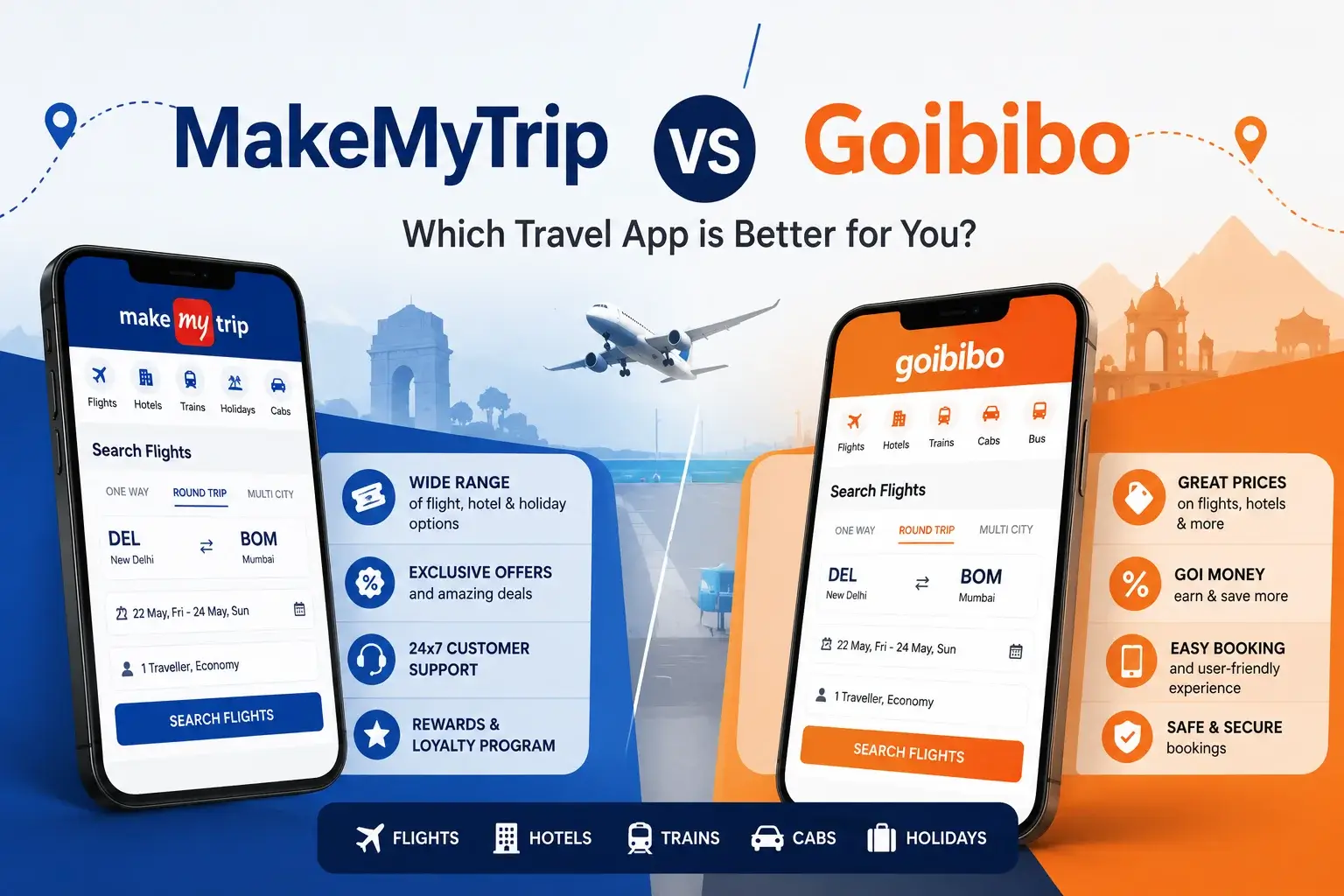
Comparing MakeMyTrip and Goibibo as if they’re two genuinely competing companies fighting over the same booking is the single most common mistake in every “which is better” article written on this topic. They haven’t actually been separate, independent companies since January 2017.
On This Page 11 sections
MakeMyTrip Limited bought 100% of the Ibibo Group, Goibibo’s actual parent company at the time, for roughly $1.8 billion, and has owned it outright, completely, ever since that deal closed. What you’re actually choosing between whenever you open both apps is two separate brands run by the exact same company, deliberately kept apart from each other, not two genuine rivals fighting for your booking.
That doesn’t mean the choice between them is meaningless, though. Real, measurable differences in pricing, loyalty perks, and inventory focus still exist between the two platforms, they’re simply differences that exist by deliberate design rather than by any genuine market competition between rivals.
- MakeMyTrip has owned Goibibo since January 2017, after a roughly $1.8 billion deal to acquire the entire Ibibo Group from Naspers, both now operate under the same parent company.
- The combined MakeMyTrip group holds an estimated 50 to 60% of India’s organized OTA market, far ahead of the next tier of competitors, Cleartrip at roughly 8.5% and EaseMyTrip at roughly 8.1%.
- MakeMyTrip posted $1.04 billion in revenue for FY26, its first time crossing $1 billion, with record gross bookings of $10.4 billion, though Q1 FY27 profit fell 65% largely due to rupee depreciation against the dollar.
- MakeMyTrip is positioned as the premium brand and Goibibo as the value focused one, a deliberate strategy, not an accident, letting the same parent company capture both ends of the market without one brand undercutting the other.
- Both run separate loyalty programs, MakeMyTrip’s MMT Black (Gold and Platinum tiers) versus Goibibo’s goTribe (Basic, Star, and SuperStar tiers), with different perks and spend thresholds despite sharing a parent company.
MakeMyTrip Limited investor filings, industry market share research. Checked August 2026.
The 2017 Deal That Made This Comparison Complicated
Goibibo launched in 2007, founded by Ashish Kashyap as part of the Ibibo Group, which also built the bus ticketing platform RedBus. Naspers, the South African media and internet investment giant, backed Ibibo Group with a $250 million funding round in February 2016, a year before everything changed.
On January 31, 2017, MakeMyTrip completed the purchase of 100% of Ibibo Group’s equity from MIH Internet, an indirect Naspers subsidiary, under a transaction agreement dated October 18, 2016. The deal, valued at roughly $1.8 billion, instantly created India’s largest online travel company and made Naspers and Tencent the largest shareholders in the newly combined entity.
The obvious question after a deal like that is why the acquiring company didn’t just fold Goibibo into the MakeMyTrip brand entirely. The answer is a deliberate multi brand strategy, not an oversight, and it’s the single most important thing to understand before comparing the two platforms on anything else.
MakeMyTrip launches, founded by Deep Kalra, initially focused on US to India travel before expanding into the domestic Indian market.
Goibibo launches as part of the newly formed Ibibo Group, founded by Ashish Kashyap.
Ibibo Group acquires RedBus, the dominant Indian bus ticketing platform, adding a third brand to what would later become one combined company.
Ctrip, the Chinese travel giant, agrees to invest $180 million in MakeMyTrip, ahead of the much larger deal still to come.
Naspers invests $250 million into Ibibo Group, Goibibo and RedBus’s parent company, in a single funding round.
MakeMyTrip completes its roughly $1.8 billion acquisition of 100% of Ibibo Group, bringing MakeMyTrip, Goibibo, and RedBus under one parent company.
MakeMyTrip confidentially files draft IPO papers with SEBI for its India business, and posts its first ever $1 billion plus revenue year.
Why the Parent Company Keeps Them Separate on Purpose
MakeMyTrip is positioned as the premium option and Goibibo as the value focused one, letting the same parent company capture travelers at both ends of the market without either brand undercutting the other’s pricing or identity. Goibibo has built real affinity specifically in budget hotel bookings, while MakeMyTrip tends to win on international flight pricing and its broader premium travel packaging.
That’s a genuinely common corporate playbook once a company reaches this kind of market dominance, individual branding lets one parent operate what look like two competing choices to the shopper, while actually running shared infrastructure and inventory behind the scenes. The 2017 merger’s combined inventory base across MakeMyTrip, Goibibo, and RedBus is also what made large scale cross category bundling, flight plus hotel plus cab packages, viable in a way neither brand alone could easily support before merging.
Practically, that means the two apps often draw from overlapping hotel and flight inventory today, but continue running independent pricing campaigns, promo codes, and seasonal sales separately from each other. Checking both before booking genuinely can turn up a different price for the same room or the same flight, not because the platforms are truly competing on cost, but because their promotional calendars don’t run in lockstep even under one owner.
The Third Sibling Most Comparisons Forget About
Most “MakeMyTrip versus Goibibo” comparisons leave out that there’s actually a third brand sitting under the same parent company, RedBus, and it’s the most dominant of all three within its own specific category. RedBus controls roughly 70 to 75% of India’s entire online bus ticketing market, a level of dominance that makes MakeMyTrip’s 50 to 60% OTA share look almost modest by comparison.
Ibibo Group acquired RedBus back in 2013, four years before Ibibo itself was acquired by MakeMyTrip, meaning RedBus has actually been part of this combined corporate family longer than Goibibo’s own current ownership structure has existed. RedBus posted ₹1,010 crore in revenue for the year ended March 2025, connecting travelers to more than 2,500 bus operators across over 80,000 routes spanning India and parts of Southeast Asia.
The practical takeaway is that this isn’t really a two brand comparison at all, it’s one company running three separately branded consumer products, each dominant or near dominant in a different corner of Indian travel, flights and hotels through MakeMyTrip, budget travel through Goibibo, and buses through RedBus.
RedBus holds a level of category dominance even MakeMyTrip’s own core OTA business doesn’t match. Industry bus ticketing market share research. Checked August 2026.
What the Parent Company Is Actually Building Toward
MakeMyTrip confidentially filed draft IPO papers for its India business with India’s securities regulator, SEBI, on July 17, 2026, a real, dated step toward what would be a significant public listing event for the combined group. Part of the stated purpose is addressing roughly $1.6 billion in outstanding convertible bonds, including a large $1.4 billion tranche due in 2029, alongside funding further growth.
That growth push extends outside India too. MakeMyTrip expanded its Vietravel partnership in May 2026 to cover Cambodia and Laos in addition to Vietnam, letting Indian travelers book multi country Southeast Asian itineraries through a single platform, and separately partnered with Premier Inn to add more than 900 UK hotel options aimed at long haul Indian tourists.
Diversification beyond air ticketing specifically, into hotels, holiday packages, and ground transport, is what’s actually offsetting softer air travel margins and driving the group’s overall profitability higher, according to the company’s own recent reporting. None of that international and category expansion happens under the Goibibo name specifically, it’s built and reported at the MakeMyTrip Limited parent company level, another real, structural reminder of which brand is actually driving the group’s next phase of growth.
The Numbers Belong to One Company, Not Two
Because Goibibo has been a wholly owned subsidiary since 2017, it doesn’t file separate public financial results, everything below comes from MakeMyTrip Limited’s own consolidated filings and covers both brands together, not MakeMyTrip in isolation.
| Period | Result | Detail |
|---|---|---|
| FY26 (full year) | $1.04 billion revenue, up 10.7% | First time crossing $1 billion, gross bookings hit a record $10.4 billion, up 10.4% |
| Q3 FY26 | $295.7 million revenue, up 10.6% | Gross bookings up 11.8% year over year |
| Q1 FY27 (most recent, ended Jun 2026) | $285.6 million revenue, up 6.2% | Profit fell 64.7% to $9.1 million, driven largely by the rupee depreciating more than 10% against the dollar |
MakeMyTrip Limited consolidated investor filings and earnings calls. Checked August 2026.
That Q1 FY27 profit drop is worth reading correctly rather than as a sign the business is struggling. Revenue and gross bookings both grew in the same quarter, the profit hit came specifically from currency effects, MakeMyTrip reports in dollars while most of its actual revenue is earned in rupees, and a weaker rupee shrinks the dollar denominated profit figure even when the underlying rupee denominated business is genuinely still growing well.
How Dominant the Combined Group Actually Is
The Indian online travel market itself is worth $25.38 billion in 2026, growing at an 8.74% compound annual rate toward $38.58 billion by 2031. Within that market, the MakeMyTrip group’s combined share of the organized OTA segment is estimated at 50 to 60%, a level of concentration that leaves every other named competitor fighting over a much smaller remainder.
Estimated shares, midpoint of the 50 to 60% MakeMyTrip Group range used for this chart. Industry OTA market share research. Checked August 2026.
Two Different Loyalty Programs, Same Parent Company
Despite sharing an owner, MakeMyTrip and Goibibo run genuinely separate loyalty programs with different tier structures and perks, another real, checkable sign the brands operate independently day to day even under common ownership.
| Program | Tiers | Core Reward |
|---|---|---|
| MakeMyTrip: MMT Black | Gold (₹50,000 to ₹2,00,000 annual spend, 4+ trips), Platinum (₹2,00,000+, 4+ trips) | MyCash wallet credit, room and meal upgrades, priority support, ₹10,000 holiday vouchers at Platinum |
| Goibibo: goTribe | Basic (automatic), Star (₹25,000 spend), SuperStar (₹1.25 lakh spend) | goCash+ rewards, up to 10% extra hotel discounts, free seat selection, Tribe Coins at 5x value |
MMT Black and goTribe program terms, both brands’ official program pages. Checked August 2026.
MMT Black replaced an older 3 tier structure with a simpler 2 tier Gold and Platinum system, both invitation based or earned automatically once your booking history crosses the qualifying spend threshold. goTribe is free and automatic from your very first booking instead, with its top SuperStar tier requiring meaningfully less annual spend, ₹1.25 lakh, than MMT Black’s Platinum tier at ₹2 lakh plus.
That gap in entry threshold tracks with the brands’ broader positioning covered earlier, MMT Black is built around a smaller number of higher spending premium travelers, while goTribe is designed to reward a much larger base of more frequent, lower spend bookings, consistent with Goibibo’s budget focused identity.
Which One People Actually Use More
MakeMyTrip’s app has passed 30 million downloads across the Google Play Store and Apple App Store combined, ahead of Goibibo’s more than 20 million, a real gap but not a landslide one for a brand explicitly positioned as the smaller, budget focused option within the same corporate family.
App store star ratings for both platforms fluctuate meaningfully over time and across review batches, and we couldn’t find a clean, directly comparable current rating for the two primary consumer apps specifically, worth checking each app’s current listing yourself immediately before choosing, rather than trusting any single comparison article’s snapshot, including this one.
Getting a Coupon Code to Actually Work on Either Platform
Both platforms accept promo codes at checkout, but the two loyalty programs covered earlier already claim a meaningful chunk of the discount budget before a separate coupon code even enters the picture, worth understanding before assuming every code stacks cleanly on top of everything else.
A wallet credit, MyCash on MakeMyTrip or goCash+ on Goibibo, typically applies automatically at checkout and usually can combine with a separate promo code, since it functions more like store credit than a discount code itself. A percentage off coupon code, by contrast, is far more likely to explicitly exclude combination with another active promotional code on the same booking, even if it happily stacks with your existing wallet balance.
The practical order worth checking is applying any available wallet balance first, since it rarely conflicts with anything else, then testing a specific coupon code on top of that before finalizing payment. If a code fails to apply, it’s very often because it’s flagged as exclusive of an already active sale price on that route or property, not because the code itself is invalid, worth trying a different flight, hotel, or date before assuming the code has simply expired.
Which One Should You Actually Check First
- Booking a budget hotel or a domestic short trip: start with Goibibo, its positioning and goTribe rewards are built specifically around this kind of booking.
- Booking an international flight or a premium package: start with MakeMyTrip, where the brand’s pricing strength and MMT Black perks concentrate.
- You already have loyalty status on one platform: that status doesn’t transfer to the other, despite the shared owner, factor your existing MyCash or goCash+ balance into which app is actually cheaper for you specifically.
- You want the genuinely lowest price on a specific room or flight: check both anyway. Shared ownership doesn’t mean identical pricing, independent promotional calendars mean the same booking can still come out cheaper on one app than the other.
- You’re comparing beyond just these two: Cleartrip and EaseMyTrip, each holding roughly 8% of the market, are the most credible independent alternatives outside the MakeMyTrip group entirely.
For the broader booking strategy behind getting the best price on either platform, timing, refund rules, and India’s newer airline fare regulations, see our companion flight booking savings guide and hotel booking savings guide.
None of this is really a story about picking a winner. It’s a story about one company that got big enough to stop competing with itself and started segmenting its own customers instead, MakeMyTrip for the premium traveler, Goibibo for the budget conscious one, and RedBus for anyone booking a bus ticket, all quietly reporting up to the exact same parent.
Knowing that doesn’t make either app a worse choice. It just means the real comparison worth making every time isn’t MakeMyTrip against Goibibo, it’s whichever of the two, checked side by side for your specific dates and route, actually comes out cheaper on the day you’re booking.
Frequently Asked Questions
Are MakeMyTrip and Goibibo owned by the same company?
Yes, since January 31, 2017, when MakeMyTrip acquired 100% of Goibibo’s parent company, the Ibibo Group, from Naspers for roughly $1.8 billion in total deal value. They’ve operated as sibling brands under one single parent company ever since that date, not as genuine independent competitors.
If they’re the same company, why do prices differ between the two apps?
Because the brands run independent pricing campaigns, promo codes, and seasonal sales despite sharing ownership and often overlapping inventory. The parent company deliberately keeps both brands operationally separate to capture different customer segments, so checking both before booking can still turn up a genuinely different price.
Is MakeMyTrip or Goibibo cheaper for hotels?
Goibibo has built stronger affinity specifically in budget hotel bookings, while MakeMyTrip tends to lead on premium packages and international flight pricing. Neither is universally cheaper though, checking both for a specific booking is the only reliable way to know for that exact trip.
How big is the combined MakeMyTrip group in India’s travel market?
Estimated at 50 to 60% of the organized OTA segment, far ahead of the next tier of competitors, Cleartrip at roughly 8.5% and EaseMyTrip at roughly 8.1%. That combined figure covers MakeMyTrip and Goibibo together, not either brand individually.
Does loyalty status on MakeMyTrip carry over to Goibibo?
No. MMT Black and goTribe are separate loyalty programs with different tiers, spend thresholds, and rewards, despite both brands sharing the same parent company. Wallet balances and status earned on one platform don’t transfer to the other.
Why did MakeMyTrip keep Goibibo as a separate app instead of merging them?
A deliberate multi brand strategy, positioning MakeMyTrip as the premium option and Goibibo as the value focused one lets the same parent company capture both ends of the market without either brand’s pricing or identity undercutting the other.
Is RedBus also owned by MakeMyTrip?
Yes. RedBus was acquired by Ibibo Group in 2013, four years before Ibibo itself, including Goibibo, was acquired by MakeMyTrip in 2017. RedBus now holds roughly 70 to 75% of India’s online bus ticketing market, even more dominant in its category than MakeMyTrip’s own OTA share.
Is MakeMyTrip planning to go public?
It’s taken a real step in that direction. MakeMyTrip confidentially filed draft IPO papers for its India business with SEBI on July 17, 2026, with proceeds partly earmarked to address roughly $1.6 billion in outstanding convertible bonds, including a $1.4 billion tranche due in 2029.
Does Goibibo operate outside India?
Goibibo itself remains focused on the Indian market. The parent company’s international expansion, partnerships covering Vietnam, Cambodia, and Laos, plus a UK hotel partnership with Premier Inn, has been built and reported under the MakeMyTrip brand specifically, not Goibibo.