20 Coupon Code Ideas That Actually Boost Sales, by Goal
-
 Written by
Rajat Singh
Written by
Rajat Singh
- Published
- Updated
- Read time 15 min read
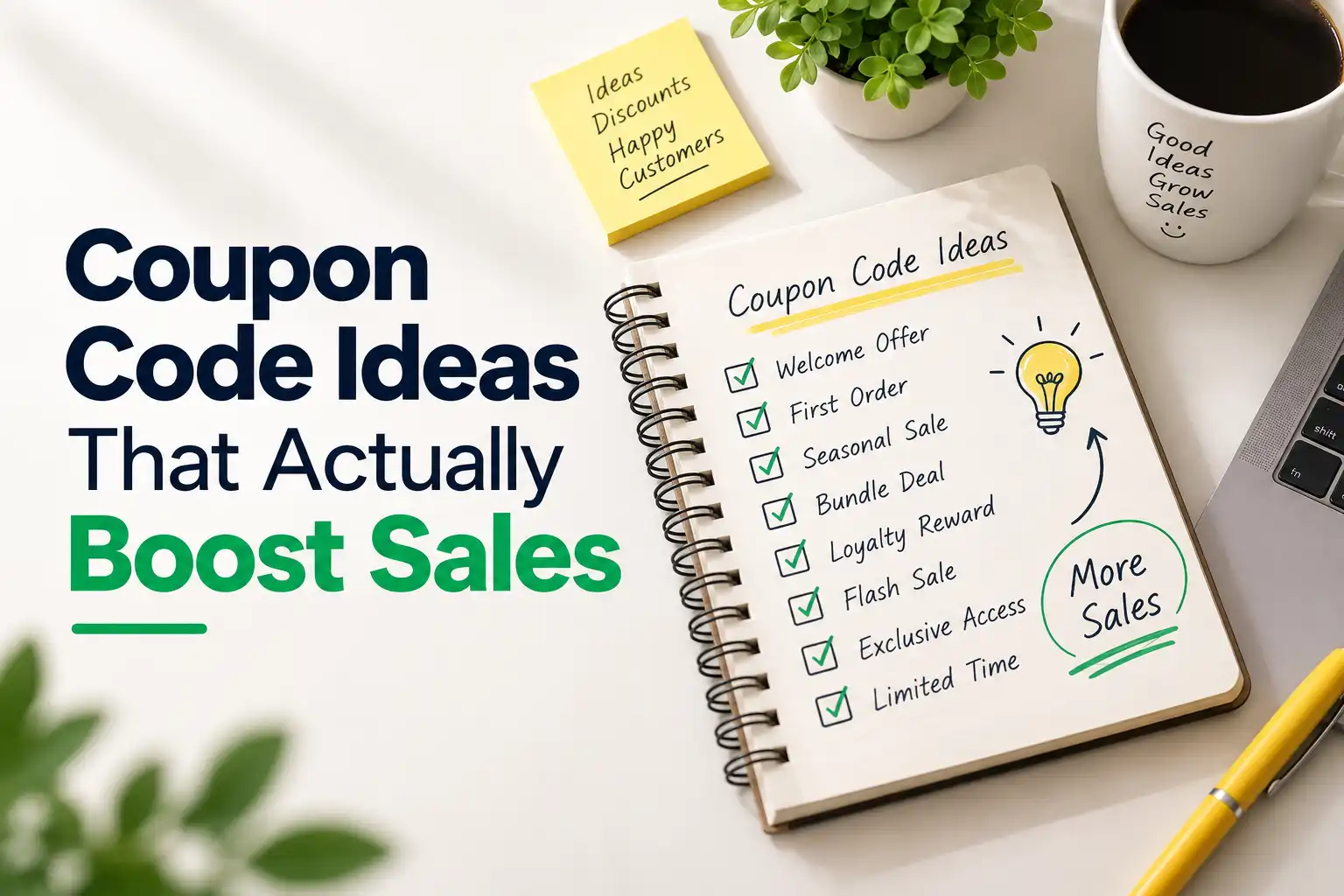
A discount code isn’t a strategy on its own. It’s a tool that only works when it’s matched to a specific business problem, a new visitor who needs a reason to trust you, an abandoned cart that needs a nudge, a loyal customer who deserves recognition. Running the same generic 10% off code for every situation wastes what the tool could actually do.
On This Page 11 sections
This is a working menu of coupon code types, organized by what business problem each one actually solves, with the real data behind why each one works and a practical tip for setting it up correctly. For the deeper research on measuring whether any of these actually pay off, see our companion piece on the real impact of coupon marketing on sales, which covers the measurement side this article deliberately leaves out.
Key facts:
- 70.22% of online shopping carts get abandoned according to Baymard Institute’s 2026 analysis, and recovery emails convert at around 10%, with a 45% open rate and 21% click through rate.
- Referred customers convert at 4 times the rate of non referred customers and generate 16% higher lifetime value, but only when the referral program rewards both the referrer and the friend.
- Dual sided referral rewards see a 52% program completion rate compared to just 29% for single sided rewards, according to 2026 referral marketing benchmarks.
- Nike still runs a genuine 10% military and student discount verified through SheerID, UNiDAYS, or Student Beans, confirmed active as of 2026.
- The right coupon type depends entirely on the funnel stage it targets: acquisition, cart recovery, retention, or reactivation each need a different mechanic, not the same blanket discount.
Match the Coupon Type to the Actual Goal
Before picking a coupon idea, name the specific problem it needs to solve. A code built for winning a first time visitor’s trust and a code built for rewarding a five year customer are structurally different offers, even if the discount percentage looks the same on paper, because the trust each one needs to earn is not the same thing.
| Goal | Best coupon types | Why it works |
|---|---|---|
| New customer acquisition | Welcome offer, prelaunch offer, influencer partnership | Lowers the risk of trying an unfamiliar brand |
| Cart and checkout recovery | Abandoned cart code, exit intent offer | Recovers demand that already existed but stalled |
| Order value growth | Qualifying purchase offer, tiered discount | Rewards spending more without discounting everything |
| Retention and loyalty | Loyalty reward, milestone code, comeback promotion | Reinforces an existing relationship rather than buying a new one |
| Word of mouth growth | Referral code, social engagement reward | Converts existing customers into an acquisition channel |
A goal first framework for choosing a coupon type, rather than picking a discount amount and working backward.
Coupon Ideas for Winning a First Purchase
Welcome offer for new shoppers. A visitor unfamiliar with your brand has a real reason to hesitate, and a discount specifically for first time buyers lowers that bar. The offer only works if the first order actually ships fast and arrives in good condition, since a bad first experience undoes whatever the discount earned.
Prelaunch offer. Collecting email signups ahead of a launch, in exchange for early access or a discount once the product ships, turns interested browsers into a warm list before you need a single sale. Pairing this with a preorder mechanism means your first customers get the product before general availability, which is its own incentive independent of the discount.
Influencer partnership codes. A discount code tied to a specific creator gives their audience a concrete reason to act and gives you a clean way to measure which partnership actually drove sales. The code needs to be genuinely easy to remember, and the influencer’s actual audience needs to overlap with your real customer base, not just have a large follower count.
Coupon Ideas for Recovering Lost Carts and Visitors
70.22% of online shopping carts get abandoned, according to Baymard Institute’s 2026 analysis pooling data across dozens of studies. Mobile abandonment runs even higher, at 80.02%, compared to 66.41% on desktop, meaning a mobile heavy store has more recoverable demand sitting in stalled carts than a desktop heavy one.
Abandoned cart code. A discount sent by email after a cart sits idle recovers demand that already existed but stalled somewhere in checkout. Abandoned cart emails average a 45% open rate and 21% click through rate, converting at around 10%, well above most other automated email types.
Exit intent offer. A popup triggered right before a visitor closes the tab or navigates away gives a browsing shopper one last, low friction reason to complete the purchase instead of leaving to compare prices elsewhere. Well optimized exit intent campaigns recover 10 to 15% of abandoning visitors on average, with the strongest cart abandonment specific offers reaching as high as 17.12% according to 2026 popup conversion research.
This works specifically because it catches someone at the exact moment of leaving, not days later when the intent has faded. A generic discount performs noticeably worse than a personalized one here too, since popups tailored to what the visitor was actually browsing improve conversion by 20 to 40% over a one size fits all offer.
Personalizing the recovery message with the customer’s name and the specific item left behind consistently outperforms a generic reminder, since it demonstrates the email actually knows what the shopper was looking at rather than being a blanket blast. For a deeper look at how offers get matched to individual behavior rather than sent identically to everyone, see our research on personalized coupons.
How that message gets personalized matters more than whether it happens at all. 2026 data on AI driven cart recovery emails, which adjust subject lines and offer framing based on the specific shopper’s browsing history, shows a real gap against standard template based recovery emails.
2026 industry research on cart recovery email conversion by personalization method.
Coupon Ideas for Growing Order Value
Qualifying purchase offer. Rather than discounting everything, set a threshold, free shipping or a percentage off orders above a specific total, calculated from your actual average order value over the last few months. Setting the threshold 10 to 20% above your current average pushes shoppers who were already close to spend a bit more, rather than subsidizing purchases that would have happened anyway.
Tiered discounts. A code that gives a bigger percentage off at higher spend thresholds, 10% off $50, 15% off $100, rewards larger baskets without eroding margin on every single transaction the way a flat storewide discount does. A well designed tier structure typically drives a 15 to 25% average order value increase, according to 2026 ecommerce pricing research.
The size of each tier jump matters. Industry guidance points to 10 to 15% off per tier as the effective range, since a discount below 8% rarely motivates a shopper to add more to their cart, while one above 20% tends to erode margin faster than the extra volume makes up for. Quantity break apps can apply these tiers automatically at checkout, so the shopper sees the incentive update in real time as they add items.
Coupon Ideas Tied to Timing and Urgency
Holiday and seasonal offers. Black Friday and Cyber Monday remain the highest traffic shopping days of the year, and a seasonal discount timed around them captures buyers who are already actively looking to spend. Shoppers buying gifts during these windows respond better to novelty and limited availability framing than to a generic percentage off.
Flash sales. A steep, short duration discount plays directly on urgency and fear of missing out, and shorter windows genuinely drive faster action than longer ones. The tradeoff is real: a flash sale needs enough inventory and server capacity to handle the traffic spike, or the urgency you created backfires into a broken checkout experience.
Weekly or monthly clearance discounts. A recurring, predictable discount cadence works well for moving seasonal stock ahead of a new collection, though running it too often trains shoppers to simply wait for the next cycle instead of buying at full price. That discount dependency pattern is a real, measurable risk worth understanding before committing to a permanent recurring schedule.
Referral and Social Coupon Ideas
Referred customers convert at 4 times the rate of non referred customers, retain at 37% higher rates, and generate 16% higher lifetime value than customers acquired through other channels, according to 2026 referral marketing research. That gap makes referral codes one of the most effective coupon types on this entire list, when the mechanics are set up correctly.
2026 referral marketing benchmarks across industries.
Referral reward code. Give a discount to both the existing customer who refers a friend and the new customer they bring in, rather than rewarding only one side. Dedicated referral platforms like ReferralCandy or Friendbuy handle the tracking and payout automatically, which matters once the program has more than a handful of participants to keep straight.
Social engagement rewards. Offering a discount in exchange for a share, a tag, or user generated content extends your reach through existing customers’ own networks at a much lower cost than paid ads. Be specific about the exact reward on offer, since a vague promise of “exclusive perks” converts far worse than a stated discount percentage or dollar amount.
Social insider offers. A discount reserved specifically for your social media followers gives people a concrete reason to follow you beyond just liking your content, and it builds a channel you can market to repeatedly afterward. Boosting these posts with a modest paid spend can widen the audience beyond your existing followers when a specific offer is worth pushing harder.
Both social tactics work best treated as separate lines in your reporting, not folded into a single generic social media discount code. A follower only offer and a broad share for a discount campaign attract genuinely different people, and measuring them together makes it harder to tell which one is worth doubling down on next quarter.
Coupon Ideas for Existing Customers
Loyalty rewards. A discount reserved for repeat customers reinforces a relationship that already exists, rather than trying to build a new one. Platforms like Shopify let you assign discount codes to specific customer segments directly, and a dedicated loyalty app like LoyaltyLion or Smile.io can automate points and tiers once a program grows beyond simple manual tracking.
Milestone savings. Marking a customer’s account anniversary, a spending threshold, or a purchase count with a small discount signals that the relationship is genuinely being tracked, not just transactional. Thanking the customer directly in the offer copy, rather than framing it as a generic sale, matters more here than the discount size itself.
Comeback promotions. A discount aimed specifically at customers who haven’t purchased in a while works because they already know your brand, unlike a cold acquisition target. Segmenting these by how the customer previously shopped, what they bought, how recently, makes the offer feel relevant rather than like a generic “we miss you” blast everyone else also received.
The discount itself often matters less here than simply being remembered. A lapsed customer who left because a competitor’s product genuinely fit better won’t come back for a coupon alone, so it’s worth reviewing why customers actually lapsed before assuming price is the only lever available.
Identity Based and Cause Aligned Coupon Ideas
Military and student discounts. Nike currently runs a genuine 10% discount for active duty, veteran, and retired military members, plus their spouses and dependents, verified through SheerID. Students get the same 10% through SheerID, UNiDAYS, or Student Beans, with each verified code typically valid for a limited window before needing renewal.
The mechanics matter here specifically because these audiences actively search for this exact type of discount. A verification service like SheerID or ID.me prevents abuse while still making the offer genuinely easy for eligible shoppers to claim, and advertising the discount clearly on both your website and in physical locations captures demand that’s already looking for it.
Earth friendly deals. A discount tied to an eco conscious action, choosing slower shipping, opting into a recycling program, buying a specific sustainable line, rewards behavior that also reduces your own operating costs in some cases. Partnering with a genuine environmental organization for a portion of proceeds adds credibility that a standalone “green” claim on its own doesn’t, and it gives customers a specific, checkable reason to trust the offer beyond marketing language.
In Person and Event Coupon Ideas
In store coupons. A physical code handed out at a storefront, trade show, or pop up event drives sales through a channel entirely separate from your online funnel. People tend to remember an in person interaction better than a purely digital one, which makes these codes useful for brand recall even when the immediate redemption rate is modest.
Event participation deals. Offering a discount or small gift to attendees, before or after an event, whether in person or online, keeps the relationship active and gives people a concrete reason to show up to your next one. Promoting the event consistently in the days beforehand, across email and social, matters as much as the offer itself for turning interest into actual attendance.
Choosing Which Ideas to Actually Run
Not every business needs every coupon type on this list running simultaneously. Running too many active codes at once makes it genuinely hard to tell which one actually drove a given sale, and it multiplies the operational burden of managing expiration dates, usage limits, and segment eligibility across all of them, especially once several are stacking together on the same order.
Pick 2 to 3 coupon types tied to your actual weak point
If cart abandonment is high, start there before adding a referral program. Solve the biggest leak before optimizing a smaller one.
Set a control group or a before and after baseline
Without a comparison point, you can’t tell whether a lift in sales came from the coupon or from something else happening at the same time.
Track each code separately, not blended together
A welcome offer and a flash sale attract different customers with different long term value, and averaging their performance hides which one is actually worth scaling.
Review and retire underperforming codes quarterly
A coupon type that made sense 6 months ago may no longer fit your current customer base or margin structure. Don’t let old codes run indefinitely on autopilot.
For the full measurement framework, including how to calculate whether a campaign’s incremental revenue actually outweighed its cost, our guide to the real impact of coupon marketing covers the profitability math in depth. And for documented examples of specific campaigns that worked or failed across different industries, see our roundup of successful coupon campaign case studies, which goes further than any single idea on this list can on its own.
Frequently Asked Questions
What is a unique discount code?
A unique discount code is a custom generated code a business issues to a customer, entered manually at checkout for a fixed amount or percentage off. Unlike a general storewide code, a unique code is typically personalized or limited to single use, which adds a layer of exclusivity and makes fraud harder.
What’s the difference between a unique code and an automatic discount?
A unique code requires the customer to manually enter it at checkout, while an automatic discount applies itself the moment a cart meets a set condition, like a minimum spend, with nothing to type. Automatic discounts avoid the cart abandonment risk tied to an empty coupon field, covered in our broader coupon marketing research.
How can coupon codes actually increase sales?
Coupon codes lower the perceived risk of a purchase decision, which is why they’re especially effective for winning a first time customer or recovering an abandoned cart. They also let a business target a specific segment, like a lapsed customer or a referred friend, with a relevant offer rather than a blanket discount for everyone.
What are the best coupon code ideas for a new ecommerce store?
A welcome offer for first time visitors and an abandoned cart recovery code are the two most effective starting points, since they target demand that already exists rather than trying to create it from nothing. A referral program is worth adding once you have an established base of repeat customers willing to actually refer friends.
How do I track whether a coupon code is actually working?
Most ecommerce platforms, including Shopify, track redemptions, revenue generated, and average order value per individual code through built in analytics. Compare that against a control group or a pre campaign baseline, since redemption count alone doesn’t tell you whether the sales were incremental or would have happened anyway.
How do I prevent coupon code abuse?
Set a limit on how many times a code can be redeemed, restrict it to a specific customer segment where possible, and use single use, unique codes for high value offers rather than a single shared code. Reviewing redemption activity regularly catches unusual spikes early, before a leaked code turns into a significant margin loss.