Hosting Renewal Prices 2026: What You Will Actually Pay After Year One
-
 Written by
Rajat Singh
Written by
Rajat Singh
- Published
- Read time 15 min read
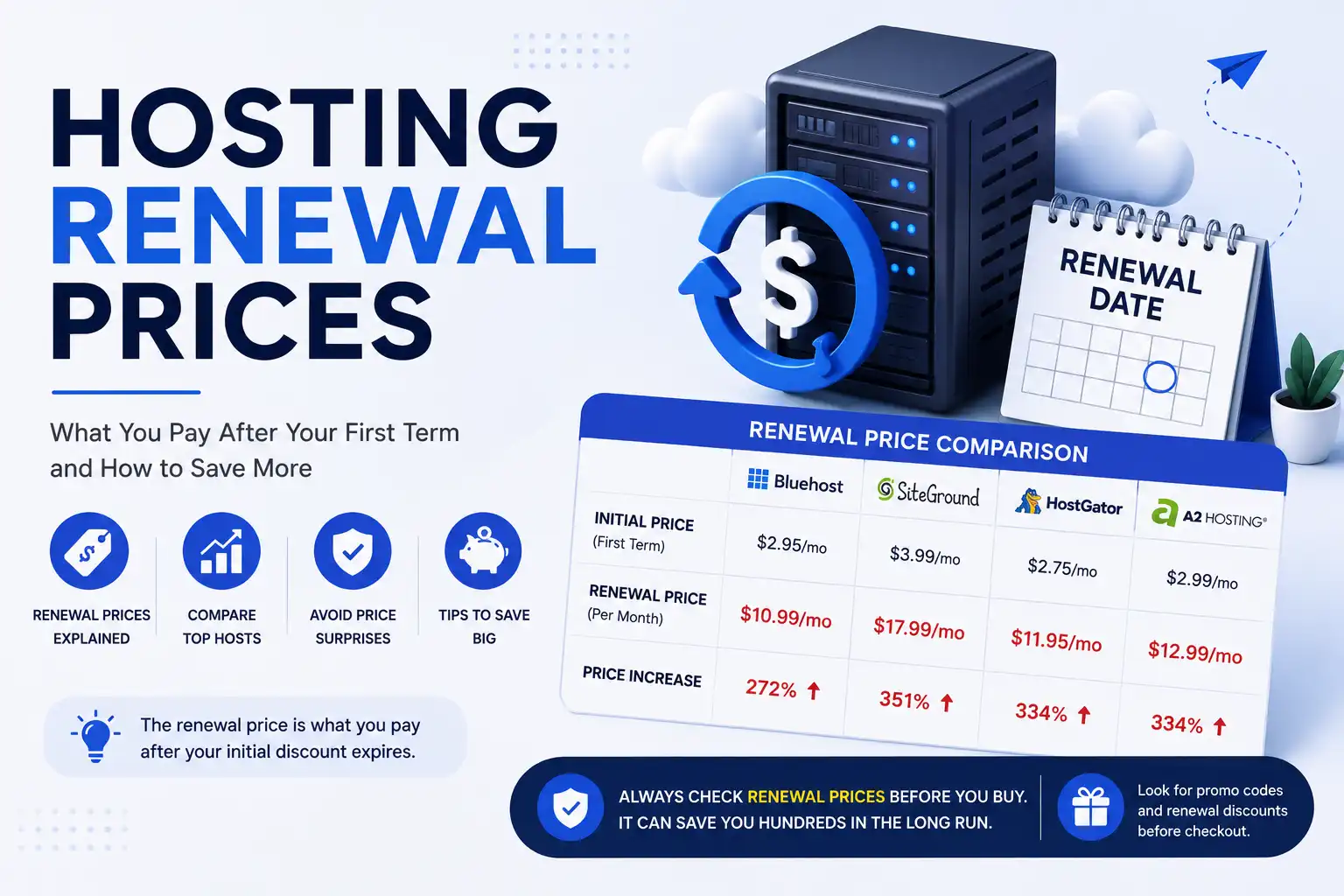
A $1.99 a month hosting plan can renew at $9.99 to $10.99 a month once the first term ends, an increase north of 400% that never shows up in the banner ad. That’s not one unusual provider, it’s close to the industry norm across the hosting category. But 3 of the 10 providers we checked for this piece don’t do this at all.
On This Page 12 sections
Here’s the real, sourced renewal pricing across every major hosting provider CouponZania tracks, pulled directly from each company’s own published pricing pages, not a marketing headline. Every dollar figure and percentage below is checked against the provider’s current, live pricing page as of this piece’s publish date, not an old cached snapshot.
Hosting isn’t unusual in using an introductory price this way, streaming subscriptions, gym memberships, and insurance policies all lean on a similar first year discount structure. What makes hosting worth a closer look is how wide the gap actually runs between providers, and how a couple of real exceptions in this list show the steep increase isn’t unavoidable.
- Renewal price increases run as high as 452% over the intro rate among the providers checked, with an average increase of roughly 288% across the 7 providers that actually raise prices at renewal.
- 3 of the 10 providers checked charge the same price at renewal as at signup, WPX Hosting, Liquid Web, and Cloudways, a real, genuine exception to how the rest of the industry prices hosting.
- HostArmada’s entry plan renews at roughly 400% above its intro price, and Hostinger’s Premium plan renews at approximately 452% above its own intro rate, the two steepest jumps found.
- One real documented HostPapa customer case saw a $461.47 renewal bill on a 3 year basic hosting plan, a concrete example of what these percentage increases actually cost in practice.
- MilesWeb’s renewal price matches your original price only if you keep the same term length, switching to a shorter term at renewal triggers a real price increase even there.
Provider pricing pages and documented customer cases, checked August 2026.
Why Nearly Every Host Prices This Way
Web hosting looks genuinely cheap in year one because the advertised price is an introductory rate, not the actual long term cost of the service. Hosts discount the first term heavily specifically to win the signup, then the plan renews at the provider’s real, standard rate once that first term ends, whether that’s 12, 24, or 36 months later.
A longer initial term lowers the upfront price further still, which creates a genuinely common misunderstanding, plenty of buyers assume a longer commitment locks in a lower long term rate. It doesn’t. Both a 12 month and a 36 month plan typically renew at the exact same standard rate once their respective first terms end, the longer term just delays and discounts that first bill, it doesn’t change what comes after.
The Real Numbers, Provider by Provider
Every figure below comes directly from each provider’s own published pricing pages or documented customer cases, using each company’s lowest tier or most commonly cited entry plan for a genuine like for like comparison.
| Provider | Intro Price | Renewal Price | Increase |
|---|---|---|---|
| Hostinger | $1.99/mo | $10.99/mo | +452% |
| HostArmada | $1.99/mo | $9.95/mo | +400% |
| HostPapa | $2.95 to $4.95/mo | Varies by plan | Up to +374% |
| DreamHost | $2.89/mo | $10.99/mo | +280% |
| Bluehost | $2.99/mo | $9.99/mo | +234% |
| ScalaHosting (VPS) | $29.95/mo | $82/mo | +174% |
| MilesWeb | $1.99/mo | $3.99/mo | +100% |
| Liquid Web (Cloud VPS) | $4.25/mo | $5.00/mo | +18% |
| WPX Hosting | $17.99/mo | $17.99/mo | 0% |
| Cloudways | $14/mo | $14/mo | 0% |
Entry tier pricing, each provider’s own pricing pages. HostPapa’s exact intro to renewal pair varies by specific plan and term, the percentage shown is the documented ceiling across cited examples. Checked August 2026.
Renewal price increase over intro rate, ranked highest to lowest, entry tier plans. Checked August 2026.
Providers grouped by whether renewal pricing increases over the intro rate. Checked August 2026.
The Business Reason Behind the Loss Leader Price
This pricing pattern isn’t random or accidental, it’s a deliberate customer acquisition strategy shared across nearly the entire hosting industry. Hosting companies compete overwhelmingly on the number shown in the ad or comparison table, so the intro price effectively functions as marketing spend disguised as a product price.
A provider that charged its real, standard rate from day one would look far more expensive next to a competitor’s discounted headline figure, even if the two ended up costing roughly the same over 3 years. Once a customer has already set up their site, moved their domain, and started actually using the service, the cost of switching to a different host, technical hassle, downtime risk, DNS propagation delays, becomes the provider’s real retention tool, not the price itself.
That dynamic is exactly why the 3 providers covered next stand out. Building a business around retaining customers through fair ongoing pricing, rather than through the friction of switching, is a genuinely different strategy than the rest of the category runs on.
The 7 Providers That Raise Prices, One by One
A single percentage figure per provider hides real differences in how each company actually structures its renewal pricing. Here’s what’s specifically going on with each of the 7 providers in this piece that do raise prices at renewal, beyond the headline number.
Hostinger shows the steepest jump found in this comparison, and its renewal pricing varies meaningfully by product line, shared hosting plans renew at roughly 4 to 5 times the intro rate, while VPS renewal has been reported increasing 140% to 232% depending on the specific tier chosen.
HostArmada follows a near identical pattern to Hostinger on its entry tier, with its Start Dock plan’s renewal price landing at roughly 400% above the $1.99 intro rate, among the steepest increases documented for this piece.
HostPapa does deserve credit on transparency even with a steep increase, it publishes renewal rates upfront rather than obscuring them, and documented cases show increases ranging from roughly 200% up to 374% depending on the plan and term length chosen.
DreamHost‘s increase varies unusually widely by product, from as little as 33% on its DreamPress managed WordPress plan up to roughly 301% on a 4 year shared hosting term, with its most commonly cited entry tier landing at approximately 280%.
Bluehost‘s renewal pricing has also been reported as not always clearly stated upfront at the point of purchase, with increases on its Starter tier landing around 234%, and some documented cases showing increases beyond 150% on other plans depending on term length.
ScalaHosting‘s VPS renewal increase, roughly 174% on its entry Build#1 tier, is real but still leaves its renewal price below what Cloudways and several other cloud VPS competitors charge even after the increase.
MilesWeb shows the smallest increase of the 7, roughly 100%, and carries the one genuine caveat covered in more detail below, its price stays flat at renewal specifically when the same term length is kept.
The 3 Providers That Don’t Play This Game
WPX Hosting, Liquid Web, and Cloudways stand apart from the other 7 providers checked for this piece in a genuinely real, structural way, not just a marketing claim. WPX charges the exact same price at renewal as at signup, no introductory discount that quietly disappears later.
Cloudways avoids the whole problem differently, through a usage based, pay as you go pricing model with no fixed term contract at all. You pay for the server resources you’re actually using each month, so there’s no separate “renewal” event where a discount expires, the price simply reflects your current usage every month, checkout to checkout.
Liquid Web’s Cloud VPS entry tier shows the smallest genuine increase found anywhere in this piece, just 18%, from $4.25 to $5.00 a month, functionally closer to WPX and Cloudways’ flat pricing than to the 100% plus jumps common across the rest of the category.
MilesWeb’s Real Renewal Rule Comes With a Catch
MilesWeb deserves its own specific mention, since its renewal policy is genuinely more nuanced than either the flat pricing group above or the steep increase group covered earlier. MilesWeb’s stated policy is that your renewal price matches your original purchase price only if you renew at the exact same term length you originally bought.
Switch to a shorter term at renewal time and the price goes up regardless, a real, specific condition worth checking before assuming this provider behaves like WPX or Cloudways above. Its entry tier renewal increase, roughly 100% from $1.99 to $3.99 a month, reflects what happens specifically when that same term length condition isn’t met.
What This Actually Costs a Real Customer
Percentages can feel abstract until they’re attached to a real bill. One documented HostPapa customer case shows a $461.47 renewal charge on a 3 year basic hosting plan, a genuinely large single payment for a service that likely cost a small fraction of that to originally sign up for.
HostPapa does deserve real credit on one specific point though, it publishes its renewal rates upfront rather than hiding them, meaning a buyer who actually checks before purchasing can see this coming rather than being surprised by it after the fact. The problem industry wide isn’t usually that renewal pricing is secret, it’s that almost nobody checks it before clicking buy on the much smaller number shown first.
Does the Type of Hosting Change the Renewal Pattern?
Shared hosting plans, the cheapest, most beginner friendly tier at nearly every provider in this piece, consistently show the steepest percentage increases, since their intro prices start so low that even a modest dollar increase looks enormous as a percentage. Hostinger’s shared plan increase of roughly 452% versus its own VPS increase of 140% to 232% on the same brand shows this pattern clearly within a single provider.
VPS and cloud hosting plans generally show gentler percentage swings, partly because their higher starting price leaves less room for a dramatic multiple, and partly because the buyers signing up for VPS hosting tend to be more technically informed shoppers who compare pricing more carefully before committing. Liquid Web’s 18% Cloud VPS increase and ScalaHosting’s 174% VPS increase, both meaningfully lower than the shared hosting figures from Hostinger or HostArmada, fit this same general pattern.
Managed WordPress hosting sits somewhere in between the two, DreamHost’s own DreamPress managed WordPress renewal increase, just 33%, is dramatically lower than its own shared hosting plan’s 280% figure, again inside the same single provider.
Average renewal increase grouped by hosting type, entry tier plans across the 10 providers checked. Checked August 2026.
Already Got Hit With a Renewal Charge? Here’s What Actually Helps
If a renewal charge already went through at a much higher rate than expected, contacting the provider’s support team directly is worth doing before assuming nothing can be done. Many hosting companies will apply a retention discount or match a current new customer promotion for an existing customer who asks, specifically to avoid losing that customer to a competitor entirely.
Downgrading to a lower tier plan at renewal, if your site’s actual resource usage allows it, is another real option worth checking before accepting the full charge. And if switching providers altogether makes sense for your situation, most hosting migrations for a single small to medium site can be completed within a day or two using tools like cPanel migration or a provider’s own free migration service, several providers in this comparison offer exactly that.
A Worked Example, 3 Years on the Same Plan
Take a hypothetical shared hosting plan priced at $1.99 a month for a 12 month intro term, a genuinely common structure in this category. The first year costs $23.88 total, a number that looks appealing enough to justify skipping any further research.
If that plan renews at $10.99 a month, the increase seen at the high end of this comparison, years 2 and 3 each cost $131.88, bringing the 3 year total to $287.64. Compare that against a plan priced higher upfront but with flat renewal pricing, say $17.99 a month across all 3 years, which totals $647.64 over the same period.
In this specific example the steep renewal plan still ends up cheaper over 3 years despite the dramatic percentage increase, which is exactly why checking the actual renewal price and running the real multi year math matters more than reacting to the percentage figure alone. The right choice depends entirely on how long you actually intend to keep the plan, a 1 year commitment and a 5 year commitment can favor genuinely different providers from this same list.
Total cost over 3 years, hypothetical example plans illustrating the math, not a specific provider quote.
How to Actually Avoid the Renewal Shock
- Find the stated renewal price before you buy, not after. Every provider covered in this piece publishes it somewhere, usually in the pricing page’s fine print or a dedicated renewal pricing page.
- Don’t assume a longer term locks in a lower long term rate. A 36 month plan and a 12 month plan on the same tier typically renew at the identical standard rate, the longer term just delays that renewal date further out.
- If minimizing long term cost matters more than the lowest possible first bill, weight WPX, Liquid Web, and Cloudways higher in your comparison, their flat or near flat renewal pricing can make them cheaper over a genuine 3 to 5 year horizon despite a higher looking intro price.
- Check MilesWeb’s specific term length condition if you’re considering it, the flat renewal only applies when you keep the exact same term length at renewal time.
- Set a calendar reminder before your renewal date regardless of provider, so you have time to compare a fresh new customer offer elsewhere against your current provider’s real renewal bill before it actually charges.
For the broader market context behind these numbers, uptime guarantees, provider market share, and how the wider hosting industry is actually growing, see our Web Hosting Market Statistics piece, and for a full breakdown of how each of these providers actually performs beyond price, our Best WordPress Hosting Providers guide and dedicated ScalaHosting review.
Frequently Asked Questions
Why do hosting plans renew at a much higher price than the intro rate?
The advertised price is a discounted introductory rate meant to win the signup, not the provider’s actual standard rate. Once that first term ends, whether 12, 24, or 36 months later, the plan renews at the real, undiscounted price, which is why the jump can look so dramatic if you never checked it beforehand.
Which hosting provider has the biggest renewal price jump?
Among the 10 providers checked for this piece, Hostinger’s entry tier showed the steepest increase, roughly 452% from a $1.99 intro rate to a $10.99 renewal rate, with HostArmada close behind at roughly 400%.
Are there any hosting providers that don’t raise prices at renewal?
Yes, 3 of the 10 checked. WPX Hosting and Cloudways both charge the same price at renewal as at signup, Cloudways through a usage based pay as you go model with no fixed contract, and Liquid Web’s Cloud VPS entry tier shows only an 18% increase, the smallest genuine jump found in this piece.
Does a longer hosting plan term lock in a lower renewal price?
No, this is a common misunderstanding. A 12 month and a 36 month plan on the same tier typically renew at the exact same standard rate, the longer term only delays and discounts the first bill, it doesn’t change the price you’ll actually pay once that term ends.
Does MilesWeb really keep the same renewal price?
Only under a specific condition, you have to renew at the exact same term length you originally purchased. Switching to a shorter term at renewal time triggers a real price increase even with MilesWeb, its stated policy is genuinely conditional, not unconditionally flat like WPX or Cloudways.
How much can a hosting renewal actually cost in real terms?
One documented HostPapa customer case shows a $461.47 charge for renewing a 3 year basic hosting plan, a real, dated example of what these percentage increases translate to as an actual bill rather than an abstract number.
How can I avoid a surprise hosting renewal charge?
Check the stated renewal price on the provider’s own pricing page before you buy, not after, since nearly every host publishes it even when it isn’t shown prominently. Setting a calendar reminder before your actual renewal date also gives you time to compare a fresh offer elsewhere against your current provider’s real bill.
Is a cheaper intro price ever still the better deal despite a steep renewal increase?
Sometimes, yes, it depends entirely on how many years you actually plan to keep the plan. A plan with a low intro price and a steep renewal increase can still cost less over 2 to 3 years than a plan priced higher but flat throughout, the real math only works out in the provider’s favor over a genuinely long multi year horizon.
Does Cloudways have a renewal price at all?
Not in the traditional sense. Cloudways runs on usage based, pay as you go pricing with no fixed term contract, so there’s no discounted intro rate that later expires, your monthly bill simply reflects the server resources you’re actually using that month.
Does shared hosting or VPS hosting show a bigger renewal increase?
Shared hosting consistently shows the steeper percentage increase across the providers checked here, since its very low starting price makes even a modest dollar increase look enormous as a percentage. Hostinger’s own shared plan increase, roughly 452%, dwarfs its VPS increase of 140% to 232% on the exact same brand.