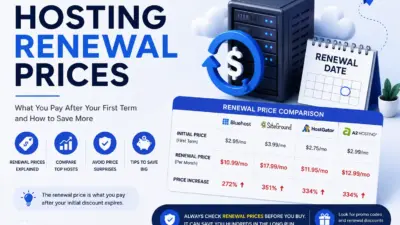
Hosting Renewal Prices 2026: What You Will Actually Pay After Year One
A $1.99 a month hosting plan can renew at $9.99 to $10.99 a month once the first term ends, an…
Best today: up to 85% off at Hostinger. 363 live offers from 75 brands, checked 19 Oct 2026.
The best of 363 live offers. Each card opens the store page with every live code.
 MilesWeb
 Bunny.net
 Scala Hosting
 Hostinger
 Namecheap
 Contabo
 GoDaddy
 Ultahost
 HostNoc
 Cloudways
 Ultra Web Hosting
 Bluehost
 Kamatera
 HostGator
 WPX Hosting
 One.com
 Godlike
 HostArmada
 Hostwinds
 Crazy Domains
 GURU UK
 eUKhost
 10Web
10Web
 Verpex
 Webhosting UK
 RackNerd
 Elementor
 StackPath
 BigScoots
 Bigrock
 Z.com
Z.com
 InterServer
 Apex Hosting
 Plesk
Plesk
 Name.com
 KnownHost
 DigitalOcean
 FastComet
 HostingSpell
 DomainFactory
MilesWeb
Bunny.net
Scala Hosting
Hostinger
Namecheap
Contabo
GoDaddy
Ultahost
HostNoc
Cloudways
Ultra Web Hosting
Bluehost
Kamatera
HostGator
WPX Hosting
One.com
Godlike
HostArmada
Hostwinds
Crazy Domains
DomainFactory
MilesWeb
Bunny.net
Scala Hosting
Hostinger
Namecheap
Contabo
GoDaddy
Ultahost
HostNoc
Cloudways
Ultra Web Hosting
Bluehost
Kamatera
HostGator
WPX Hosting
One.com
Godlike
HostArmada
Hostwinds
Crazy Domains
No offers match. Clear a filter to see more.
 MilesWeb9 offers
 Bunny.net8 offersScala Hosting7 offers
 Hostinger21 offers
 Namecheap9 offers
 Contabo11 offers
 GoDaddy16 offers
 Ultahost10 offersHostNoc6 offers
 Cloudways8 offers
 Ultra Web Hosting6 offers
 Bluehost9 offers
 Kamatera6 offers
 HostGator8 offers
 WPX Hosting12 offersOne.com5 offers
 Godlike3 offers
 HostArmada8 offers
 Hostwinds2 offers
 Crazy Domains7 offers
 GURU UK3 offers
 eUKhost7 offers
 10Web3 offers
 Verpex5 offers
 Webhosting UK6 offers
 RackNerd5 offers
 Elementor7 offersStackPath1 offer
 BigScoots7 offers
 Bigrock12 offers
An uptime guarantee of 99.9% sounds close to perfect, but it still allows almost nine hours of downtime a year. That is why the details behind hosting marketing, such as renewal prices, server location, backups and support, decide whether a plan is good value.
Web hosting ranges from a few dollars a month for a shared plan to hundreds for dedicated servers. This category covers shared, VPS, cloud, managed WordPress and game server hosting, from Hostinger, Bluehost, HostGator, Namecheap, A2 Hosting and ChemiCloud to Cloudways, Kinsta, WP Engine, DigitalOcean, Vultr, Linode, OVHcloud and Contabo.
Domain names are in Domains, security certificates in SSL, and WordPress plugins in WordPress.
| Type | Examples here | Best for |
|---|---|---|
| Shared hosting | Hostinger, Bluehost, HostGator, Namecheap, DreamHost | New and small sites |
| Managed WordPress | Kinsta, WP Engine, Rocket.net, WPX Hosting, Nexcess | Busy WordPress sites without server work |
| Cloud and VPS | DigitalOcean, Vultr, Linode, Contabo, Cloudways | Developers and growing sites |
| Dedicated and enterprise | Liquid Web, OVHcloud, InterServer, KnownHost | High traffic and custom setups |
| Game servers | Apex Hosting, Shockbyte, Nitrado, Godlike | Minecraft and multiplayer games |
Shared hosting puts many websites on one server, which keeps it cheap but means a busy neighbor can slow your site. A VPS gives you a guaranteed slice of a server's resources, and cloud hosting spreads your site across infrastructure that can scale up when traffic grows.
Dedicated servers give you a whole machine, for the most control and performance. Most new sites start on shared hosting and move up only when traffic or speed demands it.
Managed hosts such as Kinsta, WP Engine and Cloudways handle server updates, caching, backups and security for you. Unmanaged VPS providers such as DigitalOcean and Vultr give you a bare server, which is cheaper but assumes you can configure and secure it yourself.
If you do not want to manage a server, the extra cost of managed hosting usually pays for itself in time saved.
The headline price on most hosting plans applies only to the first term, often when you prepay for several years. Renewal prices are frequently two or three times higher, so check the renewal rate before signing up.
Longer first terms lock in the discount for longer, but they also lock you in if the host turns out to be a poor fit. Check the refund window, commonly 30 days, before paying for years upfront.
A server closer to your visitors responds faster, so pick a data center in or near the country where most of your audience lives. A content delivery network, such as Cloudflare or Bunny.net, stores copies of your files around the world and narrows that gap.
Page speed feeds into Google's Core Web Vitals, which Google names as part of page experience in its ranking systems.
Plans sold as unlimited still have fair use limits, often on CPU, memory or the number of files. Read the acceptable use policy to see what actually triggers a suspension or an upgrade request.
SSD or NVMe storage is faster than older hard drives. For most small sites, memory and CPU limits matter more than disk space.
Check how often the host backs up your site, how long backups are kept and whether restoring them is free. Some cheap plans charge for restores or keep backups for only a few days.
Keep your own copy as well, stored somewhere other than the hosting account. A host's backup does not help if the account itself is lost.
Good hosts include free SSL certificates, a web application firewall, malware scanning and isolation between accounts on shared servers. Automatic updates for PHP and the server software also close common security holes.
Round the clock live chat is standard now, but the knowledge of support staff varies widely. Test support before buying with a technical question and see how quickly and clearly they answer.
Many shared plans include email accounts, while cloud and managed WordPress hosts often do not. Dedicated email services can be more reliable for business mail, so budget for them if your host does not include email.
Game server hosts such as Apex Hosting, Shockbyte and Nitrado run servers for games such as Minecraft, ARK and Rust, with control panels built for installing mods and managing players. Memory is the main factor, since each player and mod adds load.
Choose a location close to your players to keep latency low, and check whether the plan allows the mods you want.
Many hosts offer free site migration for new customers. Move before your old plan renews, keep the old account running until the new site is checked, and lower your DNS record time to live ahead of the switch to speed up the change.
Hosting companies run their biggest discounts around Black Friday and Cyber Monday, often on multi year plans. Some also run sales on their company anniversaries.
Hosting coupons usually apply to the first term only, so the longest term you are comfortable with gets the most from the code. Compare the total over three years, including renewals, rather than the monthly figure in the advert.
A $1.99 a month hosting plan can renew at $9.99 to $10.99 a month once the first term ends, an…
Shopify hosts more websites than any single traditional hosting company on earth, 5.3% of the entire web as of August…
Picking a WordPress host is easy to get wrong in a way that doesn’t show up for months, a plan…