BOGO Statistics 2026: Why Buy One Get One Beats a Discount
-
 Written by
Rajat Singh
Written by
Rajat Singh
- Published
- Read time 14 min read
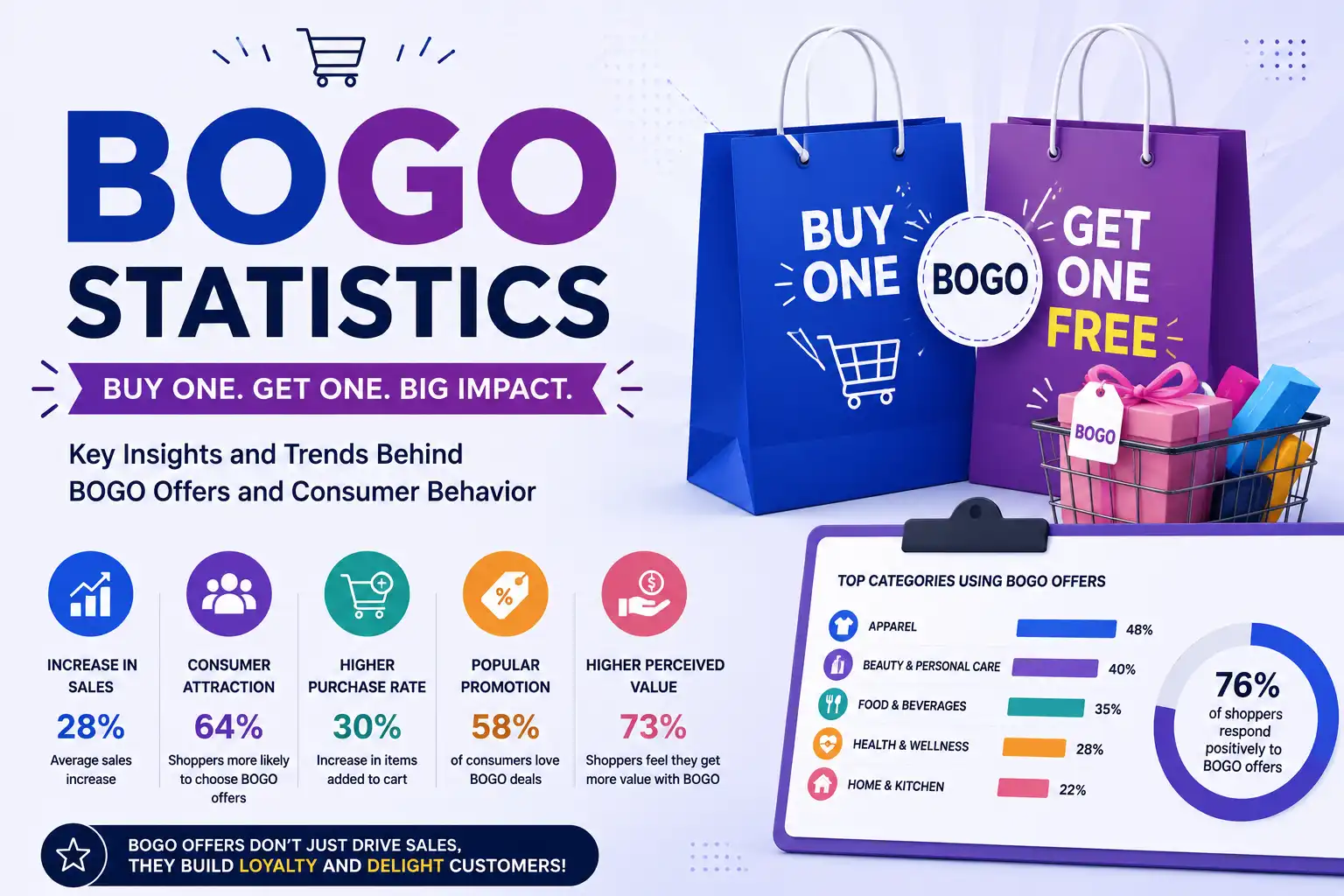
A 2012 controlled study published by The Economist sold the exact same hand lotion two entirely different ways, once packaged as a bonus pack, buy one get a second one free, and once at an equivalent straight percentage discount instead. The bonus pack sold 73% more units, even though a shopper doing the actual math would find the two offers worth roughly the same amount of real money in their pocket.
On This Page 11 sections
That gap is the entire reason BOGO exists as its own distinct offer format rather than just another way to write a percentage off. The word “free” does something to a shopper’s brain that an equal value discount simply doesn’t, and the real data behind that effect explains a lot about how retailers actually structure their promotions.
- Buy one get one free promotions outsold an equivalent percentage discount by 73% in a controlled 2012 study on hand lotion, despite the two offers carrying identical real world savings.
- 61% of consumers say they prefer BOGO style deals over other discount formats when making a purchasing decision, and shoppers choose BOGO over an equal value price cut even when told the two are worth the same.
- 50% of shoppers say they’d switch brands or retailers entirely for a BOGO deal, a genuinely strong purchase driver compared to most other promotional formats.
- A well run BOGO campaign can hit a 70% redemption rate, based on real retailer data, a high bar for any promotional code format to clear.
- India’s fashion retailers cut average markdowns from 44% in 2024 to 34% in 2025, per Fynd’s Festive Readiness Report, shifting spend toward value framed formats like BOGO instead of ever deeper flat percentage cuts.
Consumer research and retailer case study data, checked August 2026.
Why “Free” Beats an Equal Value Discount
Behavioral researchers have a specific, well documented name for what’s actually happening here, the zero price effect. When something genuinely costs nothing, the normal cost benefit calculation a shopper’s brain would otherwise run largely shuts itself off entirely, and the perceived value of that free item ends up meaningfully higher than its real, actual dollar value would ever justify on its own merits.
The Economist, 2012 controlled hand lotion pricing study. Checked August 2026.
Shoppers consistently choose a BOGO offer over an equal value percentage discount even when both are explained as carrying identical real savings, a genuinely counterintuitive result if you assume shoppers are purely rational calculators comparing final prices. Price conscious shoppers who actively track offers and discounts respond to BOGO promotions especially strongly, since the format rewards exactly the kind of deal seeking behavior that group already engages in.
How Strongly Shoppers Actually Prefer This Format
61% of consumers report preferring BOGO style deals specifically when making a purchasing decision, a real majority preference over other discount formats available to them. That preference translates directly into purchase intent and satisfaction, not just a stated opinion in a survey with no real behavior attached to it.
The brand switching data is even more striking for retailers to consider. 50% of shoppers say they’d switch brands or buy from a competing retailer entirely for a BOGO deal, according to 2025 research, a genuinely strong lever for customer acquisition specifically, not just for driving incremental sales among shoppers already loyal to a brand.
Preferred Doesn’t Always Mean Redeemed More
Here’s a genuine tension worth sitting with rather than glossing over. Shoppers say they prefer BOGO, 93% of consumers report taking advantage of a BOGO offer at least once, and shoppers choose BOGO over an equal value percentage discount at roughly 3 times the rate when the two are presented side by side. But percentage off coupons actually redeem at a higher rate than BOGO offers do once you look at aggregate real world redemption data across the industry, not just stated preference in a survey.
That gap between preference and redemption has a straightforward explanation. A percentage off coupon applies to almost anything in a cart with minimal friction, while a BOGO offer usually requires buying 2 specific, often matching or qualifying items to unlock the free one, a real, extra decision step that filters out shoppers who liked the idea of the deal but weren’t already planning to buy 2 of something. BOGO wins on preference and brand switching specifically, percentage off wins on raw redemption volume across a broader base of shoppers.
The Category That Actually Runs the Most BOGO Deals
Grocery and supermarket retail is where BOGO actually dominates the promotional mix most heavily, not the beauty and fashion categories covered later in this piece. 80% of supermarket promotions in the US specifically run as BOGO or 3 for 2 offers, making it the single most common discount format in that entire retail category.
Share of each retailer’s own total promotional mix structured as BOGO specifically. Checked August 2026.
That’s not a static picture either, individual retailers are moving in real, measurably different directions on how heavily they actually lean into the format. H-E-B grew its own BOGO share from 17% of total promotions in 2023 to 26% by 2025, a real, deliberate strategic shift toward the format over that specific 2 year window, while Albertsons moved in the completely opposite direction, dropping to under 3% of its promotions run as BOGO in that exact same window. Retailers competing in the exact same grocery category are making genuinely opposite strategic bets on how much weight to put behind this one specific promotional format.
Adoption also splits by generation more than you might expect. Gen X shoppers show the highest BOGO usage at 55%, narrowly ahead of both Millennials and Gen Z, who each report using BOGO discounts at 54%, a genuinely even spread across age groups rather than a format that skews toward any single generation.
Where BOGO Offers Actually Get Abused
Promotional offer abuse is a real, documented problem for retailers running BOGO and similar deals, not a rare edge case. A full 1/3 of shoppers surveyed admitted to opening a new email account specifically to reuse a promotional offer they’d already redeemed once, exactly the kind of single use restriction most BOGO and first order discounts are built around, covered in more depth in our companion First Order Discount Guide.
Nearly half of consumers, 45%, admit to some action that counts as a form of return or promotional policy abuse more broadly, everything from exploiting extended return windows to gaming seasonal pricing by buying during a promotional window and returning once prices rise again. That’s exactly why so many BOGO offers now come with the specific guardrails covered elsewhere on this site, purchase limits, exclusions, and single account restrictions, they exist because the abuse is real and well documented at scale, not because retailers are being unnecessarily restrictive.
What a Genuinely Good Redemption Rate Looks Like
One documented clothing retailer case distributed 1,000 BOGO coupons and saw 700 actually redeemed, a 70% redemption rate the retailer itself considered a clear success. That’s a meaningfully higher bar than most promotional code formats clear, where redemption in the low double digits is often treated as perfectly normal.
BOGO promotions consistently rank among the highest performing incentive types across fashion, FMCG, and direct to consumer subscription categories specifically, lifting average order value, speeding up inventory turnover on the paired product, and nudging shoppers toward a repeat purchase down the line. Retailers can also structure a BOGO offer to protect margin rather than simply eating the full cost of the free item, by limiting which products qualify, capping how many times one customer can redeem it, or targeting the offer at a specific customer segment rather than running it sitewide.
BOGO Now Lives Mostly on a Phone Screen
Where a BOGO offer actually gets discovered and redeemed has shifted decisively toward mobile in recent years, a real, measurable change from the print circular era the format originally grew up in. 93.8% of digital coupon users specifically redeem through a smartphone rather than any other device, and inside a physical store specifically, 40% of shoppers now use their phone to look up discounts and promotions while they’re standing in the aisle.
That shift is happening inside a genuinely large and still growing overall market. Digital coupon revenue is projected to reach $12.6 billion in 2026, a real reflection of how much of promotional retail has moved from a paper circular to a phone screen.
Redemption rates still vary meaningfully by exactly how a digital offer gets delivered though, a gap worth knowing if you’re comparing why one channel seems to convert better than another for the exact same underlying offer.
Digital coupon redemption rate by delivery channel. Checked August 2026.
For a BOGO offer specifically, that in store advantage makes real practical sense. A shopper already standing in front of the qualifying product, phone in hand, has already cleared the exact friction point covered earlier in this piece, actually having 2 qualifying items in reach, making an in aisle digital BOGO prompt a genuinely easier conversion than one delivered days earlier through an app notification or email.
How Long a BOGO Campaign Should Actually Run
The right campaign length depends specifically on what the retailer is trying to accomplish, and the two ends of the typical range serve genuinely different purposes.
| Campaign Length | Best Suited For |
|---|---|
| 3 to 7 days | Flash sales, inventory clearance, creating real time pressure urgency |
| 10 to 14 days | Product launches, seasonal sales, giving shoppers more time to discover and act |
Retail promotional campaign structuring research. Checked August 2026.
A shorter window trades reach for urgency, useful specifically when clearing existing stock matters more than maximizing total redemptions. A longer window trades urgency for reach, better suited to a genuine new product launch where the goal is introducing as many shoppers as possible to something they haven’t tried yet, exactly the kind of trial the brand switching data covered earlier suggests BOGO is unusually good at driving.
Why India’s Retailers Are Leaning Into BOGO Right Now
Flat percentage discounts are genuinely losing their pull across Indian fashion and lifestyle retail specifically, a real, measured shift rather than a marketing narrative. Fynd’s Festive Readiness Report 2026 found average markdowns across major fashion and lifestyle marketplaces fell from 44% in 2024 to just 34% in 2025, a meaningful pullback in how deep the average flat discount actually runs.
That pullback tracks directly with a specific shift in what younger Indian shoppers actually respond to. The 18 to 35 age group driving a large share of India’s fashion consumption is value conscious in a particular way, not simply hunting for the single lowest price, but looking for the feeling of having made a genuinely smart decision. A BOGO offer delivers that feeling more reliably than a same value percentage cut does, consistent with the zero price effect covered earlier in this piece.
India’s beauty and personal care market, valued at $17.77 billion, and its fashion retail market, worth more than ₹6 trillion, are exactly the two categories where this shift shows up most heavily in practice, and not coincidentally, exactly where BOGO offers concentrate most heavily across the stores covered in the next section.
Real Stores Currently Running BOGO Offers
CouponZania tracks active BOGO offers across 57 stores as of this check, concentrated heavily in the exact categories the data above would predict.
- Mamaearth, Plum, and Pilgrim, beauty and personal care, the single most heavily represented category in CouponZania’s BOGO listings.
- Max Fashion and Allen Solly, fashion, where India’s markdown pullback covered above is showing up most directly.
- Casetify, accessories, where a paired free item works especially well on lower cost add on products like phone cases.
- PharmEasy, health and pharmacy, a category where BOGO on wellness and personal care items drives genuine trial of new product lines.
- BookMyShow, entertainment, proof the format extends well beyond physical retail into ticketing and experiences too.
Browse the full, current list on our BOGO Buy 1 Get 1 collection page, and for the companion offer mechanic in this same deal type family, see our First Order Discount Guide.
None of the numbers in this piece point to BOGO as a universally superior format over every other kind of discount. It’s genuinely better at winning brand switchers and driving stated preference, genuinely more prone to promotional abuse without the right guardrails, and genuinely weaker on raw redemption rate than a simple percentage off code once friction enters the picture.
What the data actually supports is narrower and more useful than a blanket verdict, BOGO is the right tool specifically when a retailer’s real goal is introducing a shopper to something new, not simply squeezing more revenue out of a purchase they were already going to make anyway.
Frequently Asked Questions
Is a BOGO deal actually better than an equivalent percentage discount?
Financially they’re often close to identical, but behaviorally BOGO wins clearly. A 2012 controlled study found buy one get one free outsold an equivalent percentage discount by 73%, driven by the zero price effect, the perceived value boost that comes specifically from something being labeled free rather than discounted.
Do most shoppers actually prefer BOGO deals?
Yes, a real majority. 61% of consumers report preferring BOGO style deals over other discount formats when making a purchase decision, and research shows shoppers choose BOGO over an equal value price cut even when told the two carry identical savings.
Will people actually switch brands for a BOGO offer?
Yes, at a genuinely high rate. 50% of shoppers say they’d switch brands or buy from a competing retailer specifically for a BOGO deal, making it an unusually strong format for winning new customers rather than just rewarding existing ones.
What’s a good redemption rate for a BOGO campaign?
One documented retailer case hit 70%, distributing 1,000 coupons and seeing 700 redeemed, a bar well above what most promotional code formats typically achieve. BOGO consistently ranks among the highest performing incentive types across fashion, FMCG, and DTC categories specifically.
How long should a BOGO sale typically run?
It depends on the goal. Shorter campaigns of 3 to 7 days work best for flash sales and inventory clearance, creating real urgency, while longer 10 to 14 day campaigns suit product launches and seasonal sales better, giving shoppers more time to discover and act on the offer.
Why are Indian retailers using BOGO more instead of flat discounts?
Average markdowns across major Indian fashion and lifestyle marketplaces fell from 44% in 2024 to 34% in 2025, per Fynd’s Festive Readiness Report, as flat percentage discounts lose their pull with younger, value conscious shoppers who respond more strongly to a BOGO offer’s feeling of a smart decision made.
What is the zero price effect?
A behavioral economics finding that something costing nothing shuts off a shopper’s normal cost benefit calculation almost entirely, making the perceived value of a free item higher than its actual dollar value alone would justify. It’s the core psychological mechanism behind why BOGO consistently outperforms equal value discounts.
If shoppers prefer BOGO, why do percentage off coupons redeem more?
A BOGO offer requires buying 2 specific items to unlock the free one, an extra decision step that filters out shoppers who liked the idea but weren’t already planning that purchase. A percentage off coupon applies to almost anything in a cart with far less friction, which is why it wins on raw redemption volume even though BOGO wins on stated preference and brand switching.
Which retail category runs the most BOGO promotions?
Grocery and supermarket retail, by a wide margin. 80% of US supermarket promotions run as BOGO or 3 for 2 offers, with Publix structuring roughly 40% of its total promotions as BOGO specifically, the heaviest use of the format among major grocery chains tracked.
Do people actually abuse BOGO and promotional offers?
Yes, at a real, documented scale. A third of shoppers surveyed admitted to opening a new email account specifically to reuse a promotional offer they’d already redeemed once, and 45% of consumers admit to some form of return or promotional policy abuse more broadly, which is exactly why most BOGO offers carry purchase limits and single account restrictions.
Where do most shoppers actually redeem a digital BOGO offer?
Increasingly on a phone, and specifically while already standing in a store. In store digital coupons redeem at 6.7%, a real edge over the 5.2% redemption rate general mobile app coupons see, since a shopper already holding the qualifying product has already cleared the biggest friction point a BOGO offer creates.