Successful Coupon Campaigns: The Real Case Studies
-
 Written by
Rajat Singh
Written by
Rajat Singh
- Published
- Updated
- Read time 15 min read
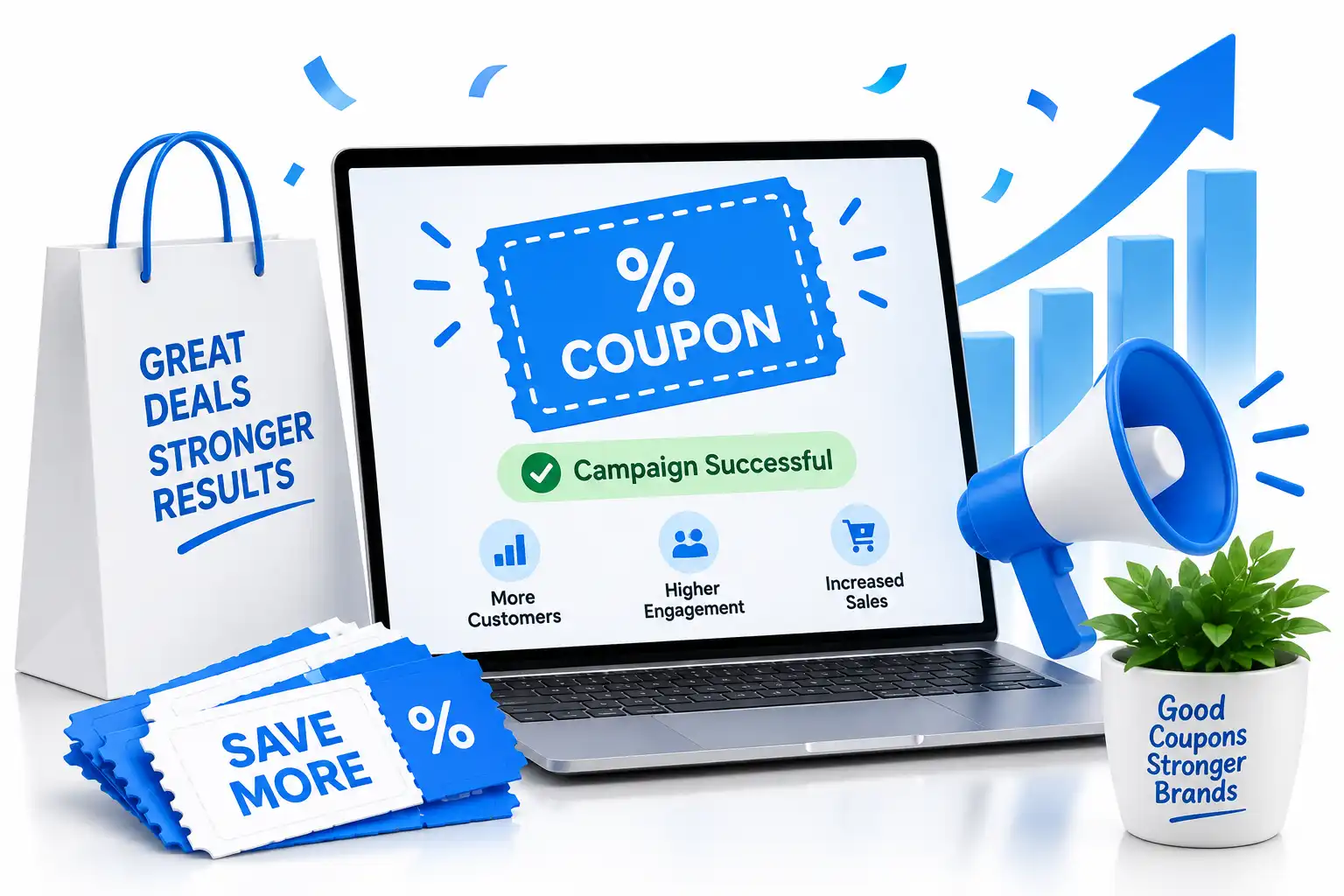
Coupons remain one of the most reliable tools connecting businesses and consumers, and the real data behind them is more interesting than most marketing case studies let on. Some of the most famous coupon campaigns in retail history were genuine successes. Others, told honestly, are cautionary tales that still get repeated as success stories.
On This Page 6 sections
This guide walks through both kinds, with the real, currently verifiable numbers behind each one, plus what actually holds up as a lesson for building a campaign today.
- The US digital coupon market reached $10.6 billion in 2025, up from $8.96 billion in 2024, with 169.2 million Americans redeeming a digital coupon that year.
- Groupon’s active customer base has fallen from a real 2013 peak near 42.6 million to about 16.1 million in 2026, a genuine decline the daily deal model never recovered from.
- J.C. Penney’s 2012 coupon elimination is one of retail’s most severe self inflicted disasters: sales fell $4.3 billion in a single year, and even after coupons returned, many customers never did.
- Target’s Cartwheel app, often cited as a coupon success story, was actually discontinued in 2019 and folded into Target Circle, which now has more than 100 million members.
- The 1983 American Express Statue of Liberty campaign is widely credited as the true origin of cause based marketing, and its real, documented numbers still outperform most modern claims made in its name.
The Real Scale of Coupon Marketing Today
Coupons work by tapping directly into consumer psychology, urgency, perceived value, and the simple pleasure of getting a good deal. The scale behind that psychology, measured in real current numbers, is larger than most people assume.
Digital now accounts for roughly a third of all coupon redemptions, with the remaining two thirds still moving through print, in store, and mailed formats. Both channels remain genuinely active, they simply serve different shopping habits.
Share of coupon redemptions by channel, US, 2025.
Survey data on repeat behavior tells a consistent story too. In industry research on first time coupon use, 57% of shoppers said a coupon led them to buy from a brand they had not tried before, and 91% of that group went on to purchase from the same retailer again. A well designed coupon is not just a one time discount, it is frequently a genuine acquisition tool.
Anatomy of a Successful Coupon Campaign
Before the case studies, five elements show up consistently across the campaigns that actually worked, and their absence explains most of the ones that did not. Every case study below either had all five in place or is a clear example of what happens when one of them is missing.
- Audience understanding. Campaigns built around a specific, well understood customer segment consistently outperform generic, broad discounts.
- A genuinely compelling value proposition. The discount has to feel significant enough to change behavior, not just pad a receipt.
- The right distribution channels. Apps, email, social platforms, and in store promotion all reach different segments of the same audience.
- Real urgency and exclusivity. A genuine time limit or limited availability drives faster decisions than an open ended offer.
- Measurable goals from day one. Redemption rate, customer acquisition cost, and return on investment need to be tracked as the campaign runs, not estimated afterward.
Case Studies, Told With the Real Numbers
1. Groupon: A Genuine Revolution That Did Not Fully Last
Groupon genuinely reinvented local group discounting, partnering with local businesses on deep, time limited deals and building real virality through group buying thresholds that made the offer feel like a shared event rather than a solo purchase.
Groupon’s active customer base peaked around 42.6 million in 2013. By 2026, that figure sits closer to 16.1 million, a real, sustained decline of well over 60% from peak, even as the company’s revenue has recently stabilized around $513 to $523 million in 2026 guidance after years of decline.
The honest lesson: group buying and urgency genuinely drive explosive short term growth, and Groupon’s playbook proved that beyond doubt. The lasting lesson is that a coupon model built entirely around new customer acquisition, without a credible path to retaining them at full price, has a ceiling that shows up eventually in the numbers.
Groupon itself has adapted rather than disappeared, shifting emphasis toward local experiences and services with better repeat purchase economics than the one time restaurant and spa deals that defined its early years. The company that invented the daily deal category is still standing, just at a fraction of its former scale, which is arguably the more instructive version of this story than either a total collapse or an unbroken success would have been.
2. J.C. Penney: What Actually Happens When Coupons Disappear
In 2012, J.C. Penney’s new CEO, Ron Johnson, arrived fresh off a genuinely successful run building Apple’s retail stores and eliminated most coupons and sales events in favor of a simplified “everyday low prices” strategy. The logic looked sound on paper, simpler pricing, less promotional clutter, a cleaner brand.
The results were not a slow decline, they were immediate and severe.
- Total sales fell $4.3 billion in a single year, a 25% drop.
- Same store sales fell 25.2% for the year.
- Fourth quarter same store sales fell 32%, described by multiple outlets at the time as the worst quarter in retail history.
- The CEO behind the strategy was ousted after just 17 months.
J.C. Penney’s shoppers, it turned out, were not simply buying products, they were buying the experience of finding a deal. Removing that experience entirely, even while lowering some list prices, read to loyal customers as the store no longer being for them.
Coupons and familiar sales events were reinstated once new leadership took over, and foot traffic did recover somewhat. But the honest ending to this story, confirmed by later retail reporting, is that a meaningful share of J.C. Penney’s original customer base never came back at all, even after the coupons returned.
The real lesson: for a retailer whose brand identity is built around deal seeking behavior, a coupon program is not a discretionary marketing line item, it is core to what customers believe the store actually is. Removing it is not a pricing decision, it is a brand identity decision, and this case study is the clearest evidence in modern retail of how expensive that mistake can be.
What made the strategy fail was not that lower everyday prices are inherently a bad idea. It was that the strategy misjudged what J.C. Penney’s specific customer base actually valued about shopping there.
Apple customers were buying a product they already wanted at a fixed, trusted price. J.C. Penney’s customers were buying the hunt itself, the coupon, the sale event, the feeling of having found a bargain, and that experience simply cannot be replaced by a lower list price alone.
3. Pizza Hut: The Shift to App Based Digital Coupons
Pizza Hut, along with most major restaurant chains, shifted coupon distribution heavily toward its own app based ordering system over the past several years, moving away from mailed coupon books and print inserts as the primary channel.
The strategy layered app exclusive discounts with gamified rewards for repeat ordering, and personalized offers based on prior order history rather than a single blanket discount for every customer. Push notifications reminded users of expiring offers, tightening the loop between discovery and redemption.
The real lesson: this shift is now industry standard across quick service and delivery focused restaurant chains, not a Pizza Hut specific innovation. An app that already holds a customer’s order history and payment details can personalize a coupon far more precisely than a mailed insert ever could, and the data collected from every redemption compounds the targeting for the next one.
The scale behind this shift is real and current. 71% of quick service restaurants now offer a loyalty program, with adoption projected to reach 80% by the end of 2025, and loyalty driven transactions grew 28.5% year over year across more than 30,000 restaurants tracked in 2025, totaling $26 billion in loyalty sales.
93% of loyalty program members now check for a deal before even deciding where or what to eat, and loyalty specifically influences the decision for 61% of delivery customers. A restaurant without a coupon delivery mechanism inside its own app is, for a majority of frequent customers, effectively invisible at the exact moment they are deciding where to order.
4. Uber Eats: First Order Discounts as an Acquisition Engine
Food delivery platforms, including Uber Eats, have relied on first order discounts to acquire new users since the category’s earliest days, and the strategy is still very much active. Current promotions in 2026 typically offer $10 to $30 off a first order, often requiring a minimum order size and delivered through a personal referral code rather than a blanket public coupon.
Referral codes serve a second purpose beyond the discount itself, they turn every existing customer into a distribution channel, since the referring user typically earns a credit too. Geo targeting lets a platform concentrate offer spend in specific regions where a competitor is strongest, rather than spreading a fixed budget evenly everywhere.
The real lesson: a generous first order discount is a genuinely proven acquisition tactic in categories with low switching costs and frequent repeat purchases, which is exactly why it has remained a permanent fixture of food delivery marketing for over a decade rather than a one time launch tactic.
It has also gotten considerably more expensive to run. Customer acquisition cost across food delivery apps has climbed to roughly $45 to $85 per new user industry wide, well above the $15 to $20 range platforms budgeted for in the category’s earlier years. Uber Eats currently holds about 23% of the US market, behind DoorDash’s 56% and ahead of Grubhub’s 16%, a competitive gap that makes an effective first order coupon even more important to defend share rather than optional.
5. Target Circle: What Actually Replaced Cartwheel
Target’s Cartwheel app is frequently cited in older marketing content as a coupon success story, and it genuinely was one while it existed. What most of that content leaves out is that Cartwheel was discontinued in October 2019, folded entirely into Target’s new loyalty program, Target Circle. Accounts and savings history transferred automatically, but the standalone app itself no longer exists.
Target Circle has grown into one of retail’s largest loyalty programs, passing 100 million members, with more than 75% of Target’s transactions now involving a loyalty member. Members spend an average of 3 times more than non members, and shoppers on the paid Circle 360 tier spend around 8 times more while shopping roughly 6 times more frequently.
The real lesson: Cartwheel’s actual legacy is not that a standalone coupon app succeeded and stayed unchanged. It is that Target correctly recognized personalized, gamified coupon delivery worked well enough to become the foundation of a much larger loyalty program, then evolved the product rather than protecting the original app for its own sake.
Target also added 13 million new loyalty members in a single year, 2024, and over 70% of the company’s total sales now come from repeat customers. Anyone citing Cartwheel specifically as a still active example in 2026 is citing a product that has not existed for more than five years, a reminder that even a genuinely successful coupon program needs to be checked against its current status before being held up as a model to copy.
6. American Express: The Campaign That Invented Cause Marketing
In 1983, American Express ran a promotion tying card usage directly to the restoration of the Statue of Liberty, donating one cent for every card transaction and a dollar for every new card issued during the campaign period. It is not, strictly speaking, a coupon campaign. It is worth including because it is the case most marketing historians credit with inventing the entire discipline of cause based marketing that later coupon campaigns, including cause linked coupon books still run by grocery chains and CPG brands today, are built on.
The results were real and well documented at the time. Card usage jumped 28% during the promotional period, and new card applications rose 45%. The campaign ultimately raised over $1.7 million toward the statue’s restoration.
The real lesson: tying a purchase to a visible, specific cause, not a vague corporate responsibility statement, genuinely moves real purchase behavior, and has for more than four decades. Modern cause linked coupon programs, where a redemption triggers a specific, named donation, are direct descendants of this exact mechanic, and the ones that work today still follow the same core structure Amex proved out in 1983.
The specificity is what made it work, and it is the part most modern imitators skip. Amex did not ask customers to support “a good cause,” it named an actual landmark, gave a concrete dollar amount per action, and set a defined end date. A coupon campaign that donates a vague, unstated amount to an unnamed charity is borrowing the emotional appeal of cause marketing without the concrete specificity that made the original campaign measurably effective.
What Each Campaign Actually Proves
| Campaign | Real Result | Actual Takeaway |
|---|---|---|
| Groupon | Peak 42.6M active customers (2013), ~16.1M by 2026 | Acquisition without a retention plan has a ceiling |
| J.C. Penney | Sales fell $4.3B (25%) the year coupons were cut | Coupons can be core to brand identity, not just pricing |
| Pizza Hut | Industry wide shift to app based, personalized offers | Order history enables far sharper targeting than print |
| Uber Eats | First order discounts still active a decade later | Works reliably where switching costs are low |
| Target Circle | 100M+ members, 3x to 8x higher member spend | A coupon app can become a full loyalty ecosystem |
| American Express | +28% card usage, +45% new applications, 1983 | A specific, visible cause outperforms a vague one |
Best Practices for Building a Campaign Today
1. Build From Real Customer Data
Segment actual purchase history and behavior before designing an offer, rather than guessing at what a generic customer wants.
2. Lean Into the Channels Customers Already Use
93.5% of coupon redemptions are expected via smartphone in 2025, which makes a mobile first distribution channel the default, not an optional add on.
3. Make Urgency Genuine
A real, enforced expiration date prompts faster decisions. An urgency claim customers learn is not actually enforced trains them to ignore it on every future offer.
4. Reward Repeat Engagement, Not Just First Use
Both Pizza Hut’s and Target’s real results came from rewarding continued use, not just a single redemption, which is exactly the retention layer Groupon’s model never fully built.
5. Track Redemption Against Actual Repeat Purchases
Redemption rate alone does not tell you whether a campaign built lasting customers or simply subsidized a one time bargain hunt. Track the second purchase, not just the first.
Every case study above makes the same point from a different direction. Groupon proved acquisition without retention has a ceiling, J.C. Penney proved removing a coupon program can cost more than running one, and Target proved a coupon mechanic can outgrow its original app entirely if the underlying idea is sound.
None of these are abstract lessons, they are backed by real, sourced numbers, which is exactly what most retellings of these campaigns leave out.
Frequently Asked Questions
Is Target’s Cartwheel app still around?
No. Cartwheel was discontinued in October 2019 and folded into Target’s new loyalty program, Target Circle, which has since grown to over 100 million members. Existing Cartwheel accounts and savings history transferred automatically at the time.
How big is the digital coupon market right now?
The US digital coupon market reached $10.6 billion in 2025, up from $8.96 billion in 2024, and is projected to exceed $12.55 billion in 2026. About 169.2 million Americans redeemed at least one digital coupon in 2025.
What actually happened to J.C. Penney when it removed coupons?
Sales fell $4.3 billion in 2012, a 25% drop, with same store sales down 25.2% for the year and 32% in the fourth quarter alone. Coupons were later reinstated, but a meaningful share of the original customer base never returned even after that.
Is Groupon still a large company?
Yes, but far smaller than its peak. Active customers have fallen from roughly 42.6 million in 2013 to about 16.1 million in 2026, though revenue has recently stabilized with 2026 guidance around $513 to $523 million after years of decline.
What was the first real cause marketing campaign?
American Express’s 1983 campaign tying card usage to the Statue of Liberty’s restoration is widely credited as the origin of cause marketing as a discipline. It genuinely worked, card usage rose 28% and new applications rose 45% during the promotional period, raising over $1.7 million for the restoration.
Do first order discounts on delivery apps actually work?
Yes, and the tactic has remained a permanent fixture of food delivery marketing for over a decade rather than a short term launch trick. Current 2026 offers on platforms like Uber Eats typically provide $10 to $30 off a first order, usually delivered through a personal referral code.
Coupon campaigns are strategic tools, not just discounts, and the real history behind them is more useful than the sanitized version. The genuine wins and the genuine mistakes both teach something a rounded up success story cannot.
The next campaign worth studying is not the one with the cleanest headline number. It is the one whose real, current numbers actually hold up when someone bothers to check them.
Before You Go
See Real, Active Coupons Today
Skip the case studies and browse verified, currently working deals across hundreds of stores.
Browse All Stores