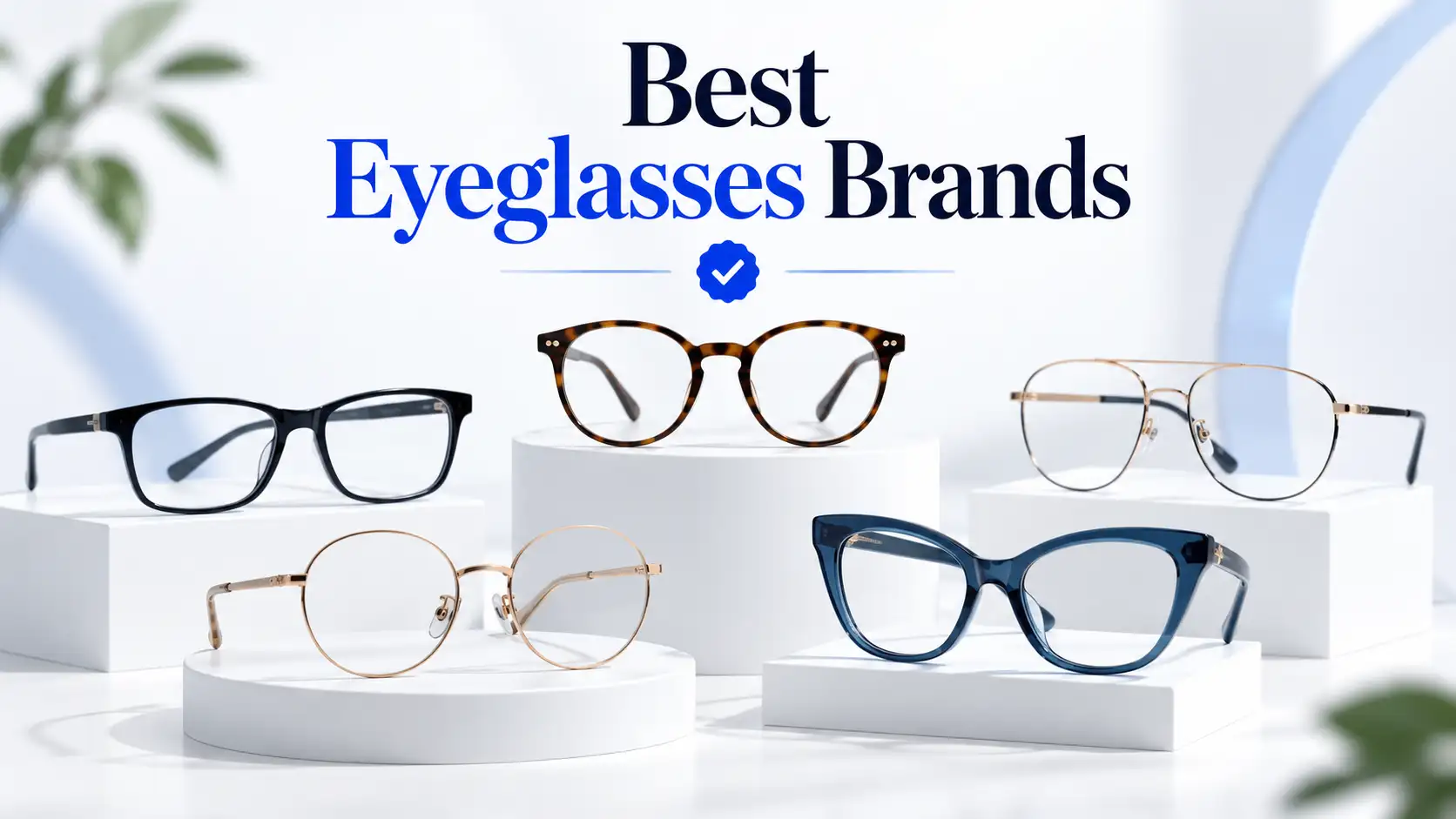
Best Eyeglasses Brands in the World: The Real Top 10
-
 Written by
Rajat Singh
Written by
Rajat Singh
- Published
- Read time 15 min read
On December 19, 2024, a French luxury group and an Italian eyewear company issued a joint press release renewing a licensing agreement for another ten years, through December 31, 2030. It read like routine corporate housekeeping, the kind of announcement most shoppers will never see.
On This Page 10 sections
But that filing explains something a shelf of designer glasses never tells you outright. The name printed on the temple and the company that actually designed, cut, and assembled the frame are very often two completely different businesses, and once you know which brands share a manufacturer, the whole category looks different.
- Ray-Ban is the world’s most popular eyeglasses brand, accounting for roughly 20% of all sunglasses sold globally, and it has been owned by EssilorLuxottica since Luxottica bought it from Bausch & Lomb in 1999.
- Five of the ten brands on this list are made by the same parent company, EssilorLuxottica, either outright (Ray-Ban, Oakley, Persol, Oliver Peoples) or under a long running license (Prada, renewed through 2030 in December 2024).
- Tom Ford Eyewear is not made by EssilorLuxottica, despite the assumption being common. It’s made under a perpetual license by Marcolin Group, signed in 2023, and the Tom Ford brand itself is owned by The Estée Lauder Companies.
- Gucci is the rare fashion house that makes its own eyewear, through Kering Eyewear, a division Kering built in 2014 specifically to stop licensing its brands to outside manufacturers.
- Three brands on this list remain genuinely independent: Lindberg (Danish, family owned since 1986), Garrett Leight (founded 2011 in California), and Linda Farrow (London, founded 1970, revived in 2003).
- Starting prices span from $75 for Oakley sunglasses to $540 for Linda Farrow, and the gap has almost nothing to do with who actually manufactures the frame.
- This list was built by cross referencing multiple independently published brand rankings for this exact search, not from a single source or an invented sales figure.
The Top 10 at a Glance
| Brand | Made By | Known For | Starting Price |
|---|---|---|---|
| 1. Ray-Ban | EssilorLuxottica | Aviator, Wayfarer | $150 |
| 2. Tom Ford Eyewear | Marcolin (license) | Bold acetate, T temple | $400 |
| 3. Gucci | Kering Eyewear | Oversized, GG hardware | $300 |
| 4. Prada | EssilorLuxottica (license) | Geometric shapes | $300 |
| 5. Oakley | EssilorLuxottica | Sport, Prizm lenses | $75 |
| 6. Persol | EssilorLuxottica | Arrow hinge, Italian | $250 |
| 7. Oliver Peoples | EssilorLuxottica | Vintage, understated | $432 |
| 8. Lindberg | Independent (Denmark) | Screwless titanium | $500 |
| 9. Garrett Leight | Independent (USA) | California acetate | $355 |
| 10. Linda Farrow | Independent (UK) | Oversized, avant garde | $540 |
Starting prices are approximate, sourced from official brand and authorized retailer pricing, and vary by frame, lens, and material choice. Full detail on each brand, including ownership history and founding facts, follows below.
How We Determined This List
No single index ranks eyeglasses brands the way sales trackers rank smartphones or cars. Search for “top 10 eyeglasses brands” and you’ll find retailer bestseller pages, regional optician lists, and pure style roundups, each built on different criteria and often not disclosing any criteria at all.
To avoid guessing or padding the list with brands that happened to fit a theme, we cross referenced several independently published eyewear brand rankings covering this exact query, then kept only the brands that showed up across multiple unrelated sources. Where a hard number exists, like Ray-Ban’s share of global sunglasses sales, we used it. Where it doesn’t, we verified ownership and founding facts directly against company filings, press releases, and trade publications like WWD and Business of Fashion rather than repeating unsourced claims.
Brands that appeared in only one list with no independent corroboration were left out, even when they’re genuinely well known within a specific style niche.
Eyeglasses, by the Numbers
Before getting into individual brands, these four figures explain the scale of the industry sitting behind them.
Global market size from Future Market Insights (2026 estimate). Ray-Ban share and EssilorLuxottica brand count from aggregated market research and company disclosures, checked September 2026.
Half of This List Shares One Parent Company
This is the part most “best eyeglasses brands” roundups skip entirely. Once you map out who actually owns and manufactures each name on this list, ten seemingly competing brands collapse into four real groups.
Ownership and licensing data compiled from EssilorLuxottica, Kering Eyewear, and Marcolin company disclosures and trade press coverage, checked September 2026.
The Top 10 Eyeglasses Brands in the World
Ranked by how consistently each brand appeared across independently published rankings for this search, backed by real ownership, founding, and pricing facts rather than a single arbitrary order.
1. Ray-Ban
Bausch & Lomb launched Ray-Ban in 1937, originally to cut glare for US Army Air Corps pilots, which is where the name comes from. Luxottica bought the brand in 1999 and it’s been part of EssilorLuxottica since the 2018 merger.
The Aviator and Wayfarer remain the two most copied frame silhouettes in eyewear history, and Ray-Ban still holds roughly 20% of global sunglasses sales on its own. Prices start around $150 for classic acetate frames and climb past $300 for polarized lenses or limited runs.
Luxottica itself was founded in 1961 by Leonardo Del Vecchio in Agordo, Italy, and that same factory town still produces roughly 60% to 70% of every Ray-Ban frame made today, including the Aviator, Wayfarer, and Clubmaster lines.
2. Tom Ford Eyewear
Designer Tom Ford launched his eponymous fashion house in 2005. Its eyewear line is made under a perpetual license by Marcolin Group, a deal signed in 2023 that came with a $250 million upfront payment, while the Tom Ford brand itself is owned by The Estée Lauder Companies.
That’s genuinely worth knowing, since it’s easy to assume EssilorLuxottica makes every major fashion label’s glasses. It doesn’t make this one. Tom Ford Eyewear is known for bold acetate shapes and the signature T temple detail, with prices starting around $400.
3. Gucci
Guccio Gucci founded the house in Florence in 1921, and Kering has owned it since 1999. For years Gucci’s eyewear was licensed out to Safilo, but Kering ended that arrangement in 2014, paying Safilo roughly €90 million to exit the license early and founding Kering Eyewear to bring production in house.
Kering Eyewear launched its first Gucci collection in June 2015. Gucci is known for oversized acetate frames and its interlocking GG hardware, with prices starting around $300, and its most recognized optical style remains the thick round frame popularized in the brand’s early Alessandro Michele era.
4. Prada
Mario Prada founded the house in Milan in 1913. Its eyewear license has belonged to Luxottica, now EssilorLuxottica, since 2003, covering Prada, Prada Linea Rossa, and Miu Miu, and the two companies renewed the deal in December 2024 through December 31, 2030, with an option to extend to 2035.
Prada eyewear is known for geometric, architectural frame shapes, with prices generally starting around $300.
5. Oakley
Jim Jannard started Oakley in 1975 selling motocross handgrips before moving into sport eyewear. Luxottica bought the company in 2007 for $2.1 billion, folding it into what later became EssilorLuxottica.
Oakley is built around wraparound lenses and its own Prizm lens technology for sport and outdoor use. Sunglasses start around $75, with sport specific prescription frames running higher.
6. Persol
Giuseppe Ratti founded Persol in Turin in 1917, originally under the name Protector Occhiali before it was shortened to Persol, from the Italian “per il sole,” meaning for the sun. Luxottica Group acquired it in 1995.
Persol is known for its arrow shaped hinge detail and classic Italian styling, the same frames Steve McQueen wore. Its frames are still produced through EssilorLuxottica’s Italian manufacturing network, the same one behind Ray-Ban. Prices generally start around $250.
7. Oliver Peoples
Larry Leight, Kenny Schwartz, and Dennis Leight founded Oliver Peoples in Los Angeles in 1986, opening its first boutique the following year. Oakley bought the brand in 2006 for $46.7 million, and it came under Luxottica’s ownership when Luxottica acquired Oakley in 2007.
Oliver Peoples is known for understated, vintage inspired frames popular in film and entertainment circles. Prices typically start around $432.
8. Lindberg
Optometrist Poul Jørn Lindberg teamed up with architect Hans Dissing in Aarhus, Denmark, launching the screwless AIR Titanium collection in 1986. Lindberg remains independent and family owned, one of only three brands on this list that isn’t part of a larger licensing group.
Lindberg is known for ultralight titanium frames with no visible screws, built by hand in Denmark. Prices start around $500 and premium horn or precious metal collections run past $1,800.
9. Garrett Leight
Garrett Leight, son of Oliver Peoples co founder Larry Leight, launched his own namesake brand in Venice, California, in 2011, two years after opening his first optical shop. It’s grown into an independent label carried by more than 600 retailers worldwide.
Garrett Leight is known for relaxed, California styled acetate frames, now carried by more than 600 retailers worldwide, including Bergdorf Goodman and Dover Street Market. Prices typically start around $355.
10. Linda Farrow
Linda Farrow founded her London label in 1970 and was one of the first designers to treat sunglasses as a genuine fashion statement rather than a practical accessory, working directly with fashion houses including Dior, Yves Saint Laurent, and Balenciaga in the brand’s early years. Production stopped in the 1990s, then her son, Simon Jablon, revived the brand in 2003.
Linda Farrow is known for oversized, avant garde shapes, the kind Yoko Ono wore in the brand’s early years. Prices generally start around $540.
What Actually Separates a $75 Frame From a $540 One
Price on this list has almost no relationship to who manufactures the frame. EssilorLuxottica alone makes brands starting at $75 (Oakley) and brands starting at $432 (Oliver Peoples), using entirely different pricing strategies for each.
Approximate starting prices from official brand and authorized retailer pricing pages, checked September 2026. Actual cost varies by frame material, lens type, and prescription.
The independents cluster at the higher end for a specific reason. Lindberg and Linda Farrow both manufacture in small batches with premium materials, titanium and hand finished acetate respectively, without a large licensing group’s manufacturing scale to spread costs across.
A licensed or in house luxury brand like Gucci or Prada can spread tooling, lens coating, and factory overhead across dozens of other product lines running through the same manufacturer. An independent brand carries all of that cost alone, on a fraction of the production volume, which shows up directly in the shelf price.
Why Licensing Deals Matter More Than the Logo
A fashion house licensing its name to an eyewear specialist is the industry’s default arrangement, not an exception. The house keeps design input and collects a royalty plus a guaranteed minimum payment, while the manufacturer handles production, lens technology, and global distribution under its own factories and supply chains.
These deals aren’t permanent, and their expiration dates genuinely change what you’re buying. Versace, for one example outside this list, renewed its own EssilorLuxottica license in April 2020 through December 31, 2029, an agreement that first began in 2003.
Gucci shows the reverse move. It spent years under a Safilo license before Kering paid roughly €90 million to exit that agreement early in 2014 and build its own in house eyewear division instead, a bet that owning production outright was worth more than the royalty income from licensing it out.
Giuseppe Ratti founds Persol in Turin, Italy.
Bausch & Lomb launches Ray-Ban for US Army Air Corps pilots.
Linda Farrow founds her label in London.
Jim Jannard starts Oakley in California.
Oliver Peoples and Lindberg are both founded, in Los Angeles and Aarhus.
Luxottica Group acquires Persol.
Luxottica acquires Ray-Ban from Bausch & Lomb.
Prada signs its first eyewear license with Luxottica.
Oakley acquires Oliver Peoples for $46.7 million.
Luxottica acquires Oakley, and Oliver Peoples with it, for $2.1 billion.
Garrett Leight founds his namesake brand in Venice, California.
Kering Eyewear is founded, ending Gucci’s license with Safilo.
Luxottica and Essilor merge to form EssilorLuxottica.
Marcolin signs a perpetual license for Tom Ford Eyewear.
Prada and EssilorLuxottica renew their license through 2030.
How to Actually Choose Between Them
- Decide if the manufacturer behind the name actually matters to you, since half this list comes from one company regardless of which logo you pick.
- Go titanium if you want the lightest possible frame, Lindberg’s screwless AIR Titanium construction is built specifically around that.
- Pick a sport specific brand for anything active, Oakley’s Prizm lenses and wraparound fit are designed for that use, unlike a fashion first frame.
- Buy from an authorized retailer or the brand’s own site, counterfeit designer eyewear is a real and common problem, and a fake frame won’t carry the real prescription accuracy or lens coatings.
- Check whether a frame is licensed or in house made if resale value matters to you, in house brands like Gucci and independents like Lindberg tend to hold collector interest longer than a licensed run that can end when the contract does.
- Budget for lenses separately from the frame, the starting prices above are frame plus basic lens pricing, and prescription upgrades, anti reflective coatings, or transitions lenses add to that total.
- Consider an independent brand if you want something less mass produced, Garrett Leight and Linda Farrow both design and manufacture their own runs rather than licensing through a large group.
Sunglasses or Prescription, and Who Actually Repairs Them
All 10 brands on this list make both sunglasses and prescription optical frames, not just one or the other. Ray-Ban and Persol are commonly associated with sunglasses because that’s how each built its reputation, but both sell full prescription optical lines through the same manufacturer that makes their sunglasses.
Who actually handles a repair or warranty claim depends on who manufactures the frame, not whose name is printed on it. A cracked Prada hinge goes through EssilorLuxottica’s service network, the same one that handles Ray-Ban, Oakley, and Persol, while a Gucci repair goes through Kering Eyewear’s own channels since Kering makes it in house.
This matters most for a licensed brand nearing the end of its contract. When Gucci’s license with Safilo ended in 2014, existing Safilo made Gucci frames didn’t disappear overnight, but replacement parts and authorized repairs for that specific generation of frames became harder to source once Kering Eyewear took over new production entirely.
Where to Actually Find These Brands, and Save on Them
Two of the ten brands above, Ray-Ban and Oakley, already have current offers tracked on CouponZania’s eyewear category page. The rest of this list, Tom Ford Eyewear, Gucci, Prada, Persol, Oliver Peoples, Lindberg, Garrett Leight, and Linda Farrow, are being added as store partners, and their own offer pages will appear on that same category page once each one goes live.
Whichever brand you land on, checking that category page before buying costs nothing and takes less time than comparing frame prices across five separate retailer sites.
Before You Buy
Check current eyewear offers on CouponZania
Ray-Ban and Oakley offers are live now, with more eyewear brands being added.
Browse Eyewear DealsFrequently Asked Questions
What is the most popular eyeglasses brand in the world?
Ray-Ban is the most popular eyeglasses brand in the world by sales volume, accounting for roughly 20% of all sunglasses sold globally. It has held that position since Luxottica bought the brand from Bausch & Lomb in 1999 and expanded its distribution worldwide.
Who owns Ray-Ban and Oakley?
Both Ray-Ban and Oakley are owned by EssilorLuxottica, the world’s largest eyewear company. Luxottica acquired Ray-Ban in 1999 and Oakley in 2007 for $2.1 billion, and both became part of EssilorLuxottica when Luxottica merged with Essilor in 2018.
Are Gucci and Prada eyewear made by the same company?
No. Gucci eyewear is designed and manufactured in house by Kering Eyewear, a division Kering built in 2014 to stop licensing its brands out. Prada eyewear is made under a license held by EssilorLuxottica, an agreement dating back to 2003 and renewed through 2030 in December 2024.
Is Tom Ford eyewear made by EssilorLuxottica?
No, despite EssilorLuxottica making eyewear for many other luxury fashion houses. Tom Ford Eyewear is made under a perpetual license by Marcolin Group, signed in 2023, while the Tom Ford brand itself is owned by The Estée Lauder Companies.
What’s the difference between an eyewear brand and an eyewear manufacturer?
A brand like Gucci or Prada designs the look and owns the name, but often doesn’t manufacture the actual frames itself. A separate eyewear specialist, such as EssilorLuxottica, Kering Eyewear, or Marcolin, licenses the name and handles production, lens technology, and distribution under contract.
Which eyeglasses brands are independently owned rather than licensed out?
Among the world’s most recognized eyeglasses brands, Lindberg, Garrett Leight, and Linda Farrow remain independently and often family owned. All three design and manufacture their own frames rather than licensing production to a larger eyewear group.